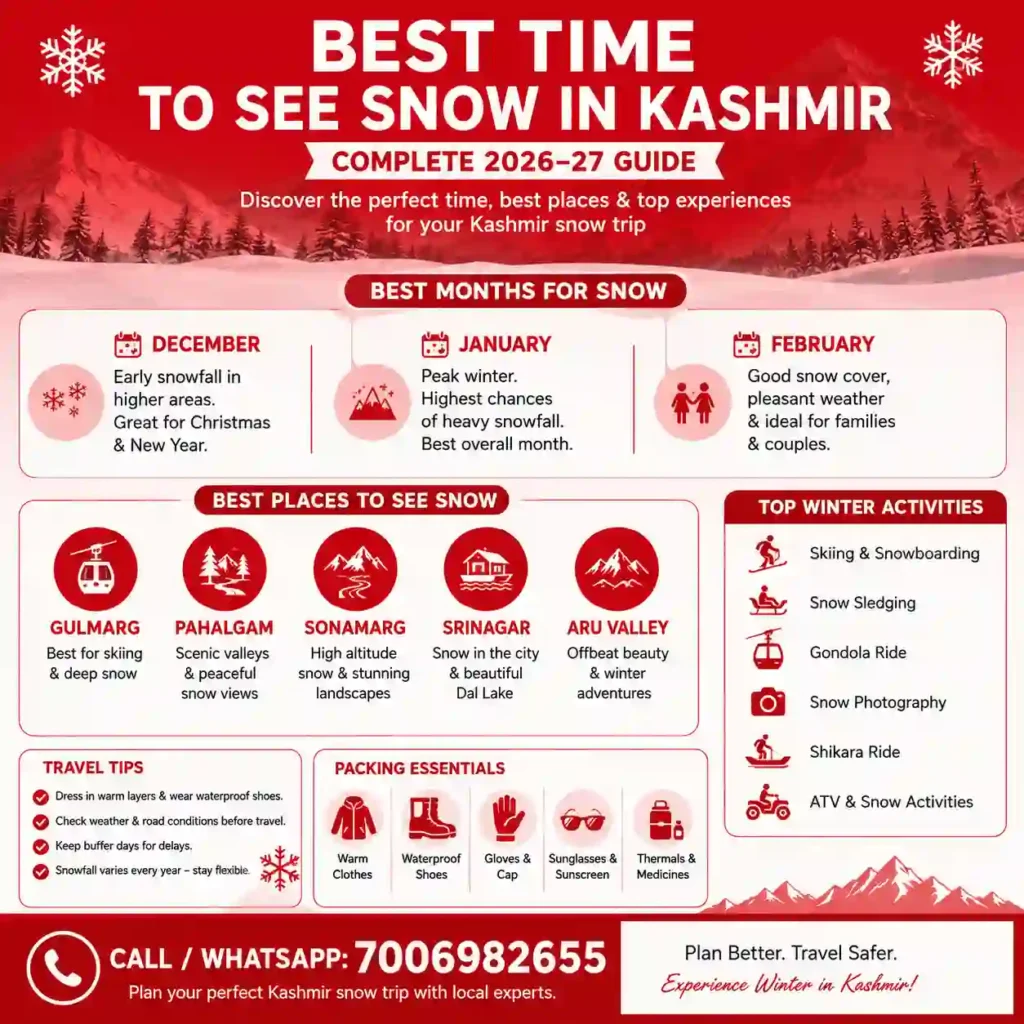
The best time to see snow in Kashmir is between December and February, with January generally being the strongest month for widespread winter snow across Srinagar, Gulmarg, Pahalgam and Sonamarg. This is the heart of what locals call Chillai Kalan, the 40-day period of the harshest cold. December can bring early snow, especially at higher elevations, while February often carries forward the deep snow cover built up in January and sometimes adds fresh spells of its own.
That said, no calendar date can promise snowfall on a particular day — Kashmir’s weather depends on elevation, the strength of that year’s western disturbances, and simple year-to-year variation. A trip planned around December–February gives you the strongest realistic chance of seeing snow, but flexibility in your itinerary always helps.
What Is the Best Time to See Snow in Kashmir?
| Details | |
|---|---|
| Best overall period | Mid-December to late February — Kashmir’s core winter, aligned with Chillai Kalan |
| Best single month | January — snow cover is deepest, most widespread and most settled across all elevations |
| Best destination for reliable snow | Gulmarg — highest elevation on the tourist circuit at 8,530 ft, snow starts earlier and stays longer |
| Second and third best | Pahalgam and Sonamarg — good snow, but more variable and access-dependent than Gulmarg |
| Srinagar snow | Less predictable — the city sits at 5,200 ft, so some winters bring good snowfall, others barely a dusting |
When Does It Start Snowing in Kashmir?
This is where a lot of first-time visitors get confused, because “when does it snow in Kashmir” doesn’t have one single answer. Snowfall in Kashmir depends heavily on elevation, and the difference between a 2,000-metre town and an 8,500-foot ski resort can be the difference between green grass and two feet of snow on the same day.
Broadly, there are three layers to think about:
- Higher-altitude snowfall: Places above roughly 8,000 feet, such as Gulmarg, the upper reaches of Sonamarg, Sinthan Top and Peer Ki Gali, often receive their first snow by late October or November, well before the valley floor does.
- Tourist-destination snowfall: Gulmarg, Pahalgam and Sonamarg (at tourist level, not the restricted high passes) typically start getting consistent snow from late November into December, building up through Chillai Kalan.
- Valley-floor snowfall: Srinagar and other low-lying towns generally see their first real snow later, often in late December or January, and in some years the city gets very little snow at all even during peak winter.
This is exactly why Gulmarg can be under a thick white blanket while Srinagar, barely 50 kilometres away, is still showing bare gardens and a clear Dal Lake. Gulmarg sits close to 8,700 feet, while Srinagar city is around 5,200 feet. That elevation gap of over 3,000 feet is enough to change rain into snow, or light snow into heavy snow, on the same weather system. We’re not making an absolute claim here — some winters bring good city-level snow to Srinagar too — but as a general pattern, altitude is the biggest single factor deciding whether you’ll actually see snow on a given day.
Call / WhatsApp: +91 7006982655
What Is the Best Month To See Snow in Kashmir?
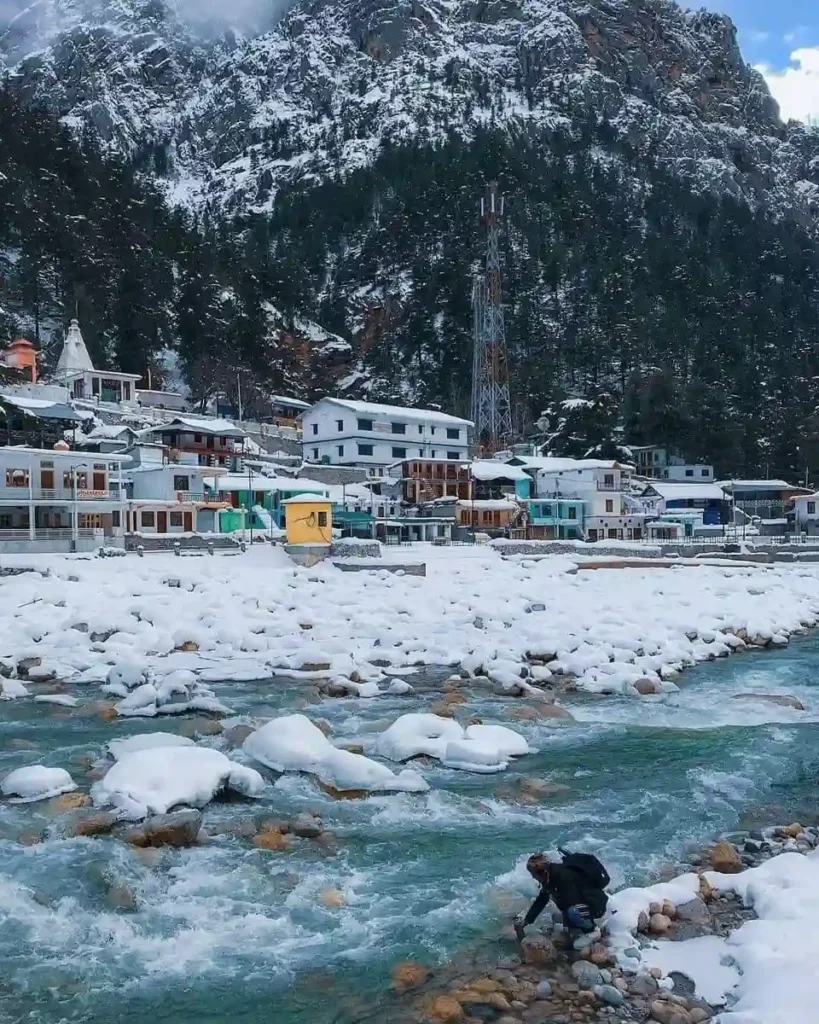
January is generally the strongest single choice if you want to maximise your chances of seeing snow in Kashmir. By this point, Chillai Kalan is in full swing, temperatures are at their coldest, and snow that has already fallen tends to stay on the ground rather than melting between spells. December and February both have real merit too, just with slightly different trade-offs.
December works well if you want a quieter trip with lower hotel rates and don’t mind that snow cover may still be building up, especially in early December. By late December, particularly around Christmas and New Year, most winters have already delivered meaningful snowfall to Gulmarg and often to Pahalgam and Sonamarg as well.
February carries forward whatever snow accumulated in January, so even if there’s a dry spell, you’re likely to still find snow-covered slopes and valleys, especially at Gulmarg. Days are marginally longer and slightly less bitterly cold than peak January, which some families and older travellers prefer.
| Factor | December | January | February |
|---|---|---|---|
| Snowfall likelihood | Moderate, increasing through the month | Highest | High, often carrying over from January |
| Snow cover | Building up, thinner in early December | Deepest and most consistent | Deep, though can start softening late in the month |
| Temperature | Cold, gets sharper toward month-end | Coldest (Chillai Kalan) | Very cold, marginally milder than January |
| Road conditions | Generally manageable, can worsen after heavy snow | More frequent closures after fresh snow | Similar to January, improving toward late Feb |
| Crowds | Busy around Christmas/New Year, quieter otherwise | Moderate to high | Moderate, quieter than January |
| Activities | Sledging, early-season skiing depending on snow | Best skiing and snowboarding conditions | Strong skiing conditions, good snow play |
| Suitability for families | Good, especially with school holidays | Good but pack for extreme cold | Good, slightly gentler weather |
| Suitability for couples | Good, romantic New Year atmosphere | Very good, classic winter scenery | Very good, quieter and relaxed |
| Suitability for photographers | Good, especially fresh December snow | Excellent, deepest and cleanest snow cover | Excellent, good light and settled snow |
| Srinagar day °C | 8–12 | 2–6 | 4–8 |
| Gulmarg night °C | -8 to -12 | -10 to -15 | -8 to -12 |
November Snowfall in Kashmir
November marks the beginning of Kashmir’s winter transition. Higher destinations like Gulmarg and the upper reaches of Sonamarg can receive early snowfall from late October onwards, but valley-level destinations including Srinagar and Pahalgam town are usually still in their autumn phase through most of November. If your dates are fixed to November and snow is your primary goal, Gulmarg is your best realistic option — treat it as early-season snow rather than peak winter, and keep expectations flexible for everywhere else.
December Snowfall in Kashmir
Early December is a transition period. The valley floor is still cooling down, and while higher spots like Gulmarg may already have snow from November spells, Srinagar and Pahalgam town often remain snow-free in the first week or two. Mid-December usually shifts this — most years bring at least one solid snowfall spell that dusts Gulmarg, Sonamarg and often Pahalgam, with Srinagar catching some of it depending on the system’s strength.
Late December, especially the Christmas and New Year window, tends to be one of the busiest and most reliable stretches for seeing snow. Many winters deliver a fresh spell right around this period, which is part of why hotel prices in Gulmarg spike sharply for these dates. Pahalgam usually has decent snow cover by this time too, while Sonamarg‘s accessible stretch (not the higher glacier zones, which shut for the season) can vary more depending on road conditions. Srinagar is the least predictable of the four in December — some years it’s snow-covered by the 25th, other years it stays green well into January.
Roads to Gulmarg and Pahalgam are generally in reasonable shape through December, though a heavy spell can cause temporary closures until snow-clearing machinery does its work. Activities available include sledging almost everywhere there’s snow, early skiing at Gulmarg if the base is thick enough, and simple snow walks and photography around Sonamarg and Pahalgam. December suits travellers who want a festive winter trip, don’t mind a chance of thinner early-month snow, and are comfortable with peak-season pricing around the holidays.”Planning a December trip? Read our complete guide to Kashmir in December.”
January Snowfall in Kashmir
January is popular for a straightforward reason: it sits right in the middle of Chillai Kalan, Kashmir’s harshest and most snow-consistent 40-day stretch, which typically runs from 21 December to 31 January. Cold air stays locked in, so once snow falls, it tends to remain rather than melting off quickly, which means you’re less likely to arrive to slush and more likely to see clean, settled snow.
It helps to understand the difference between fresh snowfall and existing snow cover here. Fresh snowfall is what’s actually falling from the sky during your visit — dramatic, photogenic, but not something you can plan around with certainty. Existing snow cover is what’s already on the ground from earlier spells, and in January this is usually thick and dependable across Gulmarg, Pahalgam and Sonamarg, even on days when nothing new is falling.
Gulmarg in January is usually at its best for skiing, with Apharwat’s upper slopes carrying deep, reliable snow. Pahalgam and its side valleys typically hold a solid white cover through the month. Sonamarg’s tourist stretch stays snow-covered, though travel further up depends entirely on road clearance that week. Srinagar’s snow in January is more of a toss-up — some years the city gets genuinely pretty snowfall on Dal Lake and the Mughal Gardens, other years it stays largely dry even as the hills around it are white.
Road disruptions are more common in January than in other winter months simply because snowfall itself is heavier and more frequent. This isn’t a reason to avoid the month, but it is a reason to build in some slack rather than a tightly back-to-back schedule. Winter activities peak here — skiing, snowboarding, sledging, Gondola rides when operational, and general snow play are all at their best. January suits travellers who specifically want deep, dependable snow and don’t mind sub-zero temperatures or occasional itinerary adjustments.
February Snowfall in Kashmir
By February, much of the snow you see is what’s remained and compacted since January, though fresh spells are still common and can refresh the landscape at any point in the month. Daylight hours stretch out slightly compared to December and January, which travellers photographing landscapes tend to appreciate.
Weather in February is broadly similar to January in intensity but can feel marginally less punishing by the back half of the month as the coldest core of Chillai Kalan passes (Chillai Khurd, a milder 20-day period, follows it). Skiing conditions at Gulmarg remain strong through February, often with good base depth carried over from January plus fresh top-ups.
Families often find February slightly easier to manage than peak January because temperatures ease marginally and crowds thin out after the January rush. Honeymoon travellers commonly choose February for similar reasons — good snow, slightly calmer resorts, and better hotel availability than the Christmas–New Year window. For photography, February offers a nice combination of established snow cover and reasonably clear spells between weather systems. Accessibility-wise, roads in February tend to be a touch more predictable than January simply because there’s typically been more time to clear and stabilise routes, though this still depends entirely on that season’s weather pattern.”See our full guide to Kashmir in February for detailed weather, itinerary and cost information.”
Can You See Snow in Kashmir in November?
November sits in a genuine grey zone. Higher elevations — Gulmarg’s upper slopes, Sinthan Top, and areas above roughly 9,000 feet — often catch early winter snow, sometimes as early as late October, and this can dust the ground through November. But you should not assume widespread valley snow in November. Srinagar, Pahalgam town and Sonamarg’s lower stretch are frequently still in their late-autumn phase during this month, with bare ground and only occasional light flurries at best. If your primary goal is snow and your travel dates are fixed to November, treat Gulmarg as your best (though still not guaranteed) bet, and keep expectations realistic for the rest of the region.
Can You See Snow in Kashmir in March?
March is a transition month rather than a peak snow month. At valley-floor and mid-elevation spots, the snow accumulated over winter typically begins retreating as temperatures rise, so Srinagar and lower Pahalgam are unlikely to hold much snow by mid-to-late March. Gulmarg, sitting higher, often retains snow well into March and sometimes into April, particularly on its upper slopes near Apharwat, making it the most reliable option if you’re travelling this month specifically for snow. Higher passes such as Sinthan Top can also hold snow into March simply because of their elevation. The core difference from January is intensity and reliability — March snow is patchier, more elevation-dependent, and generally on its way out rather than building up.
Best Places to See Snow in Kashmir
Gulmarg
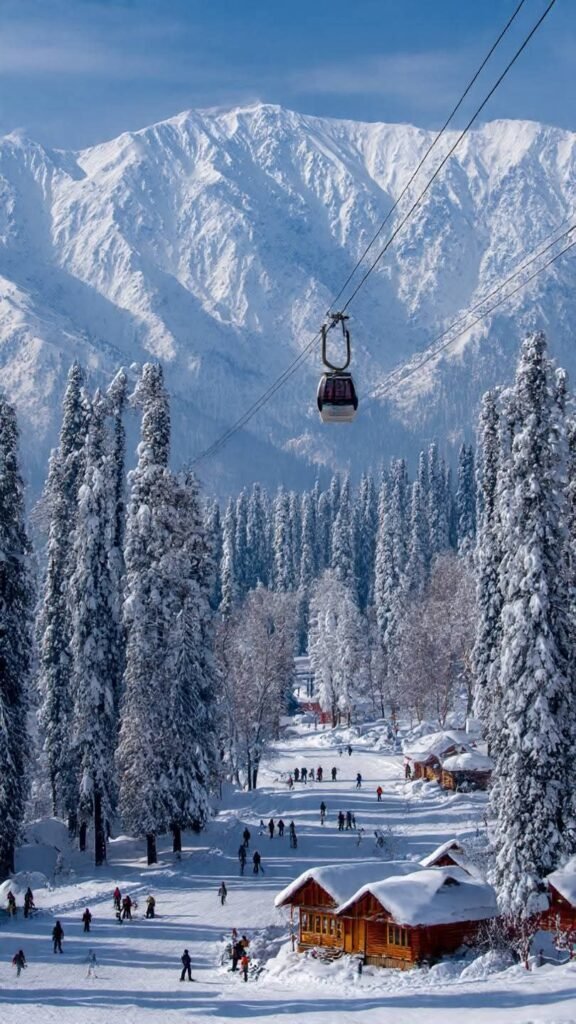
Gulmarg is generally the strongest choice for travellers specifically seeking snow because its higher elevation — close to 8,700 feet at the town itself, and much higher up the Apharwat range — makes winter snow considerably more reliable than at Srinagar or even Pahalgam. This is Kashmir’s primary winter sports destination, and for good reason.
Snowfall at Gulmarg typically starts earlier and lasts longer than almost anywhere else on the tourist circuit, with deep, skiable snow common through December, January and February. The Gulmarg Gondola takes visitors up toward Apharwat in two stages, and the upper station regularly sits amid genuinely deep snow, ideal for skiing, snowboarding and sledging. Ski schools operate through the season for beginners, and experienced skiers head to Apharwat’s steeper runs. That said, Gondola operations depend on weather, mechanical servicing and visibility, and rides are sometimes suspended for safety reasons — always verify current operating status before you travel rather than assuming it will be running on your specific dates.
Winter travel to Gulmarg also means driving on a mountain road that can be affected by heavy snow, so a flexible schedule and a good local driver matter here more than at flatter destinations.
Pahalgam
Pahalgam offers a gentler, more scenic winter experience than Gulmarg’s ski-focused atmosphere. Snowfall here is real but more variable year to year than at Gulmarg, since Pahalgam sits at a somewhat lower elevation. Betaab Valley and Aru Valley, both a short drive from Pahalgam town, often carry beautiful snow cover through winter and are popular for sledging, snow walks and photography rather than serious skiing. Road conditions toward Pahalgam are generally manageable in winter compared to some of the higher offbeat routes, though heavy snowfall can still cause temporary slowdowns. Pahalgam works well for families who want snow scenery without Gulmarg’s altitude-related cold, and for couples looking for a quieter, more relaxed winter stay.
Sonamarg
Sonamarg sits at high altitude and can carry dramatic snow, particularly around the Thajwas area, but winter accessibility here is much more weather-dependent than at Gulmarg or Pahalgam. The road to Sonamarg can be affected by both snowfall and avalanche risk in the deeper winter months, and stretches that are freely accessible in summer may be restricted or closed in winter for safety reasons.
It is important not to push into areas marked as restricted or flagged as unsafe by local authorities, however tempting the untouched snow may look — winter Sonamarg access is simply a different proposition from the open summer route toward Zojila. When conditions allow, the accessible stretch of Sonamarg offers some of the most striking snow scenery in the region.
Srinagar
Srinagar’s relationship with snow is the one most visitors misunderstand. Because the city sits at a comparatively low elevation of around 5,200 feet, it can go through winters with generous snowfall on Dal Lake, the Mughal Gardens and the houseboats, and other winters with barely a dusting even during Chillai Kalan. When it does snow, the sight of Dal Lake partially frozen with houseboats under a layer of white is genuinely special, and the Mughal Gardens take on a stark, quiet beauty very different from their spring bloom. But if snow specifically is your goal and Srinagar hasn’t received any during your dates, that’s exactly when a short trip up to Gulmarg makes the most sense.
Aru Valley
A short drive from Pahalgam, Aru Valley is a quieter alternative that often holds attractive snow cover through winter. Its accessibility can be more limited than the main Pahalgam road after heavy snowfall, since it’s a smaller, less-trafficked route, so local confirmation before heading out is worthwhile. It suits travellers who want a peaceful snow scene away from the more visited Betaab Valley crowds.
Doodhpathri
Doodhpathri, known for its meadows in summer, can receive good snowfall in winter, but it’s a less consistently visited winter destination than Gulmarg or Pahalgam and road conditions can be more variable. It’s not a place to assume will definitely be snow-covered or definitely accessible on any given date — check current status before planning it into a winter itinerary, and treat it as a possible add-on rather than a guaranteed centrepiece.
Peer Ki Gali
Peer Ki Gali sits at high elevation on the Mughal Road, and its altitude means snow can persist here noticeably later into the season than at lower stops along the same route. This also means the road itself is often closed for long stretches of winter, so Peer Ki Gali is generally more of a spring–early summer high-altitude snow destination than a mid-winter one, once the Mughal Road reopens.
Sinthan Top
Similarly, Sinthan Top’s high elevation means it can retain snow well past the point where lower areas have gone green, often into April or even May in a heavy snow year. Like Peer Ki Gali, winter access can be restricted, so it’s more reliably visited once the pass opens for the season.
Gurez Valley
Gurez Valley is a remote, high-altitude region near the Line of Control, and winter conditions here are considerably more serious than anywhere on the standard tourist circuit. Heavy snow regularly cuts off road access for extended periods, and Gurez essentially operates on a very different winter accessibility calendar compared to Srinagar. It’s a stunning destination when open, but travel here needs to be planned around confirmed road status, not assumptions carried over from how Gulmarg or Pahalgam behave in winter.
Gulmarg vs Pahalgam vs Sonamarg for Snow
| Factor | Gulmarg | Pahalgam | Sonamarg |
|---|---|---|---|
| Snow reliability | Highest among the three | Good, more variable than Gulmarg | High at altitude, access-dependent |
| Altitude | ~8,700 ft (town), higher at Apharwat | ~7,200 ft | ~9,000 ft |
| Winter accessibility | Generally manageable, weather-dependent | Generally manageable | More weather- and avalanche-dependent |
| Snow activities | Skiing, snowboarding, sledging, Gondola | Sledging, snow walks, photography | Snow walks, photography where accessible |
| Family suitability | Good, but very cold at altitude | Very good, gentler pace | Moderate, depends on access that week |
| Couple suitability | Very good for an active winter trip | Very good for a relaxed trip | Good for a scenic day visit |
| Photography | Excellent, dramatic mountain snowscapes | Excellent, valley and pine-forest views | Excellent when accessible |
| Road/weather considerations | Can close temporarily after heavy snow | Fewer disruptions than Gulmarg or Sonamarg | Most sensitive to closures of the three |
If you want the single strongest chance of deep, reliable, activity-ready snow, Gulmarg is usually the better call. If you’d rather have a gentler, more relaxed winter experience with good scenery and fewer logistics to worry about, Pahalgam tends to suit families and couples well. Sonamarg is worth including when road and weather conditions cooperate, but it shouldn’t be the only snow destination in your plan given how access-dependent it can be.
Where Can You Find Snow When Srinagar Has No Snow?
This is one of the most common situations winter travellers run into, and the explanation comes back to elevation. Srinagar sits at roughly 5,200 feet, which is genuinely borderline for consistent snow — a weather system can drop several feet of snow on Gulmarg at 8,700 feet while delivering only cold rain or a light dusting to the city below. This isn’t unusual; it’s simply how altitude interacts with temperature and precipitation in the Kashmir Valley.
So if you arrive in Srinagar and find the gardens green and Dal Lake unfrozen, that doesn’t mean your trip is snow-less — it usually means you need to go up. Gulmarg, roughly a 2 to 2.5 hour drive away, is the most reliable option in this situation because of its altitude. Sonamarg, when road conditions allow, is another option, and even parts of Pahalgam’s higher stretches or Aru Valley can hold snow when the town itself doesn’t. In practice, most travel plans built around seeing snow in Kashmir should treat Gulmarg (and Pahalgam as a secondary option) as the anchor destinations, with Srinagar’s snow treated as a welcome bonus rather than the main event.
Is Snowfall Guaranteed in Kashmir?
No responsible operator can guarantee snowfall on a particular travel date, and you should be cautious of anyone who promises otherwise. Snowfall depends on active weather systems (locally, western disturbances moving in from the west), and these systems don’t follow a fixed calendar — some winters bring frequent, heavy spells through December–February, while other winters are noticeably drier even during the traditional peak months.
What can be said with more confidence is that December to February, and especially January, offers the strongest statistical likelihood of encountering snow somewhere in the region, particularly at higher elevations like Gulmarg. The practical way to plan around this uncertainty is to choose your travel window based on probability rather than certainty, build flexibility into your itinerary so you can shift plans if one destination is dry, and keep expectations grounded — treat any actual snowfall during your trip as a highlight rather than something owed to you by the calendar.
What Is the Difference Between Fresh Snowfall and Existing Snow Cover?
These two terms get used interchangeably by travellers but mean quite different things on the ground:
- Fresh snowfall is snow actively falling from the sky during your visit — the dramatic, postcard moment of watching flakes come down over Dal Lake or Gulmarg’s slopes.
- Accumulated snow is what’s built up on the ground from previous spells, even if nothing is currently falling. This is what gives you the classic white-blanket landscape.
- Frozen or compacted snow is older accumulated snow that has hardened, common on well-walked paths and roads, and generally firmer underfoot than fresh powder.
- Melting snow happens when temperatures rise, typically toward the end of winter or at lower elevations, and can turn snow patches slushy and grey rather than clean white.
- Snow remaining at higher elevations refers to the phenomenon where places like Gulmarg or Sinthan Top hold on to good snow long after lower spots have gone green.
For most travellers, the honest goal should be to see good accumulated snow cover, since fresh snowfall on your exact travel dates is essentially a matter of luck. A trip that lands you amid deep, clean accumulated snow at Gulmarg is a genuine winter experience, even without flakes actively falling from the sky.
Best Time to Visit Kashmir for Snow — By Trip Type
Best Time for Fresh Snowfall in Kashmir
Fresh snowfall — flakes actively falling during your visit — is most likely when a western disturbance is moving through the valley. These cluster most often in January and February, with December also delivering active spells particularly in its second half. There is no way to predict exact snowfall dates months in advance; even weather departments only forecast reliably a few days ahead. The practical approach is to choose your travel window within December–February, then check short-range forecasts once you are within 7–10 days of departure and stay flexible enough to shift between destinations depending on which area is seeing active snowfall that week.
Best Time for Deep Snow Cover in Kashmir
If your goal is walking through thick, clean, settled snow rather than watching it fall, January and February are stronger than December. By January, snow that fell in earlier spells has built up and compacted across Gulmarg, Pahalgam and Sonamarg’s accessible areas — even on days when nothing new is falling, you will find deep white cover underfoot. February carries that accumulated depth forward, often with fresh top-ups. December can certainly deliver good depth by its second half, but early December is thinner and less reliable for the classic deep-snow landscape most travellers picture.
Best Time for Snow Activities in Kashmir
Late December through February is the strongest window for skiing, snowboarding and sledging, with Gulmarg as the primary hub for all three. Skiing and snowboarding depend directly on base depth — January and February, when accumulated snow is at its heaviest, tend to offer the most consistent slope conditions for both beginners and experienced skiers. Sledging is more forgiving and works well anywhere there is a reasonable snow layer, including Pahalgam’s Betaab Valley, Sonamarg’s accessible stretch, and sometimes the outskirts of Srinagar in a strong snow year. Gondola rides at Gulmarg are weather and maintenance dependent, so always confirm operational status before travelling specifically for that experience.
Best Time for a Family Snow Trip to Kashmir
Late December — avoiding the most crowded holiday dates if possible — or February tend to work best for families. February’s slightly gentler temperatures compared to peak January, combined with thinner crowds and better hotel availability, make daily logistics easier when travelling with children. Pairing Pahalgam with Gulmarg gives families a good balance: Pahalgam offers gentler snow scenery and easier terrain for children, while Gulmarg delivers the deeper snow and active experiences older children tend to enjoy. Build at least one buffer day into a family winter itinerary — road conditions can shift after heavy snowfall, and a flexible day prevents a single disruption from derailing the whole trip.
Best Time for a Honeymoon in Snow in Kashmir
February is the most popular honeymoon month for Kashmir snow trips, and for good reasons. Snow cover carried over from January is usually deep and clean, resorts are noticeably calmer than the Christmas and New Year rush, and hotel rates and availability improve compared to peak January. Both Gulmarg and Pahalgam offer the classic snow-covered romantic backdrop that most couples are picturing, while Srinagar’s houseboats add a quieter, more intimate note if the city has received snow that season. Fewer days rushing between multiple destinations and longer stays in one or two places tends to suit honeymoon travel better, particularly given how winter road timing can be less predictable than in summer.
Best Time for Skiing in Kashmir
January through February offers the strongest base depth and most consistent conditions for skiing at Gulmarg, which is Kashmir’s only serious ski destination. December skiing is possible once early-season snow has built up — generally from mid-December onwards in a typical year — but conditions can be thinner in early December. Apharwat’s steeper runs, accessed via the Phase 2 Gondola, require good depth to be properly skiable and are most reliable in January and February. Ski schools and equipment rental operate through the season at Gulmarg, but day-to-day conditions still depend on recent snowfall and current slope maintenance — confirm with your operator before travelling specifically for skiing rather than assuming a fixed standard throughout the season.
Best Time for Snow Photography in Kashmir
January and February offer the best combination for photography: deep, clean accumulated snow, strong mountain backdrops, and reasonably clear spells between weather systems. Morning light works particularly well in Kashmir winter — soft, directional, and usually clearer before afternoon cloud builds up. A sky that is actively snowing can look dramatic but often reduces mountain visibility, so photographers chasing both falling snow and clear peak views may need patience across a few days.
February gives slightly longer daylight hours than January, which helps with late-afternoon golden-hour shots. Practically, cold weather drains camera batteries noticeably faster — carry spares kept warm in an inner jacket pocket, and allow lenses a few minutes to acclimatise when moving from cold outdoor air to heated indoor spaces to avoid condensation on the glass.
Kashmir Snowfall and Road Conditions
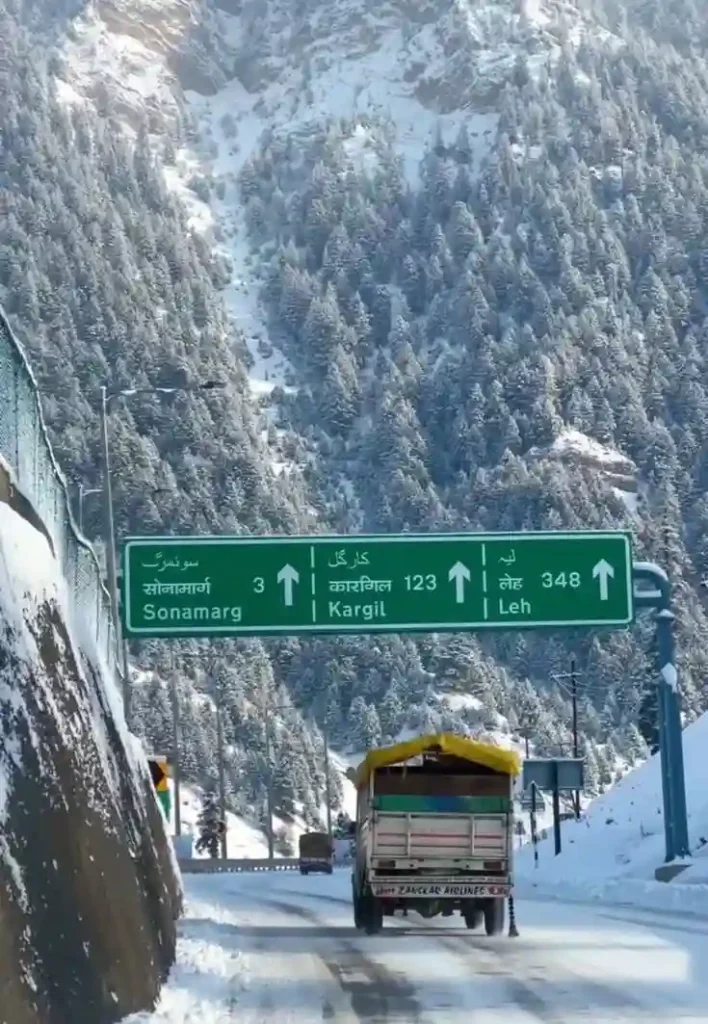
Heavy snowfall genuinely changes how winter travel in Kashmir works, and it’s worth understanding this rather than being caught off guard. The Srinagar–Gulmarg road is generally well-maintained and prioritised for snow clearance given how important the route is for tourism, but a heavy overnight spell can still delay opening by a few hours until machinery clears the way. The Srinagar–Pahalgam route tends to see fewer disruptions than Gulmarg or Sonamarg, since it runs at somewhat lower elevation for more of its length. The Srinagar–Sonamarg road is the most sensitive of the three main tourist routes, given Sonamarg’s altitude and the avalanche-prone terrain further up; access here can be closed or restricted for stretches during heavy winter weather.
High-altitude routes toward Gurez, Sinthan Top or Peer Ki Gali operate on an entirely different winter timeline, with extended closures common. Local sightseeing within towns like Gulmarg and Pahalgam is rarely affected in the same way, though very heavy snow can occasionally limit movement even locally until roads are cleared. Because conditions shift day to day, checking road status shortly before travel — rather than relying on how things were even a week earlier — is the sensible approach.
Winter Activities to Enjoy in Kashmir
Skiing
Centred at Gulmarg, with slopes for both beginners and experienced skiers, plus ski schools and equipment rental available locally. Conditions depend on current snow depth.
Snowboarding
Also based primarily around Gulmarg’s slopes, popular alongside skiing, with rental gear and instructors available during the winter season.
Snow Sledging
Widely available wherever there’s decent snow cover — Gulmarg, Pahalgam, Sonamarg’s accessible stretch, and sometimes even parts of Srinagar’s outskirts in a good snow year. This is generally weather-dependent but doesn’t require special skill.
Snow Walking
Simple walks through fresh snow in places like Betaab Valley, Aru Valley or around Gulmarg’s meadows, popular for a relaxed, low-effort way to enjoy the scenery.
Snow Photography
Available essentially anywhere there’s good snow cover, with Gulmarg’s mountain backdrops and Pahalgam’s pine forests being particular favourites among visitors.
Gondola Experience
The Gulmarg Gondola takes visitors up toward Apharwat in two stages, offering access to higher-altitude snow and mountain views, when operational — always weather and maintenance dependent.
Snow Play
General open-ended fun in the snow — building snowmen, snowball fights, simple play for children — available anywhere with a decent snow layer, no equipment required.
ATV/Snow Activities Where Available
Certain areas around Gulmarg occasionally offer ATV rides and similar snow-adjacent activities depending on operators active that season; availability varies year to year and should be confirmed locally rather than assumed.
Winter Shikara Experience
A Shikara ride on Dal Lake during winter has a quiet, almost meditative character very different from the busier summer atmosphere. This is a general Srinagar activity available regardless of whether the city has recent snow, and it’s especially atmospheric if the lake edges are lightly frosted.
What to Pack for a Kashmir Snow Trip — Complete List
Packing right makes a bigger difference to how much you enjoy a Kashmir winter trip than almost anything else. Temperatures regularly drop below freezing, especially at night and at higher elevations like Gulmarg, so layering properly matters more than any single expensive jacket.
Clothing Essentials for Kashmir Winter
Thermals (top and bottom) — the single most important item. Wear them under your regular clothes every day, not just on Gondola days. Temperatures at Gulmarg drop well below freezing after sunset even when midday feels manageable.
Insulated jacket — a proper down or heavily padded jacket, not a regular winter coat. Fleece alone is not enough at Gulmarg’s altitude.
Waterproof outer layer — essential if you plan any sledging, snow walks or time in active snowfall, where a non-waterproof jacket soaks through quickly.
Woollen sweater or mid-layer — useful for layering on milder days or in heated hotel rooms where a full jacket is too warm.
Warm trousers — regular jeans are a poor choice in snow; they retain moisture and lose insulation when wet. Thermal-lined or waterproof trousers work far better.
Footwear for Snow in Kashmir
Waterproof ankle boots with a grip sole — the single most important footwear choice. Regular sneakers soak through within minutes of walking on snow and offer almost no traction on icy patches, which is both uncomfortable and a genuine slip risk. You do not need dedicated mountaineering boots — any sturdy, waterproof boot with a decent tread handles everything on the standard tourist circuit including Gulmarg, Pahalgam and Sonamarg’s accessible areas.
Woollen socks (pack 3–4 pairs) — wet feet from inadequate socks are one of the most common complaints from first-time Kashmir winter visitors. Wool retains warmth even when slightly damp, unlike cotton socks.
Accessories You Should Not Skip
Waterproof gloves — bare hands in snow become uncomfortable within minutes. Waterproof outer gloves over thin inner gloves give you more flexibility than one thick pair.
Warm cap covering the ears — heat loss through the head and neck is significant at altitude. A simple beanie that covers the ears makes a measurable difference in overall warmth.
Scarf or neck gaiter — especially useful at Gulmarg and on the Gondola, where wind chill adds to the cold.
Sunglasses — snow glare at higher altitude is stronger than most people expect, particularly around Gulmarg’s meadows and on clear days after fresh snowfall. UV protection matters even in cold weather.
Sunscreen — reflected sunlight off snow causes sunburn even when temperatures are below freezing. A broad-spectrum SPF 30 or higher applied on exposed skin is worth carrying.
Lip balm and moisturiser — Kashmir’s dry winter air causes cracked lips and dry skin quickly, particularly after a few days at higher altitude.
Electronics and Practical Items
Power bank — cold weather drains phone and camera batteries significantly faster than normal. A fully charged power bank kept in an inner pocket (warmth preserves charge) is worth carrying every day at Gulmarg.
Spare camera batteries — if you are travelling specifically for photography, carry at least two additional batteries kept warm in an inner jacket pocket. Cold kills battery charge faster than almost anything else.
Waterproof bag or dry bag — useful for carrying camera gear, electronics or a change of clothes during snow activities where your bag may get covered in snow.
Medicines — carry your regular prescriptions plus basics for cold, fever and altitude discomfort. Pharmacies in Gulmarg are limited compared to Srinagar, so stocking up before departure is sensible.
Hand warmers (disposable) — inexpensive and genuinely useful on very cold days at Gulmarg or during long Gondola waits. Available in Srinagar markets but worth buying in advance.

How to Plan a Kashmir Trip Around Snowfall
- Choose your preferred snow window, generally within December–February for the strongest odds.
- Select higher-altitude destinations like Gulmarg as your anchor points rather than relying only on Srinagar.
- Keep your itinerary flexible enough to swap a day if one route is affected by weather.
- Check the weather forecast again once you’re within a week or two of departure.
- Confirm current road conditions shortly before travel, ideally through your local operator.
- Confirm that your accommodation has reliable heating, especially at higher-altitude stays.
- Prepare proper winter clothing well in advance rather than trying to buy it locally at the last minute.
- Keep a buffer day or two for possible flight or road delays.
- Avoid assuming snowfall is guaranteed on any specific date, however strong the season’s overall pattern looks.
- Have an alternative sightseeing plan ready in case snow-dependent activities aren’t possible on a given day.
Common Mistakes Tourists Make When Planning a Kashmir Snow Trip
- Assuming Srinagar will definitely receive snow just because it’s “Kashmir in winter.”
- Booking only one snow destination and having no backup if that specific spot is dry that week.
- Assuming January guarantees fresh snowfall on the exact dates chosen, rather than just strong odds over the season.
- Ignoring road conditions and building a rigid, back-to-back schedule with no slack.
- Wearing ordinary sneakers instead of proper waterproof snow boots.
- Not carrying thermals, then being caught off guard by how cold Gulmarg gets after sunset.
- Scheduling flights immediately after high-altitude travel with no buffer for delays.
- Relying entirely on the Gondola for a Gulmarg snow experience instead of also enjoying ground-level snow.
- Planning too many destinations into too few days, leaving no room for weather disruptions.
- Ignoring hotel heating quality when booking, especially for higher-altitude stays.
- Not checking current weather and road status close to the actual travel dates.
- Confusing old, compacted snow for fresh snowfall and being disappointed by the difference.
- Travelling without any flexibility, then feeling stuck when a single day’s plan needs to change.
Why Choose Panda Tours and Travels for a Kashmir Snow Trip?
Panda Tours and Travels is a Srinagar-based, government-registered travel agency that handles Kashmir tour planning day in and day out, including winter trips built specifically around snow destinations. Being local means our team has practical, current knowledge of which roads are open, which hotels are properly heated, and how a given week’s weather is actually playing out — not just general seasonal averages.
We handle winter transportation with private taxis suited to snow conditions, including sedans, SUVs and larger vehicles depending on group size, and our drivers are familiar with routes to Gulmarg, Pahalgam and Sonamarg. Itinerary customization is a core part of what we do, since winter trips often need adjusting day to day based on conditions rather than following a fixed script. We assist with airport pickup and drop, help coordinate accommodation, and stay reachable through the trip for support if plans need to shift because of snow or road closures. You can explore our Kashmir destinations and travel services for a fuller picture of how we work, or check our adventure activities page for what’s available beyond snow-specific plans.
We don’t promise guaranteed snowfall, because no honest operator can. What we can offer is realistic planning, local knowledge of current conditions, and support if your itinerary needs to adapt along the way.
Call / WhatsApp: +91 7006982655
Frequently Asked Questions Best Time To see Snow In kashmir
What is the best time to see snow in Kashmir?
Answer: January is the single best month, sitting in the heart of Chillai Kalan (December 21–January 31). December to February is the full reliable window. Gulmarg gets consistent snow earlier than Srinagar.
Does it snow in Kashmir in December?
Answer: Yes. Higher destinations like Gulmarg and Pahalgam typically see good snowfall from mid-December. Srinagar can also receive snow in December but it is less predictable than at higher altitudes.
Which place in Kashmir gets the most snow?
Answer: Gulmarg at 8,530 feet is the snowiest accessible tourist destination in Kashmir. The Apharwat Peak (Phase 2 Gondola) at approximately 13,780 feet has snow almost year-round.
Does it snow in Srinagar?
Answer: Yes, Srinagar does receive snowfall, typically between late December and February — but it is less reliable and less heavy than at higher destinations. When it does snow in Srinagar, the sight of Dal Lake with a snow backdrop is extraordinary.
What is Chillai Kalan in Kashmir?
Answer: Chillai Kalan is the 40-day period of harshest winter in Kashmir, running from December 21 to January 31. This is when temperatures are lowest and snowfall is heaviest across the valley.
Can you see snow in Kashmir in March?
Answer: Yes, at higher elevations like Gulmarg and Sonamarg’s upper reaches, snow often persists into March. Valley-level snowfall becomes rare after late February, but higher altitude destinations still have good snow cover in early March.
Is snowfall guaranteed in Kashmir in winter?
Answer: No snowfall can be guaranteed on a specific date anywhere in Kashmir. However, December to February gives you the strongest realistic chance, especially at Gulmarg. Planning flexibility of 2–3 days around your trip helps significantly.