

Kashmir vs Shimla: Which Is Better?
There is no single winner the right choice depends on how many days you have, when you are travelling, and what you want from the trip. Kashmir suits travellers with five or more days who want varied landscapes, lakes, houseboats, meadows and a slower, immersive Himalayan holiday. Shimla suits travellers with two or three days who want a compact colonial hill town, easy road or rail access from northern Indian cities, and a lighter sightseeing pace.
If snowfall reliability, honeymoon variety and scenic depth matter most, Kashmir generally has the edge. If you want a short weekend escape with minimal planning, Shimla is often more practical. The sections below break this down by season, budget, traveller type and trip length so you can match the destination to your actual trip rather than a generic recommendation.
Panda Tours and Travels is a Srinagar-based travel company that has spent years planning Kashmir holidays for families, couples and groups arriving from across India. The team builds customised itineraries around Srinagar, Gulmarg, Pahalgam, Sonamarg and other valleys, adjusting routes for season, group size and travel pace. If Kashmir turns out to be the right fit after reading this comparison, the team can be reached on Call/WhatsApp at +91 7006982655.
Kashmir vs Shimla: What Is the Real Difference?
Before comparing seasons and budgets, it helps to understand what is actually being compared. Kashmir is not one town — it is a Himalayan region made up of several distinct destinations: Srinagar with its lakes and gardens, Gulmarg with its meadows and gondola, Pahalgam with its rivers and pine forests, and Sonamarg near the glaciers. A typical Kashmir holiday moves between three or four of these places over several days.
Shimla, by contrast, is primarily one hill city. Most Shimla holidays are based in a single hotel, with day trips to nearby spots like Kufri, Naldehra or Mashobra. This is not a criticism of either destination — it simply means the two trips are structured differently. Comparing “Kashmir” to “Shimla” is really comparing a multi-destination valley circuit to a single hill-station base with excursions. Keeping this distinction in mind makes every comparison below more useful, because it explains why Kashmir often needs more days while Shimla can work well as a short break.
Kashmir vs Shimla at a Glance
| Factor | Kashmir | Shimla |
|---|---|---|
| Landscape | Lakes, meadows, alpine valleys, glaciers, pine and chinar forests | Pine-forested hill town, ridgelines, colonial townscape |
| Natural beauty | Multiple distinct landscapes across valleys | Consistent hill-station scenery in and around one town |
| Snowfall | Reliable in Gulmarg and higher areas in peak winter; Srinagar sees occasional snow | Kufri and Narkanda are more snow-reliable than Shimla town itself |
| Best season | April–October for general sightseeing; December–February for snow | March–June and September–November; some snow December–February |
| Honeymoon | Houseboats, Shikara rides, private meadows, varied scenery | Cosy heritage hotels, cafes, walkable town centre |
| Family travel | Doable but needs more days due to distances between valleys | Easier for short trips; less daily travel |
| Senior citizens | More comfortable with a slower, longer itinerary | Suits shorter trips with less daily road time |
| Adventure | Skiing, gondola rides, trekking, seasonal rafting | Trekking, short hikes, seasonal snow activities |
| Photography | Wide variety — lakes, snow peaks, meadows, houseboats | Colonial architecture, forested ridgelines, valley views |
| Food | Wazwan, Kashmiri specialities like Rogan Josh and Yakhni | Himachali dishes and general North Indian hill-station fare |
| Shopping | Pashmina, carpets, papier-mâché, walnut wood, saffron | Woollens, local handicrafts, Mall Road and Lakkar Bazaar-style shopping |
| Accommodation | Houseboats, lakeside hotels, valley resorts | City hotels, heritage properties, resorts near town |
| Accessibility | Flight to Srinagar, or rail to Jammu/Udhampur plus road | Road from Chandigarh/Kalka, or the narrow-gauge rail line |
| Ideal trip duration | 5–7 days for a proper circuit | 2–4 days works comfortably |
| Crowd levels | Distributed across several valleys; some spots get busy in peak season | Concentrated on Mall Road and The Ridge in peak season |
| Local culture | Kashmiri traditions, Mughal-era gardens, houseboat culture | Colonial heritage, churches, hill-town culture |
| Overall experience | Immersive, scenic, needs more planning and time | Compact, convenient, lighter on planning |
Some of these comparisons vary with the exact travel dates, chosen hotels and current road or weather conditions, so treat this table as a starting framework rather than a fixed rule.
Kashmir vs Shimla for Natural Beauty — Which Is Better?
What Makes Kashmir Different?
Kashmir’s natural beauty comes from variety rather than a single standout view. Srinagar centres around Dal Lake and Nigeen Lake, where houseboats line the water and Shikaras move between floating gardens and the Mughal-era Nishat and Shalimar Bagh. From Srinagar, the landscape changes sharply as you head to Gulmarg, a high meadow ringed by pine forest with views toward Nanga Parbat on clear days. Pahalgam follows the Lidder river through pine forests, while Sonamarg sits closer to glaciers and high alpine terrain. Lesser-visited spots like Doodhpathri and Yusmarg add quieter meadow scenery for travellers who want to move away from the main circuit.
What Makes Shimla Different?
Shimla’s appeal is more concentrated. The Ridge and Mall Road form the social and visual centre of the town, lined with colonial-era buildings, churches and viewpoints over the surrounding hills. Jakhoo hill rises above the town with forest walks and views across the Shimla valley. Nearby, Kufri offers higher-altitude scenery and snow-season activities, Naldehra is known for its meadow and golf course setting, and Mashobra adds quieter forest walks close to town. The overall character is a compact hill town surrounded by accessible day-trip scenery rather than a chain of distinct valleys.
Verdict: For travellers who want to see several different types of Himalayan landscape in one trip, Kashmir generally offers more range. For travellers who want a single scenic hill town without long daily transfers, Shimla is the simpler option.
Kashmir vs Shimla for Snowfall
Snowfall is one of the most searched comparisons, and it deserves a careful answer rather than a guarantee. In Kashmir, Gulmarg is the most snow-reliable destination during the core winter months, typically holding snow cover for skiing and gondola rides. Srinagar itself sees snowfall less consistently — some winters bring several spells, others are drier, so travellers heading to Srinagar mainly for snow should treat it as a bonus rather than a certainty. Higher-altitude spots along the Sonamarg road can also see heavy snow, though road access may be restricted in peak winter.
Around Shimla, Kufri and Narkanda tend to be more snow-reliable than Shimla town, which sometimes goes through winter weeks with little or no snow. When Shimla town does get snowfall, it is often a shorter window compared with Gulmarg’s longer snow season.
Weather in both regions is genuinely variable year to year, and road access can be affected during and after heavy snowfall in both Kashmir and Himachal Pradesh. Travellers planning a trip specifically for snow should build in flexible dates and check recent conditions closer to departure rather than relying on general seasonal expectations. No destination — Kashmir or Shimla — can guarantee snowfall on fixed travel dates.
Kashmir vs Shimla in Summer
Summer is peak comfort season for both destinations, since both sit well above the heat of the plains. Kashmir’s summer (roughly May to August) brings pleasant daytime temperatures, blooming gardens in Srinagar, green meadows in Gulmarg and Pahalgam, and generally clear conditions for sightseeing across the valleys. This is also Kashmir’s busiest tourist season, so popular spots like Dal Lake and Gulmarg’s gondola can see notable crowds, particularly during school holiday periods.
Shimla’s summer is similarly comfortable and is traditionally its highest season, drawing large numbers of travellers escaping the plains’ heat. Mall Road and The Ridge get genuinely crowded on weekends and holidays, and nearby Kufri can feel congested during peak weeks.
For families, both destinations work well in summer, since the weather is forgiving and most attractions are accessible. For honeymooners wanting a quieter atmosphere, early summer (before the main school-holiday rush) tends to be more pleasant in both places. Overall, Kashmir’s summer offers more spread-out scenery across multiple valleys, while Shimla’s summer is more about a concentrated hill-town experience with easy access to cafes and short excursions.
Kashmir vs Shimla in Spring
Spring in Kashmir, roughly late March through April, is a distinct highlight of the year. Srinagar’s Mughal gardens come alive, and the Tulip Garden — one of Asia’s largest — typically opens for a few weeks in late March or April depending on the season, drawing visitors specifically for the bloom. Almond blossoms around Srinagar and fresh green meadows in Gulmarg add to the appeal, and this period generally sees lighter crowds than peak summer.
Shimla’s spring is milder and less dramatic in terms of blooms, though the surrounding forests turn a fresh green and the weather becomes comfortable after winter. Rhododendron blooms appear in parts of Himachal Pradesh during spring, though this is more a Himachal-wide phenomenon than a Shimla-specific one.
For travellers prioritising flowers, gardens and photography, Kashmir’s spring — particularly the tulip season — is genuinely distinctive and difficult to replicate elsewhere in North India. For a milder shoulder-season hill escape without a specific floral focus, Shimla’s spring works well too.
Kashmir vs Shimla in Autumn
Autumn in Kashmir, typically September through November, is considered by many repeat travellers to be one of the most photogenic times to visit. Chinar trees across Srinagar, Pahalgam and other valleys turn shades of red, orange and gold, and the weather is crisp and clear with good mountain visibility. Crowds are generally lighter than summer, making it a favourable window for photography and a calmer overall pace.
Shimla’s autumn brings cooler temperatures and clearer skies as monsoon clouds clear, though its forests are dominated by pine and deodar rather than the broad-leafed trees that produce Kashmir’s dramatic chinar colours. The scenery is pleasant rather than strikingly seasonal.
For travellers specifically chasing autumn foliage and softer light for photography, Kashmir’s chinar season has a distinct visual identity that Shimla’s evergreen forests do not replicate in the same way.
Kashmir vs Shimla in Winter
Winter is where the two destinations diverge most sharply in character. Kashmir’s winter (December to February) transforms Gulmarg into a genuine skiing and snowboarding destination with functioning gondola access, while Srinagar takes on a quieter, misty character with houseboats and gardens under intermittent snow. Road access to higher areas can be affected after heavy snowfall, and warm clothing along with flexible planning is essential.
Shimla’s winter offers a more accessible version of snow tourism for travellers from northern Indian cities, with Kufri as the main snow-activity hub near town. Shimla town itself experiences a colder, foggier winter with snow on some but not all years.
Both destinations require warm layers, and both can face temporary road disruptions during heavy snow events. Kashmir generally offers a longer and more dependable snow season in Gulmarg specifically, while Shimla offers a shorter, more accessible winter trip for those unable to commit to a longer Kashmir circuit.
Kashmir vs Shimla for Honeymoon
Kashmir Honeymoon Experiences
Kashmir has built a long-standing reputation as a honeymoon destination, largely around experiences that are hard to find elsewhere in India. A Shikara ride at sunset on Dal Lake, a night or two in a houseboat, and drives through Gulmarg’s meadows or Pahalgam’s pine forests give couples a sequence of distinct settings rather than one static base. Private garden visits, quieter meadows like Doodhpathri, and a range of accommodation from mid-range houseboats to luxury lakeside resorts allow couples to shape the trip around their budget and pace.
Shimla Honeymoon Experiences
Shimla’s honeymoon appeal leans on its colonial charm — heritage hotels, walks along Mall Road, cafes with valley views, and short excursions to Kufri or Naldehra. It suits couples who want a relaxed, low-effort trip without long daily transfers, especially those with limited leave who are travelling from nearby northern cities.
Which is better for honeymooners? Couples wanting varied scenery, distinctive experiences like a houseboat stay, and a longer, more immersive trip tend to prefer Kashmir. Couples wanting a short, easy, low-planning getaway with a cosy hill-town feel often find Shimla a better fit.
Kashmir vs Shimla for Families With Children
Family travel comes down to logistics as much as scenery. In Kashmir, moving between Srinagar, Gulmarg, Pahalgam and Sonamarg involves multiple hotel changes and several hours of road travel between destinations, which works well for families comfortable with a longer trip but can be tiring for families with very young children or tight schedules. The upside is variety — children often enjoy the Shikara rides, pony rides in Gulmarg, and open meadows to run around in.
Shimla involves less daily travel since most sightseeing happens within or close to the town, with day trips to Kufri being a common family favourite for its snow-season activities and small zoo. This makes Shimla logistically easier for families with only two or three days available, or for families with younger children who tire on long drives.
For a longer family holiday (five days or more) where the extra travel time can be absorbed comfortably, Kashmir’s variety is a strong draw. For a shorter family trip, Shimla’s compactness is more practical.
Kashmir vs Shimla for Senior Citizens
For senior travellers, the deciding factors are usually road time, altitude changes and pacing rather than destination appeal alone. Kashmir’s multi-valley circuit means longer drives between Srinagar, Gulmarg, Pahalgam and Sonamarg, along with some altitude variation, particularly around Gulmarg and Sonamarg. This can be managed comfortably with a well-paced itinerary that builds in rest days and avoids over-packing the schedule, but it does require more planning than a single-base trip.
Shimla generally involves less daily road time once travellers arrive, since most sightseeing is close to the town itself, and altitude is moderate compared with Gulmarg or Sonamarg.
Neither destination is inherently unsuitable for senior travellers, but individual mobility, any existing medical conditions and comfort with winding hill roads should guide the decision. It is worth discussing personal fitness and medical needs with a doctor before finalising a high-altitude itinerary in either region, and choosing a tour operator who can adjust the pace accordingly.
Kashmir vs Shimla for Friends and Young Travellers
Groups of friends often prioritise photography, road trips and flexible schedules over structured sightseeing. Kashmir offers a strong road-trip feel between valleys, scenic stops for photos, adventure options like skiing in Gulmarg or trekking around Sonamarg, and a wide range of accommodation budgets from simple guesthouses to houseboats.
Shimla offers an easier social hill-town atmosphere with cafes, walkable streets and a livelier evening scene around Mall Road, which suits groups wanting a more urban hill-station vibe alongside short excursions to nearby viewpoints.
Groups wanting a longer, more adventure-focused circuit tend to prefer Kashmir. Groups wanting a shorter trip with a café-and-café-hopping social feel often lean toward Shimla.
Kashmir vs Shimla for Adventure Activities
Kashmir’s adventure options centre around Gulmarg, which has one of the highest gondola (cable car) systems in Asia, taking visitors up toward Apharwat Peak for skiing, snowboarding and snow-season views. Pahalgam and Sonamarg offer trekking routes into the surrounding hills, and river rafting is available seasonally on stretches of the Lidder river, subject to water levels and safety conditions at the time.
Around Shimla, adventure options include trekking routes through the surrounding forests, short hikes to viewpoints like Jakhoo, and seasonal snow activities concentrated around Kufri and Narkanda when conditions allow.
None of these activities should be assumed to run year-round — skiing depends on snow cover, rafting depends on river conditions, and both should be confirmed locally before the trip. Kashmir’s adventure infrastructure, particularly around Gulmarg’s gondola and ski season, is generally more developed than what is available immediately around Shimla town.
Kashmir vs Shimla for Photography
Photographers are often drawn to Kashmir for the sheer range of subject matter within one trip: Dal Lake at sunrise with Shikaras and houseboats, snow-capped peaks framing Gulmarg’s meadows, chinar-lined avenues in autumn, and alpine scenery near Sonamarg. This variety means a single Kashmir trip can produce very different types of images across just a few days.
Shimla offers a more architecture-and-forest-focused photography experience — colonial buildings along The Ridge and Mall Road, pine-forested hillsides, and valley views from viewpoints like Jakhoo. It rewards photographers interested in heritage architecture and consistent hill-station light rather than dramatic landscape variety.
Landscape and nature photographers often find Kashmir more rewarding for the breadth of scenery; architecture and street photographers may find Shimla’s colonial character more distinctive.
Kashmir vs Shimla for Food
Kashmir
Kashmiri cuisine is built around the Wazwan tradition, a multi-course meal historically served at celebrations, featuring dishes like Rogan Josh, Gushtaba and Yakhni. Kahwa, a saffron and cardamom-spiced tea, is widely available and closely associated with Kashmiri hospitality. Nadru (lotus stem) preparations are common in everyday Kashmiri cooking, and Harissa, a slow-cooked meat dish, appears seasonally, particularly in colder months. Vegetarian travellers will also find a range of Kashmiri vegetable preparations alongside general North Indian options in most restaurants.
Shimla / Himachal
Himachali food around Shimla blends regional hill cuisine with widely available North Indian dishes in restaurants catering to tourists. Simple, hearty preparations using local vegetables and grains are more common in genuinely local eateries, while Mall Road’s restaurants lean toward familiar North Indian and continental menus for visiting travellers.
Both regions offer distinct culinary identities worth exploring, and neither should be reduced to a single dish — trying a proper Wazwan meal in Kashmir or seeking out home-style Himachali food away from tourist-focused menus in Shimla will give a more authentic sense of each cuisine.
Kashmir vs Shimla for Shopping
Kashmir
Kashmir is known internationally for Pashmina shawls, hand-knotted carpets, papier-mâché work, walnut wood carving and saffron, alongside dry fruits sourced from the valley. Genuine Pashmina and hand-knotted carpets can be expensive and are sometimes imitated with machine-made alternatives, so buying from established, reputable shops and asking about certification is worthwhile for premium purchases.
Shimla
Shimla’s shopping centres on Mall Road and Lakkar Bazaar-style markets, offering woollens, Himachali handicrafts, wooden items and general souvenirs aimed at visiting tourists.
For travellers specifically interested in premium handicrafts and willing to invest time verifying authenticity, Kashmir’s shopping scene offers more depth. For casual souvenir shopping without extensive research, Shimla’s markets are simpler to navigate.
Kashmir vs Shimla for Culture and Heritage
Kashmir’s cultural identity is shaped by Kashmiri traditions, centuries of craft heritage in carpet weaving, papier-mâché and woodwork, Mughal-era garden architecture, and the distinctive houseboat culture on Dal and Nigeen Lakes. Historic shrines and mosques across Srinagar add further architectural interest.
Shimla’s heritage is rooted in its colonial past as the former summer capital of British India, visible in its churches, Viceregal Lodge-style architecture, and the layout of The Ridge and Mall Road. Broader Himachali culture is more visible in villages around Shimla than in the town centre itself.
The two offer genuinely different heritage experiences — one rooted in Kashmiri and Mughal history, the other in colonial-era hill-station architecture — and travellers interested in heritage may find value in either, depending on which period and tradition interests them more.
Kashmir vs Shimla for Luxury Travel
Kashmir’s luxury segment includes premium houseboats on Dal Lake, lakefront hotels with valley or water views, and high-end resorts in Gulmarg and Pahalgam offering mountain views and curated experiences such as private Shikara dinners or guided nature walks. Private transportation and personalised itineraries are commonly arranged by local operators for luxury travellers.
Shimla’s luxury options include heritage-style hotels with colonial architecture, resorts near town with valley views, and boutique properties around Mashobra and Naldehra offering a quieter countryside setting close to the city.
Both destinations support genuinely upscale travel; the character differs — Kashmir leans toward lakeside and valley luxury, while Shimla leans toward heritage and countryside luxury.
Kashmir vs Shimla for Budget Travellers
Neither destination can be labelled universally cheaper, since the final cost depends heavily on season, choice of hotel category, group size, mode of transport, planned activities, trip duration, how far in advance bookings are made, and current airfare or train fares. A budget Kashmir trip staying in simple guesthouses can cost less than a Shimla trip during peak-season weekends when hotel rates rise sharply, and the reverse can also be true depending on dates.
Any specific prices mentioned by travel operators or websites should be treated as indicative rather than fixed, since rates change with season and demand. Travellers working to a strict budget should request a detailed, current quote for their exact dates rather than relying on generic published figures.
Kashmir vs Shimla for a 2-Day Trip
Two days works better for Shimla, since the town is compact layout allows for a reasonable amount of sightseeing — The Ridge, Mall Road, Jakhoo and perhaps a half-day trip to Kufri — without extensive travel time. A two-day Kashmir trip is possible but limiting, generally covering only Srinagar’s city sightseeing (Dal Lake, Shikara ride, Mughal gardens) without time to properly experience Gulmarg or Pahalgam.
Kashmir vs Shimla for a 3-Day Trip
Three days remains comfortable for Shimla, allowing a relaxed pace with excursions to Kufri and Naldehra alongside town sightseeing. In Kashmir, three days is enough to combine Srinagar with one additional destination — typically Gulmarg or Pahalgam — though it means skipping the rest of the valley circuit.
Kashmir vs Shimla for a 4-Day Trip
Four days starts to favour Kashmir more, since it allows Srinagar plus two additional destinations, such as Gulmarg and Pahalgam, giving a reasonably rounded first impression of the region. Shimla at four days can comfortably include Shimla town, Kufri, Naldehra and Mashobra with a relaxed pace, without feeling rushed.
Kashmir vs Shimla for a 5-Day Trip
Five days is often considered the practical minimum for a satisfying Kashmir circuit covering Srinagar, Gulmarg, Pahalgam and possibly Sonamarg. This is generally where Kashmir starts to outperform Shimla in terms of value, since the extra time allows the region’s variety to actually come through. A five-day Shimla trip can feel comfortably slow-paced but may run out of genuinely new sightseeing by the final day unless combined with a nearby hill station.
Kashmir vs Shimla for 6–7 Days
This is Kashmir’s strongest window. Six to seven days allows a full circuit — Srinagar, Gulmarg, Pahalgam and Sonamarg — with reasonable time in each place rather than rushed overnight stops, plus room for a rest day or a quieter detour to Doodhpathri, Achabal, Verinagr, Kokernag or Yusmarg. Kashmir’s multi-destination nature genuinely benefits from this longer duration in a way a single-city Shimla trip does not require; a week in Shimla alone often means repeating similar scenery unless it is combined with other Himachal destinations like Manali or Kasauli.
How Easy Is It to Reach Kashmir Compared With Shimla?
Reaching Kashmir by Air
Srinagar has an operational domestic airport connecting to major Indian cities, and flight frequency and routes can change with season and demand, so checking current schedules closer to the travel date is advisable rather than assuming year-round frequency on every route.
Reaching Kashmir by Train and Road
Rail access to the Kashmir valley currently connects through the wider Jammu region, with onward road travel required to reach Srinagar; the exact rail terminus and connecting road journey should be confirmed at the time of booking since infrastructure in the region continues to develop. Road travel from Jammu to Srinagar covers mountainous terrain and can take a full day depending on conditions.
Reaching Shimla by Road
Shimla is commonly reached by road from Chandigarh or Kalka, a well-travelled route with regular bus and taxi services, generally taking a few hours under normal conditions.
Reaching Shimla by Train
Shimla is served by the narrow-gauge Kalka–Shimla toy train, a scenic heritage rail journey rather than a fast mainline connection; most travellers combine this scenic ride with a faster train or road journey to Kalka from their originating city, since the toy train itself is a slow, sightseeing-oriented journey rather than the primary means of covering long distance.
Which Is Easier From Delhi?
From Delhi, Shimla is generally the quicker and more straightforward option by road or rail via Chandigarh/Kalka. Reaching Kashmir from Delhi typically means flying to Srinagar for the fastest option, or a longer rail-plus-road combination.
Which Is Easier From Other Indian Cities?
From cities with direct flights to Srinagar, Kashmir can be just as accessible as Shimla, sometimes more so, since flying skips the long road approach that Shimla requires from most non-northern cities. From cities without direct Srinagar flights, Shimla’s road-and-rail approach via Chandigarh is often simpler. There is no universal answer here — it depends entirely on the traveller’s city of origin and current flight or train connectivity.
Kashmir vs Shimla — Which Involves Less Travel Fatigue?
A Kashmir trip typically involves more cumulative road time, since it moves between three or four separate valleys with hotel changes at each stop, along with mountain-road driving between them. This suits travellers who enjoy road journeys as part of the experience but can be more tiring for families or senior travellers on a tight schedule.
A Shimla trip generally involves a single base with short day trips, meaning far less cumulative road time and fewer hotel changes. For travellers prioritising comfort and minimal transfers over sightseeing variety, Shimla causes less travel fatigue. For travellers willing to trade some comfort for scenic variety, Kashmir’s longer circuit is a worthwhile exchange, especially over five or more days where the pace can be spread out sensibly.
Kashmir vs Shimla — Where Should You Stay?
Kashmir Accommodation
Srinagar offers hotels around Dal Lake and the city centre, alongside the region’s signature houseboats, which range from simple to genuinely luxurious. Gulmarg has hotels close to the gondola base and further into the meadow, with proximity to the lift affecting both price and convenience in winter. Pahalgam offers hotels along the Lidder river and in the town centre, and Sonamarg has more limited but improving accommodation given its smaller size and shorter tourist season.
Shimla Accommodation
Shimla town offers hotels close to Mall Road and The Ridge for walkable convenience, along with heritage properties reflecting its colonial character. Resorts near Naldehra and Mashobra offer a quieter countryside alternative a short drive from the town centre.
In both destinations, location relative to the main sightseeing area matters as much as the star rating — a well-located mid-range hotel is often a better choice than a distant luxury property, particularly for travellers wanting to walk to key sights.
Kashmir vs Shimla — Which Has More Variety?
The clearest way to frame this is: Shimla offers one well-developed hill-station base with several short excursions, while Kashmir offers a multi-destination valley circuit where each stop has a genuinely different character — lake city, alpine meadow, riverside pine forest, and high-altitude glacier approach. This is not simply a claim that Kashmir has “more attractions” in a numerical sense; it reflects a structural difference in how the two trips are built. Travellers wanting a single well-rounded base benefit from Shimla’s format, while travellers wanting to experience several distinct Himalayan landscapes in one trip benefit from Kashmir’s format.
Kashmir vs Shimla — Which Feels More Peaceful?
Both destinations see significant crowding during peak season and holiday weekends. In Kashmir, Dal Lake’s houseboat area and Gulmarg’s gondola queues can get busy in peak summer and winter respectively, though quieter alternatives like Doodhpathri, Yusmarg and off-season Sonamarg offer a calmer experience. In Shimla, Mall Road and The Ridge are the most crowded areas during peak weekends and holidays, while Mashobra and Naldehra offer quieter, less commercial settings nearby.
For a genuinely peaceful trip in either region, the recommendation is the same: avoid peak weekends and major holiday weeks where possible, and build in time for the quieter, less-visited spots alongside the main sights.
Kashmir vs Shimla — Connectivity, ATMs and Mobile Network
Mobile network coverage and internet connectivity are generally reliable in Srinagar, Shimla town and other well-developed tourist areas, though coverage can become patchy in remoter valleys, higher altitudes, or during adverse weather in both regions. ATMs are widely available in Srinagar and Shimla town centres, but become less frequent in smaller destinations like Sonamarg, Doodhpathri or Naldehra, so carrying some cash for smaller towns and remote stops is a sensible precaution in either region. Digital payment acceptance is growing in both areas but is not yet universal at every small vendor, particularly outside main markets.
Is Kashmir Safe for Tourists Compared With Shimla?
Safety questions deserve a calm, practical answer rather than alarming or dismissive claims. Millions of tourists visit Kashmir each year, and the tourism infrastructure across Srinagar, Gulmarg, Pahalgam and Sonamarg is well established. As with any travel destination, it is sensible to check current official travel advisories before finalising plans, follow local authorities’ instructions, stay updated on weather-related road closures, book through registered and reputable local operators, avoid any officially restricted areas, and keep emergency contact numbers on hand.
Shimla, situated within Himachal Pradesh, is generally considered a low-risk destination in terms of general safety, with typical hill-station precautions around road travel, weather and altitude being the main practical considerations rather than any specific security concerns.
Neither destination can be guaranteed risk-free — road conditions, weather disruptions and general travel precautions apply to any Himalayan trip. Working with an established local operator, staying informed through official channels, and maintaining sensible travel precautions apply equally to both Kashmir and Shimla. For more detail specific to current conditions in the valley, see Panda Tours’ dedicated guide on is Kashmir safety for tourists in 2026.
Destination-by-Destination Comparison
| Kashmir | Shimla / Nearby |
|---|---|
| Srinagar | Shimla |
| Gulmarg | Kufri |
| Pahalgam | Naldehra |
| Sonamarg | Mashobra |
| Doodhpathri | Chail |
| Yusmarg | Narkanda |
These are not exact equivalents — each pairing simply reflects a broadly similar role within its respective trip (main base, snow/adventure spot, meadow escape, and so on) based on general travel experience, not identical landscapes or elevation.
What Can You Experience in Kashmir That Shimla Cannot Replicate?
A night on a houseboat on Dal Lake, gliding past floating gardens on a Shikara at sunrise, is a genuinely distinctive experience without a real equivalent in Shimla. Gulmarg’s gondola, one of the highest cable car systems in Asia, offers a scale of high-altitude access that Shimla’s surrounding hills do not match. The sheer variety of moving between a lake city, alpine meadows, riverside pine forests and glacier-adjacent terrain within a single week is also specific to Kashmir’s geography.
What Does Shimla Offer That Kashmir Does Not?
Shimla offers a genuinely walkable colonial hill-town centre — Mall Road and The Ridge together create a compact, pedestrian-friendly core that Kashmir’s more spread-out destinations do not replicate in the same way. Its heritage architecture, churches and colonial-era buildings reflect a specific historical period distinct from Kashmir’s Mughal and Kashmiri heritage. Shimla’s relatively short, well-connected road and rail access from Delhi and Chandigarh also makes it a genuinely easier short-notice weekend option for travellers based in northern India.

Kashmir vs Shimla — Which Involves the Better First Mountain Trip?
For a first-time Himalayan traveller with limited time and a preference for easy logistics, Shimla is often the gentler introduction — short travel time, one base, familiar hill-station comforts. For a first-time traveller with five or more days available and a stronger interest in scenic variety, Kashmir tends to leave a deeper impression, though it asks for a bit more planning in return.
Decision Matrix
| If You Want… | Better Choice | Why |
|---|---|---|
| Honeymoon with distinctive experiences | Kashmir | Houseboats, Shikara rides, varied scenery |
| Compact, easy honeymoon | Shimla | Heritage hotels, walkable town, less travel |
| Family trip (5+ days) | Kashmir | Variety across valleys is worth the extra days |
| Family trip (2–3 days) | Shimla | Less daily travel, easier logistics |
| 2-day break | Shimla | Compact sightseeing within reach |
| 3-day break | Shimla | Comfortable pace with excursions |
| 5-day trip | Kashmir | Enough time for a proper valley circuit |
| 7-day trip | Kashmir | Full circuit plus a rest day or quiet detour |
| Reliable snow activities | Kashmir (Gulmarg) | Longer, more dependable ski season |
| Landscape photography | Kashmir | Greater variety of terrain and subjects |
| Architecture photography | Shimla | Colonial-era buildings and streetscapes |
| Luxury lakeside stay | Kashmir | Premium houseboats and lakefront resorts |
| Budget short break | Shimla | Lower cumulative travel and transfer costs |
| Adventure and trekking | Kashmir | Gondola, skiing, established trekking routes |
| Peace and quiet | Either, off-season | Both have quieter alternate spots off peak dates |
| Culture and heritage | Either | Kashmiri/Mughal heritage vs colonial heritage |
| Handicraft shopping | Kashmir | Pashmina, carpets, papier-mâché, woodwork |
| First mountain trip, short leave | Shimla | Easier logistics, shorter travel |
| Easy access from Delhi | Shimla | Direct road/rail route via Chandigarh |
Choose Kashmir If
- You have five days or more to spend.
- You want to experience a houseboat stay on Dal Lake.
- A Shikara ride at sunrise or sunset appeals to you.
- You want to see multiple distinct landscapes — lakes, meadows, alpine terrain — in one trip.
- You are planning a honeymoon and want something memorable and different.
- You want reliable skiing or snowboarding in Gulmarg.
- Autumn chinar colours or spring tulip blooms are part of your travel bucket list.
- You enjoy road trips through changing mountain scenery.
- You want to shop for Pashmina, carpets or papier-mâché directly from the source region.
- You are comfortable with a longer, multi-stop itinerary involving several hotel changes.
- You want landscape photography variety within a single trip.
- You are travelling from a city with direct Srinagar flight connectivity.
Choose Shimla If
- You only have a weekend or two to three days available.
- You want a compact hill-station holiday without much daily travel.
- You prefer colonial architecture and heritage buildings.
- You enjoy a walkable town centre with cafes and a lively Mall Road atmosphere.
- You are travelling from Delhi, Chandigarh or other nearby northern cities.
- You prefer shorter sightseeing transfers over long mountain drives.
- You want an easy, low-planning first hill-station trip.
- Your group includes very young children or travellers who tire on long drives.
- You want the heritage toy-train experience as part of the trip.
- You are working with a tighter budget and want to limit transport costs.
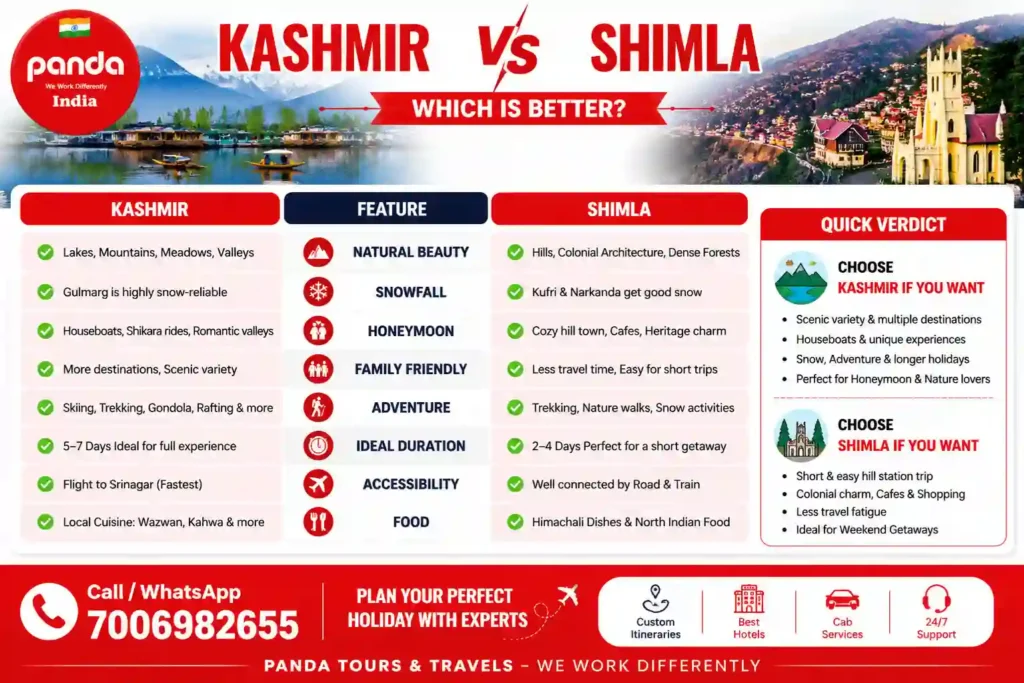
Kashmir vs Shimla: Which One Should You Choose?
If this comparison is reduced to a single practical rule, it would be this: choose Shimla when your trip is short and your priority is convenience, and choose Kashmir when your trip is five days or longer and your priority is scenic variety and a more immersive Himalayan experience. Families with limited time, first-time hill-station visitors, and travellers based near Delhi or Chandigarh often find Shimla the more practical short break. Honeymooners, photography enthusiasts, adventure travellers and anyone with a week to spare tend to get more out of Kashmir’s fuller circuit.
Both destinations are genuinely worth visiting — this is not a case of one being objectively superior to the other, but of matching the destination to the shape of your actual trip.
If Kashmir fits your plans, Panda Tours and Travels can help build a customised itinerary around your available days, budget and season — reach the Srinagar-based team on Call/WhatsApp at +91 7006982655 for a personalised route.



Frequently Asked Questions About Kashmir vs Shimla
Is Kashmir better than Shimla for a first-time hill-station visit?
It depends on your available time. Shimla suits a shorter, easier first trip, while Kashmir rewards travellers with five or more days who want a fuller experience.
How many days are ideal for a Kashmir trip compared with Shimla?
Kashmir generally needs five to seven days for a proper circuit, while Shimla works comfortably in two to four days.
Which is cheaper, Kashmir or Shimla?
Neither is universally cheaper. Cost depends on season, hotel category, group size and transport choices, so treat any published prices as indicative and get a current quote for your dates.
Does Kashmir get more snow than Shimla?
Gulmarg in Kashmir is generally more snow-reliable than Shimla town itself, though Kufri and Narkanda near Shimla also see good snow in a typical winter.
Is Kashmir safe for tourists in 2026?
Kashmir has well-established tourism infrastructure. Check current official advisories, book through registered operators and follow local guidance, as with any travel destination.
Which is better for a honeymoon, Kashmir or Shimla?
Kashmir offers more distinctive experiences like houseboats and Shikara rides, while Shimla offers a compact, low-effort colonial hill-town honeymoon.
Can I cover both Kashmir and Shimla in one trip?
They are in different states with a long road distance between them, so combining both in a single short trip generally is not practical; most travellers choose one per trip.
Which has better weather in summer, Kashmir or Shimla?
Both offer comfortable summer temperatures compared with the plains; Kashmir adds scenic variety across valleys, while Shimla offers a concentrated hill-town experience.
Is Gulmarg better than Kufri for snow activities?
Gulmarg generally has a longer, more developed ski season with a high-altitude gondola, while Kufri offers accessible snow activities closer to Shimla.
Which is better for family trips with young children?
Shimla is often easier for short family trips due to less daily travel, while Kashmir suits families with more days who want varied scenery.
Is Srinagar or Shimla easier to reach from Delhi?
Shimla is generally quicker to reach from Delhi by road or rail via Chandigarh, while Kashmir usually requires a flight to Srinagar for the fastest access.
Which destination has better food, Kashmir or Shimla?
Kashmir offers the distinctive Wazwan tradition and dishes like Rogan Josh and Yakhni, while Shimla offers Himachali hill cuisine alongside general North Indian fare.
Is a Kashmir trip more tiring than a Shimla trip?
Kashmir generally involves more cumulative road time due to its multi-valley circuit, while Shimla involves less daily travel from a single base.
What is the best time to visit Kashmir for snowfall?
December to February is Kashmir’s core snow season, with Gulmarg being the most reliable spot, though snowfall timing and intensity vary year to year.
What is the best time to visit Shimla for snowfall?
December to February is also Shimla’s main snow window, though Kufri and Narkanda tend to be more consistently snowy than Shimla town.
Which is better for photography, Kashmir or Shimla?
Kashmir generally offers more landscape variety for photography, while Shimla offers strong colonial architecture and forest scenery.
Is Kashmir good for a 2-day trip?
A two-day Kashmir trip is possible but limited, generally covering only Srinagar; Shimla suits a two-day trip more comfortably.
What can I see in Kashmir in 5 days?
Five days typically allows Srinagar, Gulmarg, Pahalgam and often Sonamarg, giving a well-rounded first experience of the region.
Is Shimla good for a 5-day trip?
Five days in Shimla is comfortable and relaxed, though sightseeing may feel complete before the trip ends unless combined with another nearby hill station.
Which is better for adventure activities, Kashmir or Shimla?
Kashmir has more developed adventure infrastructure, particularly Gulmarg’s gondola, skiing and established trekking routes.
Does Shimla have houseboats like Kashmir?
No, houseboats are specific to Kashmir’s Dal and Nigeen Lakes and are not available in Shimla.
Which destination has more variety of landscapes?
Kashmir generally offers more landscape variety since it spans lakes, meadows, alpine terrain and riverside forests across several valleys.
Is Pahalgam better than Naldehra?
They serve different purposes — Pahalgam is a riverside pine-forest destination in Kashmir, while Naldehra is a meadow and golf-course spot near Shimla; comparison depends on personal preference.
Which is more crowded in peak season, Kashmir or Shimla?
Both see significant crowds in peak season — Dal Lake and Gulmarg in Kashmir, and Mall Road and The Ridge in Shimla.
Can senior citizens travel comfortably to Kashmir?
Yes, with a well-paced itinerary that limits daily travel and builds in rest days; individual mobility and medical needs should guide the final decision.
Is Shimla easier for senior citizens than Kashmir?
Shimla generally involves less daily road travel, which can make it more comfortable for some senior travellers, though this varies by individual health and preference.
What is the best season for Kashmir sightseeing overall?
April to October generally offers the most comfortable conditions for general sightseeing across Kashmir’s valleys.
What is the best season for Shimla sightseeing overall?
March to June and September to November are generally the most comfortable periods for Shimla sightseeing.
Is Kashmir good for a honeymoon in winter?
Yes, winter adds a distinctive snowy character to Srinagar and Gulmarg, though travellers should prepare for cold weather and possible road disruptions.
Is Shimla good for a honeymoon in winter?
Yes, particularly for couples wanting a shorter, easily accessible snow-season getaway near Kufri.
Which region has better shopping for handicrafts?
Kashmir is particularly known for Pashmina, hand-knotted carpets, papier-mâché and walnut woodwork, offering deeper handicraft variety than Shimla.
Is it easy to get ATMs and mobile network in Kashmir?
ATMs and network coverage are generally reliable in Srinagar and main tourist towns, but can be limited in remoter valleys, so carrying some cash is sensible.
Is it easy to get ATMs and mobile network in Shimla?
Shimla town has reliable ATM and network access, though coverage can thin out in more remote nearby spots like Narkanda.
What is the Kashmir Great Lakes Trek and is it relevant to this comparison?
It is a multi-day Himalayan trek in Kashmir for experienced trekkers, offering a very different, more demanding experience than typical Kashmir or Shimla sightseeing trips.
Which is better for a couples’ trip without children?
Kashmir generally offers more distinctive romantic experiences, while Shimla offers convenience for couples with limited time.
Does Kashmir have a toy train like Shimla?
No, the narrow-gauge Kalka–Shimla toy train is specific to the Shimla route and does not have an equivalent in Kashmir.
Which destination has better road connectivity within the region?
Shimla’s nearby excursions involve shorter road distances, while Kashmir’s valleys are spread further apart, requiring longer drives between stops.
Is Doodhpathri worth visiting compared with Shimla’s nearby spots?
Doodhpathri offers a quieter meadow experience similar in spirit to some of Shimla’s quieter surrounding spots like Mashobra, appealing to travellers wanting to avoid crowds.
What should I pack differently for Kashmir versus Shimla in winter?
Both require heavy winter layers, but Kashmir’s Gulmarg segment may need additional snow gear if skiing or spending extended time in deep snow.
Is trekking better in Kashmir or around Shimla?
Kashmir has more established, longer trekking routes around Pahalgam and Sonamarg, while Shimla offers shorter hikes suited to less experienced trekkers.
Which is better for a budget college-friends trip?
This depends on trip length and origin city — Shimla is often cheaper and quicker for short trips from northern cities, while Kashmir can offer good value on longer, well-planned itineraries.
How far in advance should I book a Kashmir trip?
Booking a few months ahead is generally advisable during peak summer and winter seasons, since good houseboats and hotels near key attractions can fill up early.
How far in advance should I book a Shimla trip?
Booking a few weeks to a couple of months ahead is generally sufficient, though peak summer weekends can also see hotels fill up quickly.
Is Sonamarg accessible in winter?
Sonamarg’s higher-altitude access can be restricted during heavy snowfall, so winter visits should be planned with flexibility and checked closer to the date.
Which is better suited to a spiritual or pilgrimage-linked trip?
Kashmir can be combined with the Amarnath Yatra or a Vaishno Devi visit in the wider Jammu and Kashmir region, offering pilgrimage options not directly available around Shimla.
Are there quieter alternatives to crowded Kashmir spots?
Yes, Doodhpathri and Yusmarg offer quieter meadow experiences compared with busier spots like Gulmarg and Dal Lake in peak season.
Are there quieter alternatives to crowded Shimla spots?
Yes, Mashobra and Naldehra offer a calmer setting compared with the busier Mall Road and Ridge area in peak season.
Which destination suits a working professional with only a long weekend?
Shimla generally suits a long weekend better due to shorter travel time, while Kashmir is better suited to a longer planned leave.
Does either destination guarantee snowfall for a specific travel date?
No, snowfall in both Kashmir and Shimla varies year to year and cannot be guaranteed for fixed dates in either region.
How do I decide between Kashmir and Shimla for my specific trip?
Match the destination to your trip length, season and priorities using the decision matrix in this guide — Shimla for short, convenient breaks, and Kashmir for longer, more varied Himalayan holidays.