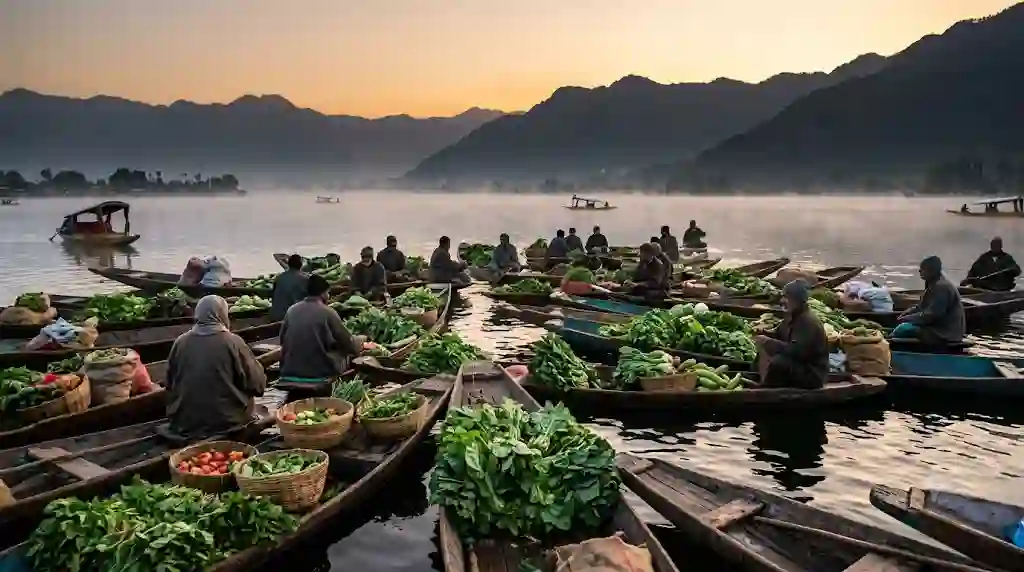
The floating market in Srinagar is an early-morning vegetable trade on Dal Lake, where growers sell produce from boats to local buyers. It starts close to sunrise, and the latest recommended start is 7:30 AM. You reach it by shikara from the ghat, so plan an early start.
Also see , Houseboat in srinagar .
What the floating market in Srinagar really is (and what it isn’t)
I have taken guests to the Dal Lake floating vegetable market for many years, and the first thing I tell them is that this is a working market, not an attraction built for visitors. Growers bring vegetables by boat, and buyers come to them by boat. Visitors watch, photograph and sometimes buy a little. The trade carries on whether or not tourists are there.
It is also different from other things you will see on Dal Lake. It is not a standard daytime shikara ride, not the flower and souvenir boats near the tourist ghats, and not the floating shops that cater to visitors. Those run through the day. The vegetable trade is a morning activity.
If you expect a covered market with fixed stalls, you will be disappointed. What you will find is a loose gathering of boats on the water, clustering, parting and regrouping as sales are made.

Best time to go and why dawn matters
Go close to sunrise. The trade is busiest in the first part of the morning and thins out once the sun is properly up. Sunrise comes at different times through the year, so the practical rule is to be on the water before the lake is fully bright.
Dawn also changes what you see. The light is soft and low, the water is usually calm, and the boats are easy to follow without glare. For photographers, this is the whole reason to come early. In cooler months you may see mist sitting low on the water, though this varies from day to day.
Timings can shift with the season and the weather. On a rainy or very cold morning the trade can be smaller, so treat any single morning as a realistic sample, not a guaranteed scene.
How to reach it
Go to Ghat No. 10. Private shikaras are available there.
If you are staying at a hotel or houseboat in Srinagar, arrange an early-morning pickup the evening before. You will be leaving before most of the city is awake, and you do not want to be sorting out transport in the dark. Tell your driver or host you are going to the floating market so there is no confusion with other ghats on the lake.
Boat and boarding details
Your shikara is yours alone for the trip, and that matters here. You can stop to watch a sale, slow down for a photograph, or hold back when a cluster of boats is moving.
Sit low and keep your bags dry. The air on the water is colder than it feels on land, and a small splash is common when boats pass close together.
Shikara rates vary by season, so for current pricing and other experiences, see our Activities to do in Srinagar guide.
Floating ATM on Dal Lake: carry cash anyway
Dal Lake has a floating SBI ATM, built as a small wooden house on the water with a lawn and a short jetty in front. If you run low on cash before your trip, it is a handy option to know about.
Even so, bring small notes with you. Sellers at the floating market deal in small daily sales, and nobody out on the boats can break a large note. A few hundred rupees in small denominations is enough if you want to buy some vegetables or lotus stem as a souvenir of the morning.
Keep your cash in a small dry pouch or zip bag. Splashes are common when boats pass close together, and a wet note is hard to hand over.
Plan to withdraw cash the evening before, not on the morning of your visit. At dawn you will be heading straight to the water, and you do not want to spend your best light looking for an ATM.

How the trade works between growers, wholesale vendors and boat sellers
This is the part most visitors miss, because it happens quickly and quietly. In general, growers who cultivate on the lake bring their harvest out by boat at dawn. Wholesale vendors, known locally as radchs, and boat sellers move between the growing boats, and sales are agreed on the water. Buyers are usually local households and traders who want fresh produce at the start of the day.
What you will notice is how little ceremony there is. Boats come alongside, goods change hands, and the boats move on. There are no announcements and no price boards. Watch one boat for a few minutes and you can follow the whole cycle: the grower arrives, a buyer comes alongside, the deal is made, and the boat is already turning.
What is sold depends on the season. Leafy greens and common vegetables are the usual stock, and lotus stem, which locals call nadru, appears when it is in season. I would not promise any one item on a given morning.
How a guided point-to-point visit works
Without a guide, many first-time visitors drift around without knowing where the activity is. The trade moves, and the busiest cluster of boats on one morning may not be where it was the day before.
On a guided visit, our guide stays with you through each stop instead of leaving you to find your own way. We go point to point: from the ghat to where the boats are gathering, then on to the next group as the activity shifts. Your guide explains what is happening, such as who is selling, who is buying and why a boat has paused, and tells you when it is polite to take a photograph.
You do not need a guide to see the market. But if it is your first visit and you have only one morning in Srinagar, someone who knows how the trade moves will save you time on the water.

Photography and etiquette tips
- Ask before photographing faces. Many sellers are happy to be part of a wide scene, but a close portrait deserves a nod or a smile first.
- Stay seated. Boats pass close together, and standing up to shoot can unbalance a small boat.
- Use the early light. Shoot wide first while the light is soft, then move to details like stacked vegetables, hands and boat sterns.
- Protect your camera. Bring a dry cloth or a small waterproof cover. The lake air is damp at dawn.
- Buy a little if you like. A small purchase, if the seller is willing, is a respectful way to take a photo. Do not bargain hard. These are small daily sales.
- Keep your voice low. The market is calm, and loud voices change the mood.
Mistakes first-timers make
- Arriving late. By mid-morning the busiest part of the trade has usually passed. This is the most common mistake and the hardest to fix.
- Expecting a stall market. It is boats on water, not a fixed bazaar.
- Dressing for the shore, not the lake. It is colder and damper on the water. Bring a warm layer, even in milder months.
- Booking a regular daytime ride by mistake. The vegetable trade will not be there.
- Leaving transport to the last minute. Pre-arrange your early pickup so you are not late.
- Treating one morning as a guarantee. Weather and season change how busy it is. Go with an open mind.
Pairing the visit with a nearby plan
The market finishes early, so most of your day is still ahead. Many guests go back for breakfast and rest, then take a daytime or sunset shikara ride later, which gives a completely different view of the lake. You can read about that and more in our guide to other experiences in Srinagar.

Frequently Asked Questions About Floating Market in srinagar
Where is the floating market in Srinagar?
The floating market in Srinagar takes place on Dal Lake, in the waterways where vegetable boats gather each morning. You go out by shikara from the lake’s ghat and move point to point with a guide. It is an early-morning activity, so plan to be on the water around sunrise.
What time should I reach the floating market on Dal Lake?
Be on the water close to sunrise. The latest start we recommend is 7:30 AM, because the vegetable trade is a morning activity and thins out as the day goes on. Sunrise shifts with the season, so allow some extra time to reach the ghat.
How do I reach the floating market on Dal Lake?
Go to Dal Lake Ghat No. 10, where shikaras are available for the market. If you are staying at a hotel or houseboat in Srinagar, arrange an early-morning pickup the evening before, since you will leave before most of the city is awake. A guide can then take you point to point.
Is the floating market in Srinagar worth visiting?
Yes, if you enjoy early mornings and real local life rather than a staged show. It is a working trade, so expect boats, produce and quiet deals, not performances. Go at sunrise for the best light and activity, and dress warmly. If you prefer a lie-in, a daytime shikara ride suits you better.
Planning your morning
If you want the early start handled for you, local operators such as Panda Tours And Travels arrange early-morning transport, private shikara pre-booking and guided visits, so you only need to be ready at your hotel or houseboat. You can find out more at pandatoursandtravels.com.
| M | T | W | T | F | S | S |
|---|---|---|---|---|---|---|
| 1 | 2 | 3 | 4 | |||
| 5 | 6 | 7 | 8 | 9 | 10 | 11 |
| 12 | 13 | 14 | 15 | 16 | 17 | 18 |
| 19 | 20 | 21 | 22 | 23 | 24 | 25 |
| 26 | 27 | 28 | 29 | 30 | 31 | |