

Achabal Garden at a Glance
Achabal Garden is a Mughal-era terraced garden built around a natural spring in the town of Achabal, Anantnag district, South Kashmir — about 8 km from Anantnag town and roughly 58 km southeast of Srinagar. Also known as Achabal Bagh or Begumabad, the garden dates to approximately 1620 and is most closely associated with Empress Nur Jahan, wife of Emperor Jahangir.
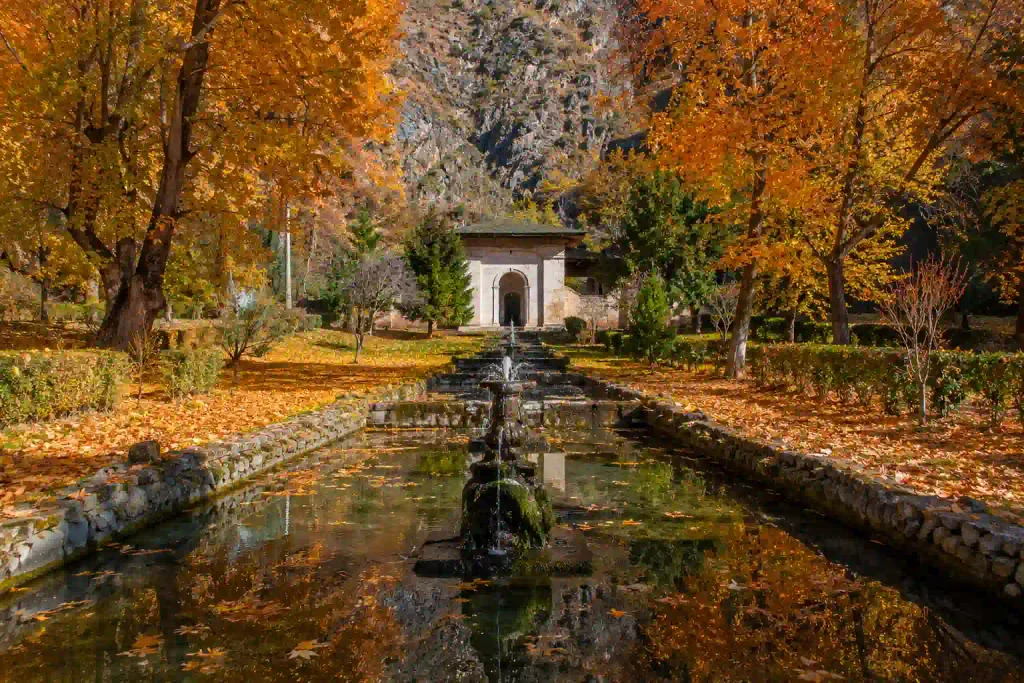
It follows the Persian chahar bagh design adapted for hillside terrain: water from the spring descends through terraces via cascades, channels and fountains, shaded by mature chinar trees. Smaller and considerably quieter than Srinagar’s Shalimar and Nishat gardens, Achabal Garden typically takes 45 minutes to about 1.5 hours to visit and works best as a half-day stop combined with nearby Kokernag or Verinag.
Panda Tours and Travels is a Srinagar-based local tour operator that arranges Kashmir travel and taxi services, including South Kashmir routes that take in Achabal Garden. For planning or cab bookings, they can be reached at +91 7006982655.
Achabal Garden: Quick Facts
| Also known as | Achabal Bagh, Begumabad, Sahibabad |
| Location | Achabal town, Anantnag district, Jammu and Kashmir |
| Built | Circa 1620 AD |
| Associated with | Empress Nur Jahan; later remodeled under Jahanara |
| Garden style | Persian chahar bagh, adapted for hillside terrain |
| Distance from Anantnag | About 8 km |
| Distance from Srinagar | Roughly 58 km by road |
| Elevation | About 1,936 metres (6,352 ft) |
| PIN code (Achabal town) | 192201 |
| Typical visit length | 1.5 hours |
Achabal Garden: History, Design and What You Can See
History of Achabal Garden
Historical sources agree on the core narrative but vary on exact dates and the attribution of specific structures. What’s well documented: the garden was developed in the early 1600s under Nur Jahan, expanded or remodeled during the 1630s–40s under Jahanara (daughter of Shah Jahan), and later rebuilt on a reduced scale under Dogra ruler Gulab Singh after a period of decay.
A mosque on the grounds is traditionally attributed to Mughal prince Dara Shikoh, though this attribution appears more consistently in tourism writing than in primary historical sources — worth flagging as commonly repeated rather than firmly established. Local tradition recorded in Kalhana’s 12th-century Rajatarangini also places a much earlier settlement here under the name Akshavala, centuries before the Mughal garden existed — a separate historical layer from the garden itself.
Who Built Achabal Garden?
Nur Jahan is the figure most consistently credited with founding the garden, generally dated to around 1616–1620, which is why it’s historically referred to as Begumabad (“the queen’s place”). Villiers-Stuart’s 1913 study of Mughal gardens singled her out, alongside Babur, as one of the era’s most committed patrons of garden design. Jahangir’s name is attached to the garden’s alternate title, Sahibabad, though the construction itself is more directly tied to Nur Jahan than to him personally.
Achabal Mughal Garden Design
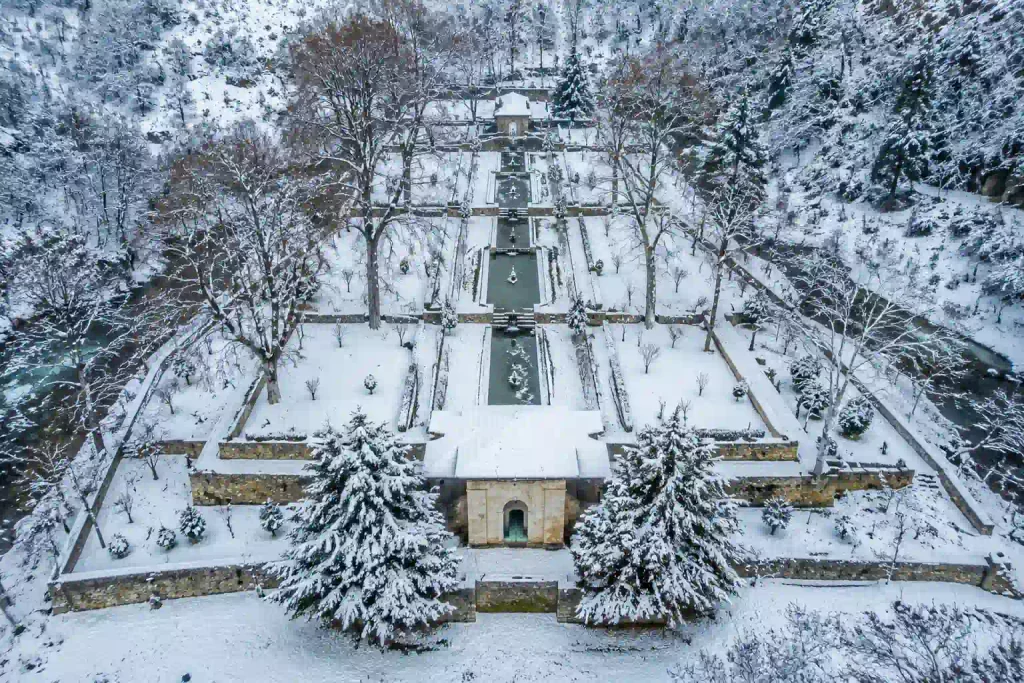
The garden follows the chahar bagh (four-part) principle used across Kashmir’s Mughal gardens — Shalimar, Nishat, and Verinag among them — but adapted for hillside sites: rather than four channels radiating from a central point, the water source sits at the top of the slope and descends through a sequence of terraces.
The Spring and Water Channels
The spring is the reason the garden exists here at all. Water emerges from an opening at the base of the hillside — traditionally described as a resurfacing of the Brengi stream, which disappears underground near the village of Wangam before reappearing at Achabal. The main channel runs the garden’s length, dropping through at least two chadars (chute-style cascades) between terraces, with side channels feeding smaller pools and fountains.
Terraces, Fountains and Garden Layout
The layout ascends across multiple terraces, with the upper section historically known as Bag-e-Begum Abad. This upper area once included a hammam — a heated bathing structure — connected to the garden’s western wall, though only portions of the original structure remain.
Trees, Flowers and Seasonal Appearance
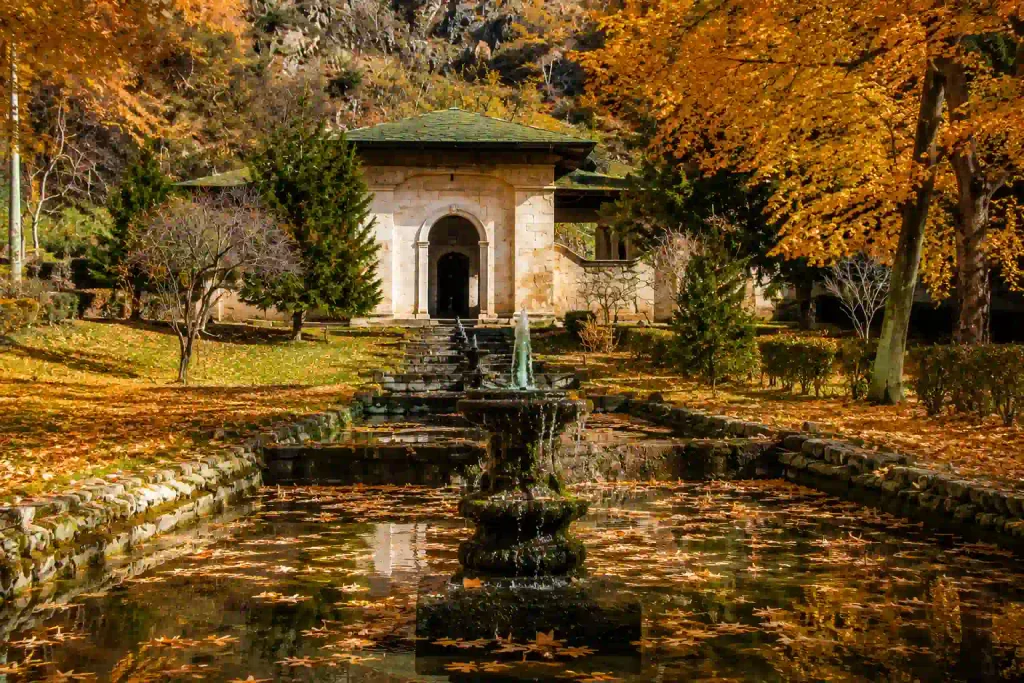
Chinar trees dominate the canopy and are the biggest factor in how the garden looks by season — full green cover in summer, gold-orange in autumn, bare in winter. Seasonal flower beds along the lower terraces are generally fullest in spring and early summer.
Historic Structures and Architectural Features
Beyond the water channels and terraces, the garden retains a mosque structure and remnants of the old hammam. Much of what’s visible today reflects the smaller-scale 19th-century Dogra-era rebuild rather than the original 17th-century Mughal construction, since the garden fell into disrepair between the Mughal and Dogra periods.
Where Is Achabal Garden Located?
Achabal Garden sits in Achabal town, at the southeastern edge of the Kashmir Valley where the outer Himalayan foothills meet the plains around Anantnag — along the road running from Anantnag toward Daksum and the Sinthan Pass. That position is also why it’s easy to combine a garden visit with Kokernag and Daksum on the same day.
Is Achabal Garden in Anantnag?
Yes. It sits about 8 km from Anantnag town, within Anantnag district, making it one of the closer South Kashmir Mughal gardens to the district headquarters.
Achabal Town PIN Code
The PIN code for Achabal town, where the garden is located, is 192201, served by the Achabal Sub Post Office under the Srinagar postal division.
Weather at Achabal Garden
Weather at the garden follows the broader Kashmir Valley pattern, with mild variation from its hillside elevation.
| Season | Months | What to Expect at the Garden |
|---|---|---|
| Spring | March–May | Cool mornings, mild afternoons; flower beds at their fullest |
| Summer | June–August | Warm, pleasant days; full green chinar cover |
| Monsoon overlap | July–August | Intermittent rain; approach roads can get slick |
| Autumn | September–October | Cool, clear days; chinar foliage turns gold-orange |
| Winter | November–February | Cold, occasional snow; garden water flow reduced, foliage bare |
Autumn is generally considered the strongest window for photographing the garden, as chinar color plays against the terraced water channels under clear skies. For current conditions before a visit, check a live forecast — Kashmir Valley weather can shift quickly, especially in shoulder seasons.
Best Time to Visit Achabal Garden
Best Time for Garden Views and Flowers
April through June, when planted beds are blooming and chinar trees are in full leaf.
Best Time for Chinar and Autumn Colours
Late September through October, when the chinar canopy turns gold and orange — many visitors consider this the single best window for photography.
Best Time for Pleasant Day Trips
March through October covers the full comfortable range; July–August adds monsoon-related rain risk but is otherwise fine for a half-day visit.
Visiting Achabal in Winter
Possible, and noticeably quieter, but expect cold temperatures, a dormant garden, and road conditions on the Anantnag–Daksum stretch that can be affected by snow. It suits travelers who specifically want a subdued, uncrowded visit rather than a peak-season garden trip.
Also, see best time to visit pahlgam .
How to Reach Achabal Garden
From Srinagar
Roughly 58 km by road depending on the exact route (via NH44/NH244 through Anantnag, or the Srinagar–Kanyakumari Highway corridor), with driving time generally between 1.5 hours depending on traffic and conditions.
From Anantnag
About 8 km along the Anantnag–Daksum road — a 15–20 minute drive.
By Taxi
The most practical option, since there’s no dedicated tourist transport network to the garden. A private taxi from Srinagar can combine Achabal Garden with Kokernag and/or Verinag in one day.
By Bus
Buses run along the Srinagar–Anantnag–Qazigund corridor; reaching the garden itself typically means getting off at Anantnag and taking a local taxi the remaining 8 km.
By Train
Anantnag has its own station on the Kashmir Valley’s Baramulla–Banihal/Sangaldan line. From there, the garden is a short taxi ride away — workable as one leg of a trip but not efficient for combining with other South Kashmir sights the same day.
By Air
The nearest airport is Srinagar International Airport, roughly 70 km away, connected onward by road.
Also, see kashmir taxi service .
Things to Do in Achabal Garden
Explore Achabal
The central activity for almost every visitor — walking the terraces, following the water channels down through the cascades, and taking in the garden’s chinar-shaded layout.
See the Natural Spring
The spring itself, at the top of the garden, is worth a few extra minutes beyond a quick garden walkthrough — it’s the actual source of everything else on site.
Photography
Autumn (chinar color) and spring (flowering beds, fresh green cover) are the strongest windows; the terraced water channels also photograph well in soft morning light before crowds build up.
Walking and Relaxing
Compared to Srinagar’s more heavily visited gardens, Achabal tends to be quieter, making it a reasonable stop for travelers who want a slower, less crowded pace.
Family Picnic
The lawns and shaded terraces suit a casual picnic stop, particularly for families already driving through on the way to or from Kokernag or Daksum.
Combine Achabal With Nearby South Kashmir Sights
Because Achabal itself is a relatively quick visit — most people spend 45 minutes to just over an hour — it works best paired with one or two nearby destinations rather than as a standalone day trip.
Places to Visit Near Achabal
Kokernag
About 25 km from Anantnag (and roughly 20–25 km from Achabal via local roads), Kokernag is known for its own spring-fed garden and a trout hatchery. Many South Kashmir itineraries pair the two gardens on the same day since both sit along a similar corridor.
Verinag
Around 26 km from Anantnag, Verinag is home to the spring traditionally considered the source of the Jhelum River, with its own Mughal-era garden built by Jahangir. It’s commonly combined with Achabal as a two-garden South Kashmir day trip.
Daksum
Further along the same Anantnag–Daksum road, roughly 40 km from Anantnag, Daksum is a forested valley near the base of Sinthan Pass — a natural next stop for travelers extending an Achabal visit into a longer day or overnight trip, rather than a same-day add-on for most itineraries.
Martand Sun Temple
An ancient temple site associated with the Karkota dynasty, generally reached via Anantnag; Achabal is often cited as a convenient base point for a Martand visit given the short distance between the two.
Pahalgam
A well-known hill destination roughly 40–45 km from Achabal by road. Some multi-day South Kashmir itineraries link Achabal with Pahalgam, though it’s a longer add-on than Kokernag or Verinag and usually treated as a separate day rather than the same outing.
Achabal Garden Day Trip Itinerary
Option 1 — Garden-Focused Half-Day
Depart Srinagar early, drive via Anantnag to Achabal Garden (roughly 1.5–2.5 hours), spend 1–1.5 hours exploring, have lunch in Anantnag, and return to Srinagar by mid-to-late afternoon.
Option 2 — Achabal Garden + Kokernag + Verinag
Depart Srinagar early, reach Achabal Garden first, spend about an hour there, continue to Kokernag (30–40 minutes further), then Verinag (another 30–45 minutes), before returning via Anantnag. This makes a full day — realistically 9–10 hours door to door — and is the most common way this South Kashmir garden circuit is actually driven.
Also , kashmir tour package 6 nights 7 days .
Is Achabal Garden Worth Visiting?
For travelers interested in Mughal garden architecture, spring-fed water design, or a quieter alternative to Srinagar’s Shalimar and Nishat gardens — yes. Achabal Garden offers a smaller-scale but genuinely well-preserved version of the same design tradition, with noticeably fewer crowds.
For travelers with only one or two days in Kashmir, it’s a reasonable one to skip in favor of higher-priority stops — it’s a strong addition to a longer trip rather than a must-see on a short one.
As a standalone visit, it works comfortably as a half-day stop; it’s rarely worth designing an entire day around it alone, which is why most itineraries pair it with Kokernag, Verinag, or a Martand stop. Compared to Srinagar’s Mughal gardens, the difference is scale and crowd density — Shalimar and Nishat are larger and considerably busier, while Achabal Garden is smaller, less polished, and quieter.
Are Medical Facilities Available in Achabal?
Achabal has access to basic medical care, while larger hospitals and more comprehensive facilities are available in nearby Anantnag. For minor needs, travelers should carry essential medicines, especially when visiting with children or senior travelers.
Where Can You Eat in Achabal?
Food options in Achabal are relatively limited compared with Srinagar or Anantnag. Travelers can find basic local food and refreshments, but carrying water and light snacks is useful for a sightseeing trip, particularly when combining Achabal with nearby destinations.
Is Mobile Network Available in Achabal?
Mobile connectivity is generally available in Achabal, although network strength can vary by location and service provider. Travelers should download important maps and travel details before leaving Srinagar in case connectivity becomes weak during the journey.
Are Hotels Available in Achabal?
Accommodation options in Achabal are limited compared with Srinagar and Anantnag. Many travelers prefer staying in Srinagar, Anantnag or another nearby destination and visiting Achabal as a day trip.
Is There an ATM in Achabal?
Yes, ATMs are available in Achabal, including HDFC Bank and Jammu & Kashmir Bank ATMs. Travelers can withdraw cash locally, but carrying some extra cash is still advisable before starting a longer South Kashmir sightseeing route.
Is Parking Available at Achabal Garden?
Parking availability can depend on the access area and current local arrangements. Travelers should follow designated parking areas and avoid obstructing the garden entrance or nearby roads.
Are Washrooms Available at Achabal Garden?
Basic visitor facilities may be available around the garden area, but travelers should not assume that facilities will always be open or fully equipped. Using facilities before starting a longer sightseeing circuit is advisable.
Achabal Garden for Families, Couples and Photographers
Families will find it manageable — flat terraced paths, shaded lawns, no strenuous walking, workable even with young children or older travelers.
Couples looking for a quieter alternative to Srinagar’s main gardens will likely appreciate the pace here, particularly outside peak summer weekends.
Photographers get the most out of early morning light on the water channels, and the autumn chinar season for colour; the spring’s source point at the top of the garden is also a reliable, less-photographed vantage point compared to the lower terraces.
Practical Tips for Visiting Achabal Garden
- Plan for roughly 1–1.5 hours at the garden; build extra time in if combining it with Kokernag or Verinag.
- Carry cash — card acceptance is limited in and around Achabal town.
- Wear comfortable walking shoes; terraces and paths are uneven in places.
- Basic food options exist in Achabal and nearby Anantnag; don’t expect extensive dining choices at the garden itself.
- Check road conditions ahead of a winter visit, especially if continuing toward Daksum or Sinthan Pass.
- A private taxi is the most flexible way to see the garden alongside nearby sights in one trip, since public transport directly to it is limited.
Final Takeaway: Is Achabal Garden Right for Your Kashmir Itinerary?
Achabal Garden earns its place on a South Kashmir itinerary as a compact, historically grounded stop rather than a headline destination. It rewards travelers who care about Mughal garden design and want a calmer alternative to Srinagar’s better-known gardens, and it slots naturally into a day that also covers Kokernag, Verinag, or Martand. Panda Tours and Travels arranges private taxis and South Kashmir day trips out of Srinagar that can include Achabal Garden alongside Kokernag and Verinag; for planning, call +91 7006982655.





Frequently Asked Questions About Achabal Garden
What is Achabal famous for?
Achabal is famous for its natural spring, terraced Mughal garden, flowing water channels, fountains, and historic association with the Mughal period. It is located in Anantnag district of Kashmir and is one of South Kashmir’s notable garden and spring destinations.
Where is Achabal located in Kashmir?
Achabal is located in Anantnag district in South Kashmir, Jammu and Kashmir. The official District Anantnag tourism page places it about 9 km from the district headquarters.
Is Achabal in Anantnag?
Yes. Achabal is in Anantnag district of Jammu and Kashmir and is commonly searched as both “Achabal Kashmir” and “Achabal Anantnag.” The district administration lists Achabal as a tourist destination.
What is Achabal Garden?
Achabal Garden is a historic terraced garden built around the natural spring at Achabal. Its defining features include flowing spring water, channels, fountains, terraces and Mughal-style garden elements.
Is Achabal Garden a Mughal garden?
Yes. Achabal Garden is recognized as a Mughal-era garden associated with the Mughal period in Kashmir. Its terraced design, water channels, fountains and spring-fed layout reflect the characteristic relationship between Mughal gardens and water.
Who built Achabal Garden?
Historical sources differ in how they describe the garden’s development and association with Mughal rulers. The District Anantnag tourism page specifically connects the spring and garden with Emperor Jahangir, while other tourism sources attribute the garden to Empress Nur Jahan. For publication, use the historically sourced explanation rather than presenting a disputed attribution as an unquestionable fact.
What is the history of Achabal Spring?
Achabal Spring is the natural water source around which the historic garden developed. The District Anantnag tourism page notes a traditional explanation connecting the spring’s water with the Brengi Nallah, which disappears near Dewalgam before re-emerging at Achabal.
What is the best time to visit Achabal?
The most pleasant period for garden sightseeing is generally from spring through autumn, when the landscape is greener and the garden is particularly attractive. Spring and summer are especially suitable for enjoying flowers and flowing water, while autumn offers a different landscape with seasonal foliage.
What is the weather in Achabal?
Achabal experiences changing conditions across the seasons. Spring brings fresh greenery and flowers, summer is generally more comfortable for sightseeing, autumn adds colour to the landscape, and winter is colder with the possibility of wintry conditions. Check the current forecast before travelling because daily conditions can change.
What is the Achabal PIN code?
The PIN code for Achabal is 192201. It is listed for Achabal in Anantnag district, Jammu and Kashmir.
How far is Achabal from Srinagar?
Achabal is roughly 58 km from Srinagar by road according to the District Anantnag tourism information. Actual travel time can vary with the route, traffic, road conditions and stopovers.
How far is Achabal from Anantnag?
Achabal is approximately 8 km from the Anantnag district headquarters according to the District Anantnag administration.
How do I reach Achabal from Srinagar?
The easiest option for most tourists is to travel by road, either by private taxi or other road transport via the Anantnag side. Public transport is also possible, although connections may require changing vehicles depending on the starting point.
Can I visit Achabal from Srinagar in one day?
Yes. Achabal can be planned as a day trip from Srinagar, especially when the visit is focused on the garden and spring. Travelers with a full day can also combine Achabal with nearby South Kashmir destinations, provided the route is planned realistically.
How much time is enough for Achabal Garden?
Around two to three hours can be enough for a relaxed garden visit, depending on how much time you spend walking, photographing the garden and exploring its water features. Current third-party visitor guides commonly recommend a similar duration.
Is Achabal worth visiting?
Yes, especially for travelers interested in Mughal gardens, natural springs, photography, history and quieter sightseeing in South Kashmir. Achabal is most valuable when you want to combine nature and heritage rather than spend the entire day at a single major tourist attraction.
What are the best things to do in Achabal?
The main experiences include exploring Achabal Garden, viewing the natural spring and water channels, photographing the terraces and Chinar trees, walking through the landscaped areas, and including the destination in a South Kashmir sightseeing circuit.
What can I see inside Achabal Garden?
The main features to look for are the natural spring, flowing water channels, fountains, terraced garden layout, mature trees, landscaped areas and historic Mughal-style architectural elements.
Is Achabal good for photography?
Yes. The combination of spring water, terraces, fountains, trees, flowers and historic garden features makes Achabal suitable for landscape, architecture and seasonal photography. Spring and autumn can provide particularly different visual settings.
Can I visit Achabal, Kokernag and Verinag in one day?
It can be possible to combine these destinations in a planned South Kashmir road trip, but the realistic schedule depends on road conditions, sightseeing time and the season. Avoid treating every stop as a long visit if you want to return to Srinagar on the same day.
What places can I visit near Achabal?
Popular destinations that can be considered around an Achabal itinerary include Kokernag, Verinag, Daksum and other South Kashmir attractions. The best combination depends on available time and your onward route.
Is Achabal Garden open in winter?
Achabal can be visited in winter, but the experience differs from the warmer months because seasonal flowers and garden conditions change. Operating hours or access arrangements may also change seasonally, so confirm current visitor information before travelling.
Is Achabal suitable for families?
Yes. Achabal can work well for families looking for a relatively relaxed sightseeing experience involving gardens, walking and natural scenery. Families should still consider seasonal weather and the amount of walking involved.
Is Achabal suitable for couples?
Yes. The garden’s landscaped setting, flowing water, Chinar trees and quieter atmosphere can make it a pleasant stop for couples, particularly when included in a wider South Kashmir itinerary.
What makes Achabal different from other Mughal gardens in Kashmir?
Achabal’s distinctive feature is the way its historic garden is organized around a natural spring and flowing water. This gives the destination a different character from gardens that are primarily known for formal terraces and landscaped lawns.