Autumn in Kashmir runs roughly from September to November, sitting between the green peak of summer and the snow of winter. It is the season most closely associated with Chinar trees, whose broad leaves turn from green to yellow, orange, and deep red across the Kashmir Valley, especially around Srinagar’s Mughal gardens and old neighbourhoods. September still carries summer warmth and greenery with the apple harvest underway in orchards across the valley. October is generally regarded as the strongest month for classic autumn colour, when Chinar foliage, clear skies, and the saffron harvest around Pampore overlap.
November brings colder mornings, thinning crowds, fewer leaves left on the trees, and the first possibility of snow at higher elevations such as Gulmarg and Sonamarg. Autumn suits travellers who want quieter sightseeing, cooler weather, harvest-season experiences, and photography, more than those chasing flowers or guaranteed snow.
Panda Tours and Travels is a Srinagar-based local travel company that helps travellers plan Kashmir holidays, private transport, and customised itineraries throughout the year. The team works out of Srinagar, which means day-to-day decisions on routes, hotels, and timing are made with direct knowledge of current ground conditions rather than from a distance. For an autumn trip, that local coordination matters more than usual, since foliage and weather shift quickly across different altitudes. Reach the team directly for planning help. Call / WhatsApp: +91 7006982655.
What Is Autumn in Kashmir?
Autumn in Kashmir is the season of transition — the valley moving from the lush green of summer toward the bare branches and snow of winter. Locally, this season is sometimes called Harud, a Kashmiri term for autumn that carries connotations of harvest, change, and a certain quiet melancholy that shows up often in Kashmiri poetry and songs. It is not just a weather description; it’s tied to the rhythm of village life, when paddy fields turn golden, orchards are picked clean, and families prepare stores of dried vegetables for the winter ahead.
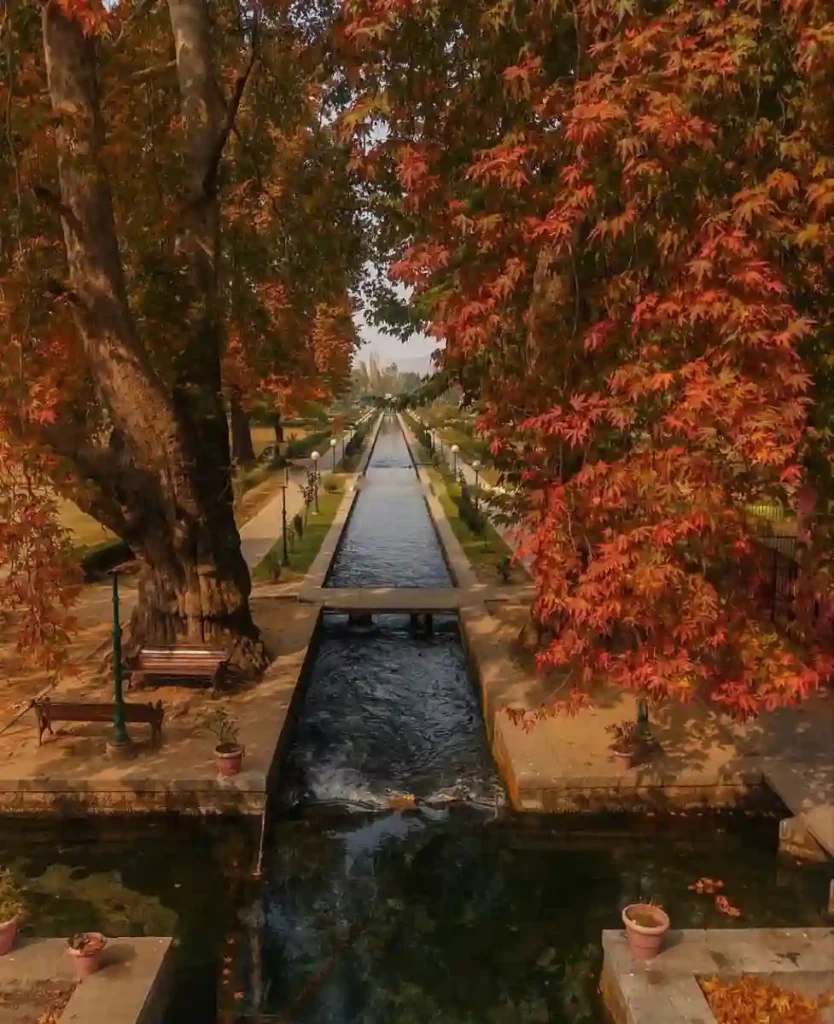
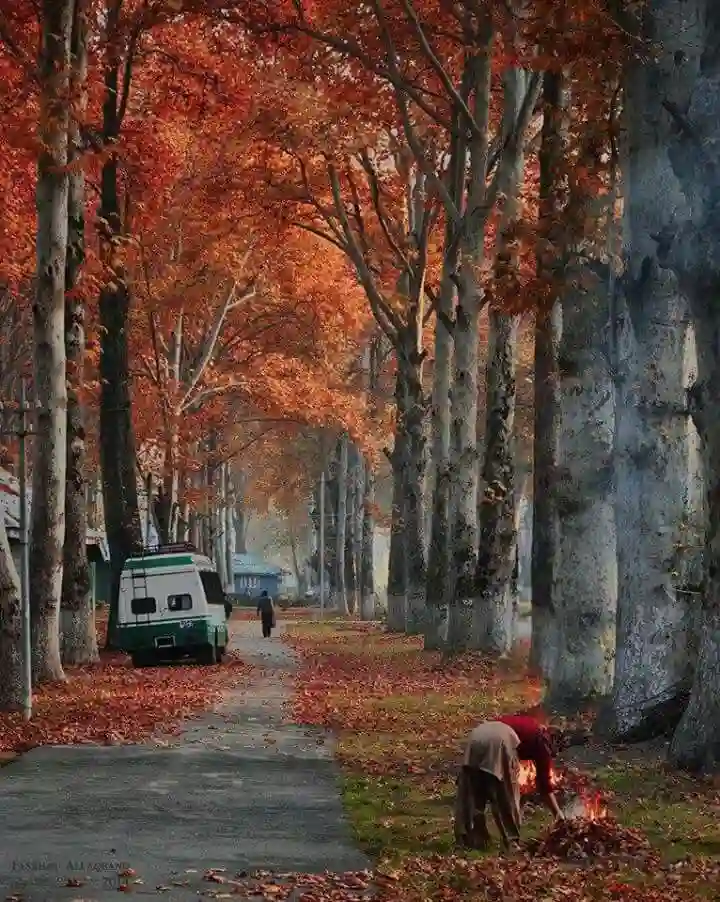
The most visible marker of autumn is the Chinar tree (Platanus orientalis), planted across Srinagar’s gardens, lakesides, and courtyards centuries ago, largely during Mughal rule. Chinar leaves are large, maple-like, and turn through a slow gradient of yellow, orange, red, and brown before falling. A single large Chinar can look like it’s on fire in the right light, and a street or garden lined with them is what most people picture when they hear “autumn in Kashmir.”
Beyond the trees, autumn changes the whole feel of the valley. Mornings and evenings turn noticeably cooler, even while afternoons can stay pleasantly mild. The tourist crowds of peak summer thin out. Orchards fill with the sound of apple-picking. In Pampore, purple saffron crocus flowers briefly appear across the fields. The light itself changes — softer, more golden, especially in the early morning and just before sunset — which is part of why autumn is considered one of the best seasons for photography in Kashmir.
Compared to spring, which is about blossom and renewal, and summer, which is about lush green meadows and long daylight, autumn in Kashmir is about colour, harvest, and a slower pace. It rewards travellers who don’t mind cooler weather in exchange for quieter gardens, dramatic foliage, and a more contemplative version of the valley.
When Is Autumn in Kashmir?
Autumn in Kashmir broadly spans September through November, though the exact peak of foliage colour depends on altitude, that year’s weather, and the specific location — a garden in Srinagar and a meadow in Sonamarg rarely turn colour on the same schedule.
Early Autumn in September
September in Kashmir still feels close to summer in many ways. Days are generally warm and comfortable, the valley is still largely green, and the shift toward autumn colours is only just beginning, usually more visible toward the end of the month. This is peak apple harvesting season across orchard belts like Shopian, Sopore, and parts of South Kashmir, and it’s also when saffron corms in Pampore begin their pre-flowering preparation.
Tourist crowds are typically lighter than the summer peak (May–July) but not as thin as November. September works well for families who want comfortable weather without full autumn cold, and it’s a solid month for travellers who want to combine general sightseeing with the very first hints of the season changing.
Peak Autumn in October
October is commonly considered the strongest month for classic Kashmir autumn scenery, and it’s the month most searches and photographs are built around. Chinar foliage is typically at or near its most dramatic through this month, running through gold, orange, and deep red across Srinagar’s gardens and lakeside avenues.
Days are comfortable for sightseeing, without the summer heat or the biting cold of late November. Gardens, Dal Lake, and the older parts of Srinagar photograph particularly well in October light. It’s also when the Pampore saffron harvest is typically at its most active, and orchards are still finishing their harvest in many areas. October tends to draw a dedicated autumn-travel crowd, so popular garden entrances and viewpoints can get busy on weekends, but it remains far less crowded than the summer months.
Late Autumn in November
By November, autumn is winding down. Many Chinar trees have dropped a large share of their leaves, though pockets of colour can still be found, particularly in sheltered spots or on trees that changed later. Mornings and evenings turn distinctly cold, and travellers should expect to need proper layers. Early snowfall becomes a real possibility at higher elevations such as Gulmarg and parts of Sonamarg, though it is never guaranteed and varies year to year. Crowds drop significantly, which appeals to travellers who prioritise quiet, uncrowded sightseeing over guaranteed foliage. November suits photographers chasing a starker, moodier version of the valley, and travellers who don’t mind cooler days in exchange for near-empty gardens and lower hotel rates.
September vs October vs November in Kashmir
| Month | Seasonal Character | Foliage | Temperature Trend | Crowd Level | Photography | Harvest Activity | Clothing | Best For |
|---|---|---|---|---|---|---|---|---|
| September | Late summer easing into early autumn | Mostly green, early colour change toward month-end | Warm days, mild-cool nights | Moderate | Good, more green tones | Apple harvest active; saffron fields preparing | Light layers, light jacket for evenings | Families, comfortable sightseeing |
| October | Peak classic autumn | Strong yellow–orange–red Chinar colour | Mild days, cool-to-cold mornings/evenings | Higher on weekends, still manageable | Best month overall for foliage shots | Saffron harvest active in Pampore; late apple picking in some belts | Layered clothing, warm jacket for morning/evening | Photographers, couples, first-time autumn visitors |
| November | Late autumn, edging toward winter | Thinning fast; scattered colour remains | Cold mornings/evenings, cool afternoons | Low | Starker, moodier light; fewer leaves but dramatic skies | Harvests largely finished | Heavier layers, thermals recommended, warm jacket | Quiet-seekers, budget-conscious travellers, those hoping for early snow at altitude |
Conditions vary from year to year depending on temperature patterns and rainfall, so treat these as general tendencies rather than fixed rules.
What Makes Autumn in Kashmir So Special?
A few things come together in autumn that don’t overlap the same way in any other season. The Chinar trees are the obvious anchor — nowhere else in India has quite this concentration of centuries-old Chinars turning colour across lakeside gardens. But it’s really the combination of elements that makes the season distinct.
The light changes. Autumn mornings in Srinagar often carry a soft haze that burns off into clear afternoons, and the low sun angle through October and November brings out warm tones on water, gardens, and mountain faces that summer’s harsher midday light doesn’t. Add in the harvest — saffron fields turning purple in Pampore, orchards being picked across the valley, paddy fields cut and stacked — and there’s a working, lived-in texture to the landscape that isn’t just decorative.
The pace slows too. With tourist numbers down from the summer peak, gardens that feel busy in June can feel almost private in late October or November. Shikara rides on Dal Lake happen against a backdrop of turning willows and Chinars rather than crowded shorelines. A cup of Kahwa — Kashmir’s traditional saffron and cardamom tea — feels more fitting on a cool autumn evening than it does in July heat, and it’s genuinely part of how locals experience the season, not just a tourist prop.
None of this needs exaggeration. Autumn in Kashmir is simply a season where colour, harvest, weather, and quiet line up at the same time, which is rare enough to be worth planning a trip around.
Best Places to Visit in Autumn in Kashmir
Not every destination in Kashmir offers the same kind of autumn experience. Some are about Chinar foliage specifically, some about countryside and harvest scenes, and some about quiet mountain scenery with only patches of colour. Below is an honest breakdown of where to go and what to expect.
Shalimar Bagh
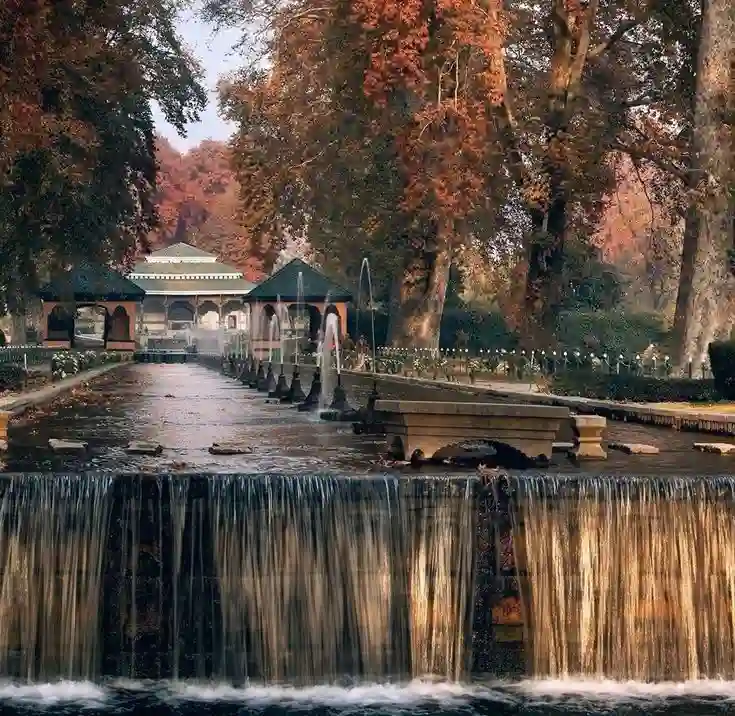
Built by Emperor Jahangir for Empress Noor Jahan, Shalimar Bagh is one of Srinagar’s grandest Mughal gardens, with terraced lawns, water channels, and a strong population of old Chinar trees. In October, the Chinars here turn a deep orange-red that photographs beautifully against the garden’s black marble pavilions. Late afternoon light works best, when the crowds thin and the sun angle flatters the terraces. It suits most kinds of travellers — families, couples, and photographers alike — and it’s an easy stop on a Srinagar sightseeing day. You can build it into a broader Kashmir tour package covering Srinagar’s gardens.
Nishat Bagh
Nishat Bagh sits on the eastern shore of Dal Lake with the Zabarwan Hills rising behind it, and its twelve terraces make it one of the largest Mughal gardens in the valley. Autumn brings colour to its Chinars while the lake views stay constant, giving a strong combination of foliage and water reflection shots. Early morning is best here, both for the light and for having the terraces relatively free of other visitors. It suits photographers and couples in particular, and pairs naturally with a Dal Lake shikara ride on the same day.
Naseem Bagh
Naseem Bagh, on the northern shore of Dal Lake, is quieter and less visited than Shalimar or Nishat, which is exactly its appeal. It holds hundreds of old Chinar trees, some believed to be centuries old, planted in the Mughal era. Because it draws fewer visitors, it’s one of the better spots for slow, unhurried photography and a genuinely peaceful walk under a canopy of turning leaves. Golden hour — early morning or just before sunset — is the best window here. It suits travellers who want an authentic, less staged version of Srinagar’s Chinar scenery.
Chinar Park / Dalgate
Chinar Park near Dalgate is a smaller, more local spot compared to the historic Mughal gardens, but it’s an easy, low-effort place to see Chinar colour up close, particularly for travellers with limited time in Srinagar. It works well as a short stop rather than a planned excursion, and suits families or anyone wanting quick, convenient photographs without a longer garden visit.
Char Chinar and Dal Lake
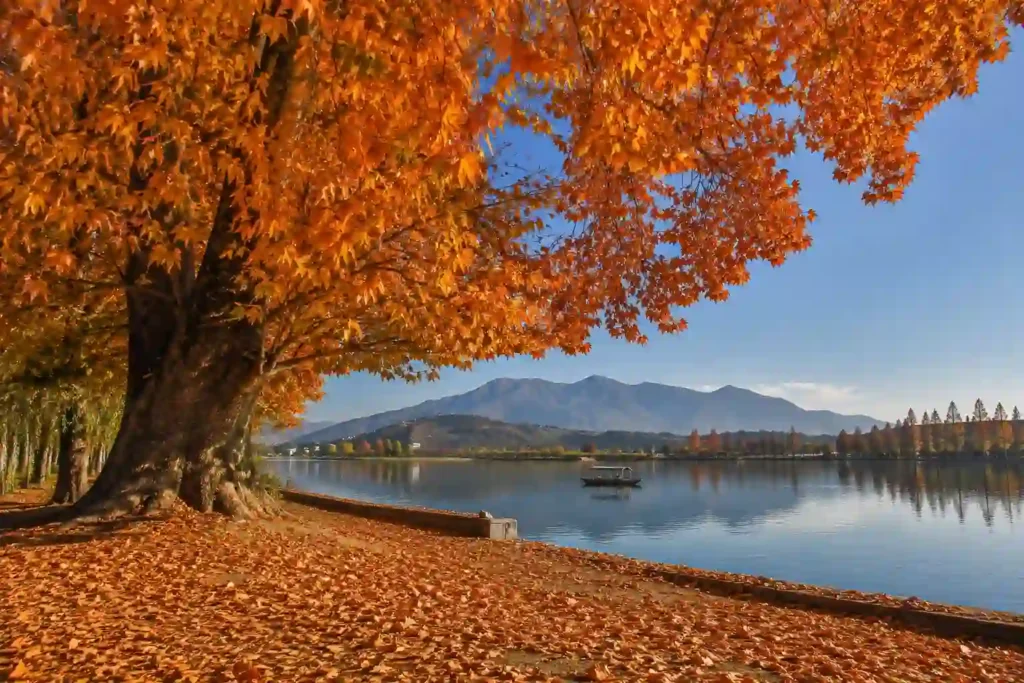
Char Chinar is a small island in Dal Lake marked by four Chinar trees, reachable only by shikara. Seeing it from the water, framed by the lake and the hills beyond, is one of the more distinctive autumn experiences in Srinagar. A shikara ride through Dal Lake in October, past floating gardens, houseboats, and Chinar-lined banks, captures the season better than almost anything else on land. It suits couples and photographers especially, and it’s worth timing for sunrise or late afternoon when the water is calmer and the light softer.
Nigeen Lake
Quieter and less commercial than Dal Lake, Nigeen Lake is ringed with willow trees that turn gold in autumn, offering a calmer, more private version of Srinagar’s lake scenery. It suits travellers looking for a peaceful houseboat stay away from the busier stretches of Dal Lake, and is particularly appealing for honeymooners.
Shankaracharya Hill
Perched above Srinagar, Shankaracharya Hill (home to the Shankaracharya Temple) gives a panoramic view over the city, Dal Lake, and the surrounding mountains. In autumn, the valley below shows patches of colour among the greenery, and the hilltop itself offers a wider, more geographic sense of the season than a single garden can. It’s best visited in the late afternoon for the light and the view, and it suits travellers who want a broader perspective on the city rather than close-up foliage shots. Some walking or a short drive up is required.
Pari Mahal
Also on the Zabarwan Hills, Pari Mahal is a terraced Mughal-era monument with sweeping views over Dal Lake. Less crowded than the lakeside gardens, it’s a good sunset spot, with golden light hitting the stone terraces and the valley below. It suits history lovers and photographers who want architecture and landscape in the same frame.
Pampore Saffron Fields
Pampore, roughly 15–20 km from Srinagar, is the heart of Kashmir’s saffron-growing region. During the flowering and harvest period, usually falling somewhere in the October–November window depending on the year, the fields turn a pale lavender-purple as saffron crocus flowers bloom briefly before being hand-picked. This is one of the more unusual autumn sights in Kashmir, more agricultural than ornamental, and it’s genuinely worth a stop for travellers interested in something beyond gardens and lakes. See more detail in the dedicated saffron section below.
Pahalgam
Pahalgam, along the Lidder River, carries a mix of pine forest and deciduous trees, so its autumn colour is more scattered through the landscape than concentrated in formal gardens. What it offers instead is scale — river valleys, forested hillsides, and open meadows that shift colour gradually through October. It suits families, honeymooners, and travellers who prefer countryside scenery over garden visits, and it works well as an overnight stop on a longer Kashmir itinerary. See the dedicated Pahalgam section below for more.
Aru Valley
A short drive from Pahalgam, Aru Valley is quieter, greener, and higher altitude, with meadows framed by pine forest. Autumn colour here is more muted than in Srinagar’s gardens, but the overall scenery — cooler air, fewer people, open pastures — makes it a good half-day trip for travellers who’ve already seen the main Pahalgam sights.
Betaab Valley
Named after the Bollywood film shot here, Betaab Valley combines a fast-flowing river with pine-forested slopes. It sees more colour change in its broadleaf trees through October, and remains a popular half-day trip from Pahalgam, best visited earlier in the day before it gets busy.
Kokernag
Kokernag in South Kashmir is known for its freshwater springs and botanical garden rather than dramatic foliage, but its manicured lawns and forest surroundings still pick up autumn tones, and the cooler climate here makes for a pleasant, unhurried visit. It suits families and travellers looking for a calm stop on a South Kashmir circuit, often combined with Achabal and Verinag.
Achabal
Achabal’s Mughal garden, built around a natural spring, has a good number of Chinar and other deciduous trees that turn colour in October. It’s smaller and less crowded than Srinagar’s gardens, which makes it a relaxed stop for photography and a short walk. It pairs naturally with Kokernag and Verinag on a South Kashmir day trip.
Verinag
Verinag, the source of the Jhelum River, centres on a spring-fed Mughal garden with geometric layouts. Autumn adds colour to the trees around the spring, and the site’s historical and hydrological significance gives it more depth than a purely scenic stop. It suits heritage-focused travellers and those doing a South Kashmir loop.
Yusmarg
Yusmarg’s high alpine meadows are surrounded by pine forest, and while broadleaf autumn colour is limited compared to Srinagar’s Chinar gardens, the contrast of green-to-gold grasslands against dark pine and increasingly bare peaks is its own kind of autumn scenery. It suits travellers who want a quieter, offbeat destination away from the main tourist circuit. Transport can be arranged through Panda Tours and Travels; see the Srinagar to Yusmarg taxi fare guide for route and cost details.
Doodhpathri
Similar in character to Yusmarg, Doodhpathri (“Valley of Milk”) is a meadow destination roughly 42 km from Srinagar, with rolling grasslands and pine forest rather than concentrated Chinar colour. Autumn here means golden grass, thinning crowds, and cooler air rather than dramatic red foliage. It suits nature lovers and travellers looking for a peaceful half-day or full-day escape from Srinagar.
Gulmarg
Gulmarg in autumn is a transitional destination — meadows that were green in summer start turning gold, and by November there’s a real chance (though never a guarantee) of the season’s first snow dusting the higher slopes. It is not a guaranteed snow destination during autumn, and travellers expecting winter conditions in September or October will be disappointed. What it does offer is cooler mountain air, thinner crowds than peak season, and the Gondola ride for panoramic Himalayan views, weather permitting. See the dedicated section below for more, and explore the Gulmarg tour package options.
Sonamarg
At higher elevation along the Srinagar–Leh highway, Sonamarg’s autumn is shorter and colder than the valley floor. By late October and November, access and weather can be more variable, and travellers should check road conditions before planning a visit that late in the season. In September and early October, it offers alpine meadows, glacier views near Thajiwas, and a noticeably different, higher-altitude character compared to Srinagar or Pahalgam. See more via the Sonamarg destination page.
Dachigam National Park
Dachigam, just outside Srinagar, is Kashmir’s most significant wildlife sanctuary, home to the endangered hangul (Kashmir stag) among other species. Autumn brings forest colour change alongside the rutting season for hangul, making it of particular interest to wildlife watchers and photographers, though visits typically require advance permission and are less suited to a casual sightseeing stop.
Hokersar Wetland
Hokersar, a wetland reserve near Srinagar, becomes active with migratory birds arriving from Central Asia and Siberia as autumn progresses into winter. It’s a niche stop, best for birdwatchers rather than general sightseeing, and late autumn typically brings more birdlife than early September.
Old Srinagar / Heritage Areas
The older parts of Srinagar — narrow lanes, wooden shrines, the Jamia Masjid, and riverside markets along the Jhelum — carry their own autumn atmosphere: wood smoke, drying vegetables strung along balconies, and a slower rhythm as the weather cools. This isn’t a “foliage” destination in the garden sense, but it’s arguably the most authentic way to feel the season as locals experience it, and it rewards travellers with time for a slower, walking-based visit.
Quick summary by category:
- Best Chinar foliage: Naseem Bagh, Shalimar Bagh, Nishat Bagh
- Best countryside scenery: Pahalgam, Betaab Valley, Yusmarg
- Best photography overall: Naseem Bagh, Char Chinar/Dal Lake, Pari Mahal
- Best harvest experience: Pampore, orchard belts near Shopian and Sopore
- Best peaceful escape: Doodhpathri, Yusmarg, Nigeen Lake
- Best family option: Srinagar gardens, Kokernag, Pahalgam
- Best couple/honeymoon option: Nigeen Lake, Char Chinar shikara ride, Pahalgam
Best Places to See Chinar Trees in Autumn in Kashmir
There is no single “best” Chinar spot in Kashmir — it depends on whether you want crowds-free quiet, historical grandeur, or lakeside framing. That said, a few locations consistently stand out for the strength and concentration of their Chinar colour.
Naseem Bagh has the highest concentration of old Chinar trees of any single site around Dal Lake, and because it draws fewer visitors than the formal Mughal gardens, the colour feels less staged and more immersive. Shalimar Bagh and Nishat Bagh offer grander, more manicured settings, with Chinars set against terraced lawns, fountains, and mountain backdrops — better for classic postcard-style shots.
Chinar Park near Dalgate is smaller but convenient for travellers short on time. In Pahalgam, Chinar and other broadleaf trees are scattered through the wider landscape rather than concentrated in a garden, giving a more countryside version of the same colour change. Srinagar’s older neighbourhoods also hold individual, centuries-old Chinars in courtyards and shrine compounds, though these are more incidental sightings than planned stops.
Timing varies by location and by year — a Chinar at lake level in Srinagar and one at higher elevation may turn colour weeks apart, so if foliage is your priority, it’s worth checking closer to your travel dates rather than assuming a fixed calendar date.
Autumn Colours in Kashmir – What Can You Actually See?
The colour change in Kashmir follows a rough progression — green, then yellow, then orange, then red or brown, before the leaves fall — but it doesn’t happen everywhere at once, and not every species follows the same pattern or the same timing.
Chinar trees are the headline act, moving through the fullest range of colour from yellow through deep red. Poplar trees, common along roadsides and field boundaries, tend to turn a cleaner yellow and drop their leaves earlier than Chinar. Walnut trees, found in orchards and courtyards, shift to yellow-brown, often less vivid but still part of the season’s texture.
Apple orchards don’t offer dramatic leaf colour so much as a working autumn scene — trees heavy with red fruit, ladders propped against branches, and crates being carried out of the rows. Higher up, mountain vegetation around Gulmarg, Sonamarg, and the meadows turns gold and brown rather than red, since the vegetation there is mostly grass and low shrub rather than broadleaf trees.
It is worth setting realistic expectations: Kashmir does not turn uniformly red overnight. Colour spreads unevenly, tree by tree and area by area, over several weeks, and a garden that looks half-green one week can look fully golden the next.
Saffron Season in Kashmir During Autumn
Can you see saffron fields in Pampore during autumn? Yes — the saffron-growing area around Pampore, roughly 15–20 km from Srinagar, comes into brief flower during the harvest window, which generally falls somewhere across late October into November depending on that year’s weather.
Kashmir produces some of the world’s most prized saffron, grown almost entirely in this belt of South Kashmir. When the crocus flowers bloom, the fields turn a soft purple for a short period — typically just a few weeks — before farmers hand-pick the flowers, usually very early in the morning, and extract the saffron threads by hand.
It is important to separate visiting the saffron-growing region from actually participating in harvesting. Driving through Pampore during the season and seeing the flowering fields from the roadside or designated viewing areas is generally possible and is a genuinely worthwhile stop. Entering private farms or joining the harvest itself is a different matter — these are working agricultural plots and private property, and access should never be assumed. If a farm visit or closer access is something you want, it needs to be arranged in advance through a local contact, not assumed on arrival.
For buying saffron, purchase from established, reputable sellers in Srinagar or Pampore rather than roadside vendors offering unusually cheap prices, since adulteration is a known issue in the saffron trade. Genuine Kashmiri saffron is expensive for a reason.
Apple Harvesting in Kashmir During Autumn
Is apple harvesting visible during a Kashmir autumn trip? Yes. Kashmir is one of India’s largest apple-producing regions, with orchard belts concentrated around Shopian, Sopore, Baramulla, and parts of South Kashmir. Harvesting typically runs from late summer into autumn, with different apple varieties picked at different points across that window, so September in particular tends to be an active harvest month.
For travellers, this mostly means passing through orchard country and seeing trees full of fruit, pickers working from ladders, and roadside stalls selling apples directly from the harvest. It’s a working agricultural landscape, not a tourist attraction with formal access, so as with saffron, entering someone’s orchard isn’t something to assume — a friendly wave from the road is one thing, walking into rows of trees is another.
Responsible tourism here means buying apples from legitimate roadside sellers or local markets rather than picking fruit uninvited, and being mindful that these orchards are people’s livelihoods, not a photo backdrop laid on for visitors.
Kashmir Weather in Autumn
Autumn weather in Kashmir shifts meaningfully across the day, and it changes further as the season progresses from September into November.
Kashmir Weather in September
Explain that September marks the beginning of autumn. Days can still be relatively comfortable, while mornings and evenings gradually become cooler. JKTDC describes September as the start of autumn, continuing into late November.
Kashmir Weather in October
Explain that October generally brings cooler, pleasant sightseeing conditions and increasingly visible Chinar colour changes. KashmirHills describes autumn as September–November and highlights the transition from green toward golden and red landscapes.
Kashmir Weather in November
Explain that November is noticeably cooler, particularly in the mornings and evenings, and Kashmir is moving toward winter. Higher-altitude destinations can feel considerably colder than Srinagar.
Is Kashmir Cold in Autumn?
Give a direct answer: It can be cool, especially in the morning and evening, but autumn is not the same as the full winter season. Temperatures also vary considerably between Srinagar and higher places such as Pahalgam and Gulmarg. For example, KashmirHills lists an autumn range for Pahalgam of approximately 0.9°C–27.4°C, illustrating how broad the variation can be.
Kashmir Temperature in September, October and November
Kashmir Temperature in September
Srinagar typically sees daytime temperatures around 24°C and nights around 12°C in September. The weather is still relatively comfortable during the day, while evenings begin to feel cooler.
Kashmir Temperature in October
October is noticeably cooler. In Srinagar, typical temperatures are around 19°C during the day and 5°C at night. This makes October particularly comfortable for sightseeing, although evenings can require a warm layer.
Kashmir Temperature in November
November brings a much stronger transition toward winter. Srinagar typically reaches around 14°C during the day, while nighttime temperatures can approach 0°C. Conditions can vary considerably from one year to another.
Suggested comparison table
| Month | Approx. Day Temperature | Approx. Night Temperature | What to Expect |
|---|---|---|---|
| September | ~24°C | ~12°C | Mild days, cooler evenings |
| October | ~19°C | ~5°C | Pleasant days, cold evenings |
| November | ~14°C | ~0°C | Cold mornings and nights |
These figures are Srinagar averages, not temperatures for the entire Kashmir Valley. Places at higher elevations such as Gulmarg, Pahalgam and Sonamarg can be considerably colder.
Does It Rain in Kashmir During Autumn?
Does it rain in Kashmir during autumn? Occasionally, yes, though autumn is generally drier than the summer monsoon fringe effects Kashmir sometimes sees, and drier than spring. Rainfall in autumn tends to come as short spells rather than prolonged wet periods, but it can happen at any point in the season and can affect visibility, road conditions on mountain routes, and outdoor plans for a day.
Practically, this means carrying a light raincoat or a jacket with some water resistance, keeping camera gear protected, and building some flexibility into an itinerary rather than locking every hour to a fixed plan. A wet morning in Srinagar doesn’t necessarily mean a wet day higher up, and conditions can shift quickly.
Does It Snow in Kashmir During Autumn?
Does it snow in Kashmir during autumn? Not typically in September or October, but it becomes possible at higher elevations by November. Snowfall in autumn should never be treated as guaranteed — it depends entirely on that year’s weather pattern.
Normal autumn conditions across most of the valley mean cool-to-cold temperatures and clear-to-partly-cloudy skies, not snow. At higher elevations — particularly Gulmarg’s upper slopes and parts of Sonamarg — an early season dusting is possible from around mid-to-late November onward, but even then it’s inconsistent from year to year. Travellers hoping specifically for snow are better served by a winter trip (December onward), when snowfall is far more reliable, rather than treating autumn as an extension of winter.
Best Things to Do in Kashmir in Autumn
Photograph Chinar Trees
Naseem Bagh, Shalimar Bagh, and Nishat Bagh offer the strongest concentrations of colour, with early morning and late afternoon light giving the best results.
Take a Shikara Ride on Dal Lake
A slow ride past Char Chinar, floating gardens, and Chinar-lined banks captures the season better than almost any single land-based stop.
Visit Mughal Gardens
Shalimar Bagh, Nishat Bagh, Chashma-e-Shahi, and Pari Mahal each offer a different angle on the same Mughal garden heritage, with autumn adding colour to their Chinars and other trees.
Explore Srinagar’s Heritage Areas
Old City lanes, Jamia Masjid, and riverside markets give a working, lived-in sense of the season beyond formal gardens.
Visit Saffron Areas Around Pampore
Time it right and you can see the fields in brief purple bloom during the harvest window — a genuinely unusual sight most travellers never associate with Kashmir.
Experience Apple Orchards
Passing through orchard belts during harvest, and buying apples directly from roadside sellers, is a simple but memorable part of an autumn trip.
Visit Pahalgam
A mix of river valley, pine forest, and scattered autumn colour, ideal for a relaxed overnight stop.
Walk Through Autumn Landscapes
Beyond the named attractions, simply walking through Srinagar’s gardens or Pahalgam’s forest trails at a slow pace is one of the better ways to experience the season.
Enjoy Kashmiri Kahwa
A cup of Kahwa — green tea with saffron, cardamom, and almonds — feels particularly suited to a cool autumn evening, and it’s a genuine local habit, not just a tourist ritual.
Try Traditional Kashmiri Cuisine
Autumn is a good season to try Wazwan dishes, and dried vegetables prepared for winter storage, which start appearing in local kitchens around this time.
Enjoy a Houseboat Stay
A night on a Dal Lake or Nigeen Lake houseboat feels different in autumn — quieter, cooler evenings, fewer boats on the water.
Take Scenic Drives
The roads through South Kashmir (Achabal, Kokernag, Verinag) and toward Pahalgam and Gulmarg pass through orchards and forest that show autumn colour along the way, not just at the destination.
Nature Photography
Beyond Chinar-specific shots, autumn light suits landscape and macro photography generally — fallen leaves, misty mornings, and orchard scenes all photograph well.
Village Walks
South Kashmir villages near Achabal and Kokernag, or countryside around Pahalgam, offer a quieter, more rural version of the season.
Selected Autumn Treks/Walks
Lower-altitude walks near Pahalgam or Yusmarg remain feasible into October; higher-altitude treks should be checked carefully for season closures and weather as November approaches.
Autumn Photography in Kashmir
Autumn is widely considered the best season in Kashmir for photography, and a little planning goes a long way toward better results.
Best time of day: early morning (roughly the first two hours after sunrise) and the last hour before sunset — commonly called golden hour — give the warmest, most flattering light for Chinar foliage and lake reflections. Midday light is harsher and flattens colour.
Chinar leaves: shoot both wide shots of full trees against gardens or water, and close-up detail shots of individual leaves in different stages of colour change — the variation within a single tree is often more interesting than a uniform canopy.
Reflections in Dal Lake: calmer water, usually early morning before wind picks up, gives the cleanest reflections of Chinar-lined banks and houseboats.
Gardens: shoot from lower terraces looking up toward mountains, and from upper terraces looking down over the layout, to capture the Mughal garden structure alongside the seasonal colour.
Mountain backgrounds: at Pahalgam, Gulmarg, or Sonamarg, use the darker pine forest as a contrast frame for lighter, colour-changing trees or golden meadows.
Portrait photography: golden hour light and Chinar-lined backgrounds make for strong portrait settings, particularly in Naseem Bagh or Nishat Bagh in the late afternoon.
Mobile photography: avoid direct backlighting into the sun for phone cameras, since they handle high dynamic range less gracefully than dedicated cameras; shoot with the sun slightly to one side instead.
Landscape photography: a slightly overcast morning can actually help landscape shots in gardens by softening shadows, even though it reduces the golden-light effect.
Respectful photography around locals: ask before photographing people directly, particularly in working settings like orchards, saffron fields, and markets — a smile and a request goes a long way, and it’s simply good practice.
Best Time of Day to See Autumn Colours
Early morning offers the softest light and the calmest water for reflections, along with fewer people at popular spots — the trade-off is cooler temperatures and sometimes light mist.
Late morning brings clearer visibility and warmer air, though the light is flatter and less colour-saturated for photography.
Afternoon is generally the most comfortable for walking and sightseeing, with good visibility, though midday sun can wash out photo colours.
Sunset brings back the warm, golden light of early morning, with the added benefit of a colourful sky as a backdrop — particularly strong at elevated viewpoints like Pari Mahal or Shankaracharya Hill. For serious photography, mornings and sunsets outperform midday; for general sightseeing comfort, mid-morning to early afternoon works best.
Is October the Best Month for Autumn in Kashmir?
Is October the best month for autumn in Kashmir? For classic Chinar foliage, generally yes — October most reliably combines strong colour, comfortable daytime temperatures, and overlapping harvest activity (saffron and late apple picking). That said, “best” depends on what you’re prioritising. Travellers who want warmer weather and don’t mind less intense colour often prefer September. Travellers who want fewer crowds and a starker, quieter version of the valley, and who don’t mind cold mornings, often prefer November. October is the safest single-month bet for a first autumn trip to Kashmir, but it isn’t the only good option.
Is November a Good Time to Visit Kashmir?
Is November a good time to visit Kashmir? Yes, for the right traveller. By November, autumn colour is thinning, though pockets remain, particularly on later-changing trees. Weather turns distinctly cold, especially mornings and evenings, and warm layering becomes essential rather than optional. This is genuinely early winter in higher areas, with the real possibility (not a guarantee) of the season’s first snow at elevation in Gulmarg or Sonamarg. Crowds drop noticeably compared to October, giving quieter access to gardens and viewpoints, and hotel rates often ease as well.
Road and access conditions to higher-altitude spots can become more variable later in November, so it’s worth checking current conditions before committing to a full itinerary that late in the season, particularly for Sonamarg. Clothing needs to shift toward proper winter layers — see the packing section below. November suits travellers prioritising quiet and cooler photography over guaranteed peak foliage.
Autumn in Srinagar
Srinagar is where most travellers experience autumn most intensely, simply because of the concentration of Chinar gardens around Dal Lake. A typical Srinagar autumn day might combine a morning shikara ride on Dal Lake, a stop at Nigeen Lake for quieter lake scenery, visits to Mughal Gardens like Shalimar Bagh and Nishat Bagh, a walk through the historic Chinars of Naseem Bagh, and a sunset stop at Shankaracharya or Pari Mahal for panoramic views over the changing valley.
The Old City adds a different, more working-class texture to the season — narrow lanes, riverside markets, and everyday Kashmiri life continuing alongside the tourist-facing gardens. Houseboats on Dal Lake or the quieter Nigeen Lake offer a way to experience the season slowly, waking up to mist over the water rather than rushing between sightseeing points. Food is part of the experience too — Kahwa in the evening, and Wazwan dishes for a fuller taste of Kashmiri cuisine. Photography opportunities are dense enough here that even a single full day can produce strong results if timed around golden hour.
Explore Srinagar sightseeing options through the Srinagar tour packages page.
Autumn in Pahalgam
Pahalgam’s autumn landscape is shaped by the Lidder River running through pine forest and open valley, giving a more spread-out, countryside version of the season compared to Srinagar’s concentrated gardens. Chinar and other broadleaf trees are scattered through the town and surrounding forest rather than planted in formal rows, so colour shows up gradually across the landscape through October.
Side trips to Aru Valley and Betaab Valley extend the day with quieter meadows and forest scenery, both a short drive from the main town. Crowds are generally lower here than in Srinagar during autumn, since Pahalgam’s peak tourist season leans more toward summer. Road access into Pahalgam itself stays reliable through the autumn months, though onward routes to higher points like Chandanwari should be checked as the season progresses toward November. It’s a good choice for travellers who prefer a slower-paced, nature-focused stop over a garden-hopping itinerary.
Autumn in Gulmarg
Gulmarg in autumn sits in a genuine in-between state — its famous meadows, green through summer, begin turning gold, and the surrounding forest picks up some colour, while the high-altitude character of the destination means it cools down faster than the valley floor. It should not be treated as a snow destination during September or October; snow, if it comes at all in autumn, is more realistically a late-November possibility at higher points, and never guaranteed.
What autumn does reliably offer is noticeably thinner crowds compared to Gulmarg’s winter ski season and summer peak, cooler mountain air that many travellers find refreshing, and Gondola rides with clear, long-distance Himalayan views on good-weather days. The difference between autumn Gulmarg and winter Gulmarg is significant — winter brings deep snow, skiing, and a full alpine-resort atmosphere, while autumn is quieter, browner-and-golder rather than white, and better suited to travellers who want mountain scenery without winter sports infrastructure or costs. See the Gulmarg tour package page for planning details.
Autumn in Sonamarg
Sonamarg’s higher elevation along the Srinagar–Leh highway means its autumn is shorter and colder than lower parts of the valley. Through September and early October, it offers alpine meadows, views near the Thajiwas Glacier area, and a noticeably crisper, higher-altitude atmosphere than Srinagar or even Pahalgam. As the season moves into late October and November, road and weather conditions become more variable, and this is generally the point where Sonamarg starts to feel like early winter rather than autumn — travellers planning a visit that late in the season should check current road and weather conditions before finalising plans, since conditions can change quickly at this altitude.
Autumn in Yusmarg, Doodhpathri and Other Quieter Places
Yusmarg and Doodhpathri are both meadow-and-pine-forest destinations, offering a quieter, less Chinar-centric version of Kashmir autumn — think golden grasslands against dark conifer forest rather than red garden foliage. Both sit within a reasonable day-trip distance of Srinagar and see a fraction of the visitor numbers that Srinagar’s gardens or Pahalgam attract, which makes them appealing for travellers who’ve already covered the main circuit and want somewhere quieter, or for those who simply prefer open landscape to formal gardens.
Yusmarg suits travellers wanting a slightly more established infrastructure (basic eateries, pony rides), while Doodhpathri feels a touch more remote and undeveloped. Neither is the right choice for travellers whose main priority is dense Chinar colour — for that, Srinagar’s gardens remain the stronger option.
Best Autumn Experiences for Families
Autumn works well for families thanks to comfortable daytime temperatures (particularly in September and October), lower crowds than summer at most attractions, and a good mix of easy, low-effort sightseeing. Srinagar’s gardens involve gentle walking on paved terraces rather than strenuous hiking, and a shikara ride is relaxing rather than physically demanding — both suit a range of ages.
Pahalgam offers open riverside areas where children have room to move, and Kokernag’s gardens and springs make for an easy, unhurried stop on a South Kashmir day. For families with elderly members or young children, it’s worth avoiding overly packed itineraries that pile too many stops into one day, since travel times between destinations in Kashmir can be longer than they look on a map.
Best Autumn Experiences for Couples and Honeymooners
Autumn suits couples particularly well because of the combination of quieter gardens, atmospheric light, and cooler evenings that make a houseboat stay genuinely cosy rather than just scenic. A houseboat night on Nigeen Lake, away from Dal Lake’s busier stretches, offers privacy alongside the season’s colour. A shikara ride at sunset past Char Chinar is a reliably strong experience without needing to be dressed up as anything more than it is.
Photography-focused couples will find Naseem Bagh and Nishat Bagh rewarding for portraits in golden-hour light. Scenic drives through South Kashmir or toward Pahalgam add a slower, conversational pace to the trip that’s harder to get during the busier summer months. None of this needs to be oversold — the season does most of the work on its own.
Is Autumn Good for Senior Citizens?
Is autumn good for senior citizens visiting Kashmir? Generally yes, with some planning. Temperatures are milder than winter and less taxing than the sometimes-humid peak of summer, which many older travellers find more comfortable. Most of the classic autumn sights — Srinagar’s gardens, a shikara ride, South Kashmir’s springs and gardens — involve gentle walking on mostly level or gently terraced ground rather than steep trekking, which keeps the trip accessible.
That said, some points are worth planning around: build in slower, less rushed itineraries rather than trying to cover too many destinations in a single day; check that hotels and houseboats have adequate heating, particularly by November; and if there are existing health conditions, a basic medical check before travel is sensible, especially before any higher-altitude stops like Gulmarg or Sonamarg, where cold and thinner air can be more noticeable. A private vehicle rather than shared transport also tends to make the day smoother for older travellers.
Is Autumn Good for Children?
Autumn’s milder daytime temperatures and lower crowd levels generally make it comfortable for children, particularly compared to the summer’s busier attractions. Outdoor activities like shikara rides and garden walks are low-risk and generally enjoyable for a wide age range. The main consideration is clothing — children feel the cold faster than adults, especially by late October and November, so proper layers, warm socks, and a good jacket matter more here than they might elsewhere. Evening temperature drops can catch families off guard if they’ve packed primarily for daytime warmth.
What to Wear in Kashmir During Autumn
September
Light layers work for most of the day — a t-shirt or light shirt, with a light jacket or sweater for the evening. Comfortable walking shoes are enough; heavy boots aren’t necessary yet.
October
Layering becomes more important. A base layer, a mid-layer like a sweater or fleece, and a proper jacket for mornings and evenings. Comfortable, closed walking shoes with decent grip help on garden terraces and slightly uneven paths. A light scarf is useful for cooler mornings.
November
This is where warm-weather packing stops being sufficient. Thermals are genuinely worth carrying, along with a heavier jacket, wool socks, and gloves for early mornings and evenings, particularly if visiting Gulmarg or Sonamarg. Waterproof or water-resistant footwear helps with occasional rain or early frost.
Across all three months: sunglasses and sunscreen remain useful even in cooler weather, since UV exposure at altitude doesn’t disappear just because the air feels cool, and rain protection (a compact raincoat or umbrella) is worth having on hand throughout the season.
What to Pack for Autumn in Kashmir
- Light-to-medium layered clothing (adjust weight by month)
- Warm jacket, heavier for November
- Thermals (essential for November, useful earlier)
- Comfortable closed walking shoes
- Warm socks
- Light scarf or shawl
- Gloves (recommended for November, especially at altitude)
- Compact raincoat or umbrella
- Sunglasses and sunscreen
- Basic first-aid and any personal medication
- Power bank and universal adapter
- A reasonably capable camera or phone for photography
How to Travel Around Kashmir in Autumn
Autumn is a great time to explore Kashmir by private taxi, especially if you want to visit Chinar-lined gardens, photograph autumn colours and travel between Srinagar, Gulmarg, Pahalgam and Sonamarg at your own pace. A private vehicle also gives you more flexibility to stop at scenic places and adjust your sightseeing according to weather and your interests. Panda Tours and Travels provides private sightseeing transport and customized Kashmir itineraries from Srinagar.
If you are arriving by air, you can pre-book a Srinagar Airport Taxi and continue your journey from Srinagar. For destinations outside the city, you can use dedicated services such as a Srinagar to Gulmarg Taxi, while Pahalgam and Sonamarg can be planned according to your itinerary and local sightseeing requirements. Panda’s existing tour information also explains that some destinations may have local transport arrangements for sightseeing.
For families and groups, choose a vehicle according to the number of travellers and luggage. A sedan can work well for smaller groups, while larger vehicles such as an Ertiga, Rumion or Innova are more comfortable for families. If you are planning a complete holiday, you can also combine accommodation, transportation and sightseeing through a Kashmir Tour Package.
Should You Book a Taxi for an Autumn Kashmir Trip?
If you want to visit several places during autumn, booking a private taxi can make your Kashmir trip more convenient. It gives you flexibility to travel between Srinagar, Gulmarg, Pahalgam and Sonamarg, stop for photographs and spend more time at places where the autumn colours are at their best. Taxi requirements and local transport arrangements can vary by destination, so it is sensible to confirm what is included before booking.
A taxi is particularly useful for families, couples carrying luggage and travellers planning multiple day trips. However, you do not necessarily need a private taxi for every activity. If you are staying in Srinagar and mainly exploring nearby gardens, markets and Dal Lake, you can combine local transport with a taxi for longer sightseeing trips.
For travellers who want a convenient, flexible itinerary, pre-booking a private Kashmir taxi is generally the easier option. Before confirming, check the vehicle type, route, sightseeing inclusions, driver charges, tolls, parking and any local taxi requirements so there are no surprises during the trip.
How Much Does an Autumn Kashmir Trip Cost?
There is no single fixed price for a Kashmir autumn trip — the real cost depends on several variables: hotel category (budget, standard, or premium), the number of travellers (which affects per-person vehicle and room costs), the type of vehicle needed, trip duration, whether a houseboat stay is included, which activities are added on, and the exact travel dates (weekend departures or long-weekend periods can shift pricing).
Because of this range, published “starting from” prices online should be treated as a rough entry point rather than a firm number for your specific trip. For an accurate, current quote based on your dates, group size, and preferences, it’s best to request a customised quote directly rather than relying on a generic figure — you can do this through Panda Tours and Travels’ trip listings or by reaching out directly on WhatsApp.
Call / WhatsApp: +91 7006982655
Why Choose a Srinagar-Based Local Tour Operator for Autumn?
Autumn is a season where local, on-the-ground knowledge genuinely matters more than in peak summer, because conditions change faster and less predictably — foliage timing varies by altitude and by year, weather can shift within a day, and higher-altitude routes can become less reliable as November approaches. A Srinagar-based operator is positioned to make real-time calls on route planning, whether that means adjusting a day’s order to catch better light, or reconsidering a Sonamarg trip if late-season conditions warrant it.
Local knowledge also extends into hotel coordination (making sure heating is actually functional going into cooler months), transport (matching vehicle type to group size and road conditions), and general on-call assistance if plans need to shift mid-trip. Panda Tours and Travels operates from Srinagar with exactly this kind of local coordination, building customised autumn itineraries around each traveller’s dates and priorities rather than a fixed template.
WhatsApp / Call: +91 7006982655
Autumn Travel Mistakes to Avoid in Kashmir
- Assuming all of Kashmir has peak foliage simultaneously. Srinagar’s gardens, Pahalgam’s forests, and Gulmarg’s meadows change colour on different timelines.
- Booking without checking exact dates. Foliage and weather shift year to year; a fixed calendar date isn’t a guarantee of peak colour.
- Packing only summer clothes. Even September evenings can catch travellers off guard without a jacket.
- Assuming November equals winter everywhere. Srinagar in November is cold-autumn, not full winter; higher points may be closer to winter conditions.
- Expecting guaranteed snowfall. Autumn snow, where it happens at all, is a late-season, higher-altitude possibility, not a reliable feature of the season.
- Overloading the itinerary. Kashmir’s driving distances between destinations are often longer than they appear on a map; cramming too much into one day undercuts the experience.
- Ignoring early sunsets. Days shorten through autumn; plan sightseeing with this in mind, especially for photography timed around golden hour.
- Not checking road/access conditions. Particularly relevant for higher-altitude routes like Sonamarg later in the season.
- Booking only based on photographs. Online images often show peak-colour moments that may not match your specific travel dates.
- Ignoring local harvesting schedules. Saffron and apple harvest windows shift year to year; if these are a priority, check timing closer to your trip.
- Treating every destination as equally accessible. Offbeat spots like Gurez Valley have different access considerations than mainstream destinations like Srinagar or Pahalgam.
- Not allowing flexibility for weather. Autumn weather can change within a day; a rigid, unchangeable schedule works against you more than it helps.
Autumn in Kashmir vs Spring in Kashmir
| Factor | Autumn | Spring |
|---|---|---|
| Scenery | Chinar foliage, harvest fields | Tulip fields, blossoming orchards |
| Flowers | Minimal, except saffron crocus | Tulips, almond and apple blossom |
| Foliage | Strong colour change (Sep–Nov) | Fresh green, minimal colour change |
| Temperature | Mild cooling to cold | Cool warming to mild |
| Crowds | Moderate, lower by November | High during peak tulip bloom |
| Photography | Warm tones, garden colour | Bright, floral colour |
| Experiences | Harvest, Chinar colour, quiet gardens | Tulip Garden, blossom season |
| Best traveller type | Photographers, quiet-seekers, harvest interest | Flower enthusiasts, first-time visitors wanting classic “Kashmir in bloom” imagery |
Autumn vs Summer in Kashmir
Summer (roughly May–August) is Kashmir’s busiest and greenest season, with warm days, full-bloom gardens, and the highest tourist numbers of the year. Autumn trades some of that lush green and warmth for cooler weather, Chinar colour, and noticeably thinner crowds, particularly by October and November. Summer suits travellers prioritising long daylight hours, guaranteed warm weather, and the widest range of open trekking routes. Autumn suits those prioritising atmosphere, photography, and a quieter version of the same destinations.
Autumn vs Winter in Kashmir
Winter (roughly December–February) brings Kashmir’s defining snow season, particularly in Gulmarg, along with the lowest temperatures and the most limited road access to higher routes. Autumn is a bridge season — cooling steadily but without winter’s reliable snow cover across most of the valley, and with better road access than deep winter. Foliage is autumn’s signature, snow is winter’s; the two seasons rarely overlap meaningfully except at the very tail end of November in higher spots.
Clothing needs escalate from autumn’s layered jackets and thermals to winter’s heavier snow gear. Crowds are lower in both seasons compared to summer, though winter draws its own dedicated ski and snow-tourism crowd to Gulmarg specifically. Choose autumn for foliage and quieter sightseeing; choose winter for snow activities and a genuine winter-wonderland experience.
Is Autumn in Kashmir Worth Visiting?
Yes — autumn is genuinely one of Kashmir’s strongest seasons, especially for travellers who value Chinar foliage, photography, cooler and more comfortable sightseeing weather, harvest-season experiences like the Pampore saffron fields and apple orchards, quieter gardens compared to summer’s peak crowds, scenic drives through changing countryside, and a more contemplative, cultural side of Kashmiri life tied to the Harud season.
That said, autumn isn’t the right fit for everyone. Travellers specifically chasing spring’s tulip blooms should visit in March–April instead. Those wanting guaranteed snow and winter sports should plan for December onward. And anyone who wants the widest range of high-altitude trekking routes fully open will find summer more reliable. For foliage, atmosphere, and a quieter version of Kashmir’s most photographed spots, though, autumn is hard to beat.



Frequently Asked Question’s For Autumn in Kashmir
What Is Autumn in Kashmir?
Autumn in Kashmir, locally known as Harud, is the transition period between summer and winter, generally covering September to November. The season is known for cooler weather, changing Chinar leaves, golden landscapes, apple harvesting and saffron-related activity. Srinagar’s gardens and lakes are particularly attractive during this period, while higher-altitude destinations can become considerably colder as winter approaches.
When Does Autumn Begin in Kashmir?
Autumn generally begins in September, although the exact seasonal transition varies with weather and elevation. Early September can still feel relatively warm during the daytime, while mornings and evenings gradually become cooler. The first noticeable changes in Chinar leaves usually become more apparent as the season progresses toward October.
When Does Autumn End in Kashmir?
Autumn generally continues through November, gradually giving way to winter. Lower areas such as Srinagar can remain accessible during late November, while higher-altitude destinations may experience colder and more changeable conditions earlier. The exact timing varies from year to year.
Which Month Has the Best Autumn Colours in Kashmir?
October is generally the best month for experiencing Kashmir’s classic autumn colours, particularly the changing Chinar leaves around Srinagar. However, the exact peak can vary depending on weather and location. Early October may show a mixture of green and changing leaves, while later October can bring stronger golden, orange and red tones.
Is October the Best Month to Visit Kashmir for Autumn Colours?
Yes, October is usually the strongest choice if your main goal is autumn foliage and Chinar colours. September is better for relatively warmer weather and early autumn scenery, while November offers a quieter atmosphere and colder conditions. If photography is your priority, October gives you the best overall balance.
Is September a Good Time to Visit Kashmir?
Yes. September is a good month for travellers who want relatively comfortable daytime weather, fewer crowds than the busiest summer period and the beginning of the autumn transition. It is also a useful period for experiencing apple harvesting activity and exploring Kashmir before temperatures become significantly colder.
Is November a Good Time to Visit Kashmir?
Yes, but November is better suited to travellers who enjoy cooler weather and quieter sightseeing. The strongest Chinar colours may already be past their peak in some locations, while mornings and evenings can become cold. Higher-altitude destinations also require more careful weather and road planning.
What Is the Weather Like in Kashmir in October?
October usually brings mild daytime weather and noticeably cooler mornings and evenings in Srinagar. Conditions become colder as the month progresses, particularly after sunset. Weather can vary from year to year, so travellers should pack layers rather than relying on a single type of clothing.
What Is the Weather Like in Kashmir in November?
November is considerably colder than September and October. Srinagar can have cold mornings and evenings, while higher-altitude destinations can feel much colder and may experience early winter conditions. A warm jacket, layers and suitable footwear are recommended.
Does It Snow in Kashmir During Autumn?
Snow is not normally something you should expect during the main autumn season. September and October are generally too early for widespread snowfall in the valley. Higher elevations can experience early winter weather toward late November, but snowfall should never be treated as guaranteed for an autumn trip.
Can I See Chinar Trees Changing Colour in Kashmir?
Yes. Chinar trees are one of the defining features of autumn in Kashmir, and their leaves gradually change from green to yellow, orange, red and brown. Srinagar’s gardens and Chinar-lined areas are among the easiest places to experience this seasonal change.
Where Can I See the Best Chinar Trees in Kashmir?
Some of the best-known places to see Chinar trees around Srinagar include Naseem Bagh, Shalimar Bagh and Nishat Bagh. These locations combine mature Chinar trees with gardens, water features and historic architecture, making them especially attractive for sightseeing and photography.
Where Can I Photograph Autumn Colours in Kashmir?
For autumn photography, consider Naseem Bagh, Shalimar Bagh, Nishat Bagh, Dal Lake, Char Chinar and Pahalgam. Srinagar is particularly convenient because several strong photography locations can be visited within the same area.
Is Srinagar Good to Visit in Autumn?
Yes. Srinagar is one of the best places to experience autumn in Kashmir because it combines Chinar gardens, Dal Lake, Mughal gardens, houseboats, historic sites and easy access to other destinations. It is also an excellent base for travellers who want to photograph autumn colours without travelling long distances every day.
Is Pahalgam Good to Visit in Autumn?
Yes. Pahalgam offers a different autumn experience from Srinagar, with forested landscapes, mountain views, rivers and open valleys. It is particularly suitable for travellers who want a more natural countryside setting rather than formal gardens and urban sightseeing.
Is Gulmarg Good to Visit in Autumn?
Yes. Gulmarg is attractive during autumn for its meadows, mountain scenery and panoramic views. However, travellers should not visit Gulmarg in early autumn expecting guaranteed snow. Snow conditions are seasonal and can change significantly depending on weather.
Is Sonamarg Good to Visit in Autumn?
Sonamarg can be excellent in September and early October, when the landscape is generally more accessible and the weather can be suitable for sightseeing. Conditions become more variable later in autumn, particularly toward late November, so check current weather and road conditions before travelling.
Is Yusmarg Good to Visit in Autumn?
Yes. Yusmarg is a good choice for travellers looking for a quieter autumn experience. Its meadows, forests and mountain surroundings provide a less crowded alternative to some of Kashmir’s better-known tourist destinations.
Is Doodhpathri Good to Visit in Autumn?
Yes. Doodhpathri is suitable for travellers who prefer open meadows, mountain scenery and a quieter atmosphere. Autumn can add golden and brown tones to the surrounding landscape, making it a useful addition to an itinerary focused on nature and photography.
Can I Visit Saffron Fields in Pampore During Autumn?
Yes. Pampore is Kashmir’s best-known saffron-growing area, and autumn is associated with the saffron flowering and harvesting period. Visitors should respect private farmland and use designated or locally permitted viewing areas rather than entering fields without permission.
Can I See Saffron Harvesting in Kashmir?
You may be able to see saffron fields and harvesting activity during the appropriate seasonal window, particularly around Pampore. However, visitors should not assume they can participate in harvesting or enter farmland. Ask local growers or guides before approaching working fields.
Can I See Apple Harvesting in Kashmir During Autumn?
Yes. Autumn coincides with apple harvesting in parts of Kashmir, particularly during September and into the following weeks depending on the variety and growing area. Travellers may see orchards and harvesting activity while travelling through rural areas, but access to private orchards should always be arranged with permission.
Is Kashmir Crowded During Autumn?
Autumn is generally less crowded than the busiest summer travel periods, although popular locations can still become busy on weekends and holidays. October can attract travellers specifically interested in Chinar colours, while November is generally quieter.
Is Kashmir Cheaper to Visit in Autumn Than Summer?
It can be, particularly during quieter periods in November, but prices depend on hotel demand, holidays, room type, transport and the specific dates of travel. Rather than assuming autumn is always cheaper, compare accommodation and transport rates for your exact dates.
What Clothes Should I Pack for Autumn in Kashmir?
Pack layers rather than relying on either summer or heavy winter clothing. A full-sleeve shirt, sweater or fleece and warm jacket are useful, while November travellers should consider thermals, warm socks and additional winter layers. Comfortable walking shoes are also important for sightseeing.
Do I Need Thermals for Kashmir in Autumn?
Thermals are generally more useful in November, especially for early mornings, evenings and higher-altitude destinations. They may not be necessary for every traveller in September or early October, particularly if you are comfortable with layered clothing.
Can I Take a Shikara Ride in Autumn?
Yes. A Shikara ride on Dal Lake is one of the best ways to experience Srinagar during autumn. From the water, you can enjoy views of houseboats, mountains, gardens and seasonal colours while experiencing a slower side of the city.
Are the Mughal Gardens Open During Autumn?
The major Mughal gardens around Srinagar are an important part of the autumn sightseeing experience. However, opening hours, entry arrangements and temporary closures can change, so travellers should check current information before visiting.
Is Autumn a Good Time for a Family Trip to Kashmir?
Yes. Autumn can be an excellent family season because the weather is generally more comfortable than peak winter and the valley offers relatively easy sightseeing options. Srinagar’s gardens, Dal Lake, Shikara rides and nearby destinations can be combined without making every day physically demanding.
Is Autumn a Good Time for a Honeymoon in Kashmir?
Yes. Couples can enjoy Chinar-coloured gardens, Dal Lake, houseboats, scenic drives and quieter sightseeing during autumn. September and October are particularly attractive for couples who want pleasant sightseeing conditions combined with seasonal scenery.
Is Autumn Suitable for Senior Citizens Visiting Kashmir?
Generally yes, provided the itinerary is paced comfortably. Spending more time in Srinagar and choosing shorter sightseeing days can make the trip easier. For higher-altitude destinations, travellers should consider their individual mobility and comfort and avoid unnecessarily rushed schedules.
Is Autumn Suitable for Children Visiting Kashmir?
Yes. Children can enjoy gardens, Shikara rides, scenic drives and family-friendly sightseeing during autumn. As temperatures fall later in the season, make sure children have appropriate warm clothing, particularly for mornings and evenings.
How Many Days Are Enough for an Autumn Trip to Kashmir?
Five to six days can cover major highlights such as Srinagar, Gulmarg and Pahalgam without making the itinerary excessively rushed. Seven or more days give you additional time for destinations such as Yusmarg, Doodhpathri, Pampore or other less-visited areas.
What Is a Good 5-Day Autumn Kashmir Itinerary?
A practical five-day itinerary could include Srinagar, Gulmarg and Pahalgam, with enough time for Dal Lake, Mughal gardens and autumn photography. The exact sequence should depend on your arrival and departure times and current road conditions.
What Is a Good 7-Day Autumn Kashmir Itinerary?
A seven-day itinerary can combine Srinagar, Gulmarg, Pahalgam and South Kashmir, with additional time for destinations such as Pampore, Achabal, Kokernag, Doodhpathri or Yusmarg. The extra days make the trip less rushed and provide more opportunities for autumn photography.
Is a Private Taxi Useful for an Autumn Kashmir Trip?
Yes, especially when your itinerary includes several destinations or photography stops. A private taxi gives you greater flexibility over departure times and sightseeing duration compared with fixed shared transport.
Can I Rent a Car in Kashmir During Autumn?
Car rental options may be available, but self-driving in unfamiliar mountain areas requires additional care. Travellers unfamiliar with Kashmir’s roads may find a local driver more convenient, particularly when travelling between destinations with changing weather and road conditions.
Are Roads Safe in Kashmir During Autumn?
Road conditions are generally suitable for normal sightseeing through much of autumn, particularly in lower areas, but conditions can change with rain, temperature and altitude. Before travelling to higher destinations, check current local road and weather conditions and allow extra travel time.
Can I Visit High-Altitude Areas in Kashmir During Autumn?
Yes, many high-altitude destinations can be visited during autumn, particularly earlier in the season. However, conditions become more unpredictable toward late November, so travellers should check current access and weather conditions rather than relying on historical expectations.
Is Late November a Good Time to Visit Kashmir?
Late November can be a good choice for travellers who prefer quiet sightseeing and colder weather, but it is less reliable for those specifically seeking peak Chinar colours. Higher-altitude travel also requires more careful planning as winter approaches.
What Should I Pack for Kashmir in October?
For October, pack full-sleeve clothing, a sweater or fleece, a warm jacket, comfortable trousers and walking shoes. Layering is the best approach because daytime and evening temperatures can feel noticeably different.
What Should I Pack for Kashmir in November?
For November, add thermal innerwear, a warmer jacket, gloves, warm socks and a woollen cap to your normal travel clothing. These are particularly useful during early mornings, evenings and trips to higher elevations.
Is Kashmir Rainy in Autumn?
Autumn is not generally considered Kashmir’s wettest travel season, but occasional rain can occur. Carrying a compact rain jacket or umbrella is sensible because weather can change, particularly when travelling outside Srinagar.
What Food Should I Try in Kashmir During Autumn?
Try traditional Kashmiri food and drinks such as Kahwa, Wazwan dishes, Rogan Josh, Yakhni and seasonal fruits such as apples. Saffron is also strongly associated with Kashmir’s autumn season, particularly around Pampore.
Can I Stay on a Houseboat in Kashmir During Autumn?
Yes. Staying on a houseboat on Dal Lake or Nigeen Lake can be particularly enjoyable during autumn. The cooler evenings, surrounding mountains and seasonal colours create a different experience from staying in a conventional hotel.
Is Autumn a Good Time for Photography in Kashmir?
Yes. Autumn is one of the strongest seasons for photography in Kashmir because of its Chinar colours, reflections, gardens, mountains, lakes and changing landscapes. Early morning and late afternoon are often useful periods for softer natural light.
Is Autumn Better Than Spring in Kashmir?
Neither season is universally better; it depends on what you want to see. Autumn is better for Chinar colours, golden landscapes and foliage photography, while spring is better known for flowers, blossoms and fresh greenery.
Is Autumn Better Than Winter in Kashmir?
Again, it depends on your travel goal. Choose autumn for Chinar colours, comfortable sightseeing and photography, while winter is more suitable for travellers specifically seeking snow, skiing and winter landscapes.
Should I Book an Autumn Kashmir Tour Package?
A tour package can be useful if you want transport, accommodation, sightseeing and itinerary planning arranged together. It can reduce the work involved in coordinating multiple destinations, particularly for families and first-time visitors.
However, compare the inclusions before booking. Check the accommodation category, vehicle type, sightseeing coverage, meals, transfers and any local transport requirements.
How Can I Plan an Autumn Kashmir Trip With Panda Tours and Travels?
You can plan your autumn Kashmir trip with Panda Tours and Travels by discussing your travel dates, number of travellers, preferred destinations, accommodation requirements and transport needs. The itinerary can then be arranged around places such as Srinagar, Gulmarg, Pahalgam and other destinations depending on your interests and available travel conditions.
For travellers who want autumn photography, you can specifically request time for Chinar gardens, Dal Lake, Mughal gardens and other seasonal landscapes rather than following a rushed sightseeing schedule.
Call / WhatsApp: +91 7006982655.