
Pony riding is one of the oldest ways to move through Kashmir’s high meadows, and it’s still the only practical way to reach several of the valley’s best-known viewpoints. Baisaran above Pahalgam, Khilanmarg above Gulmarg, and the Thajiwas Glacier above Sonamarg all sit at altitudes or on terrain that vehicles simply cannot reach — a pony, led by a local pony walla, is the standard way in.
Panda Tours and Travels is a Srinagar-based local tour operator. Registration No.: JKEA00006046. GST No.: 01BDCPA2043R1ZY. Call or WhatsApp: +91 7006982655.
Pony Ride in Kashmir at a Glance
A pony ride in Kashmir is a guided horseback trip led by a local pony walla, used to reach meadows, glaciers, and viewpoints that are off-limits to cars and taxis. It is most popular in Pahalgam (for Baisaran and the high valleys around it), Gulmarg (for Khilanmarg and the meadows beyond the Gondola base), and Sonamarg (for Thajiwas Glacier). Doodhpathri and Yusmarg offer a quieter, less commercial version of the same experience.
Prices differ by destination because each area has its own local pony union and its own rate board, set for that route and that season — there is no single “Kashmir-wide” pony rate. Development authorities in Pahalgam, Gulmarg and Sonamarg periodically fix and display these rates specifically to stop overcharging, so travellers should treat the posted board at the pony stand as the reference point, and reconfirm it in person before mounting, since boards are revised from time to time.
Pony Ride in Kashmir Price: How Rates Actually Work
Why Pony Ride Prices Vary by Destination
Each major pony-riding area in Kashmir — Pahalgam, Gulmarg and Sonamarg — has its own local pony walla union and its own rate list, usually issued or endorsed by the area’s development authority. Because the routes, distances, altitude gain and terrain are different at each destination, the boards are not interchangeable. A Pahalgam board tells you nothing reliable about what a Gulmarg or Sonamarg ride costs, and vice versa. Kashmir’s divisional administration has previously stepped in specifically to standardise these local rates after recurring complaints about tourists being overcharged, which is why fixed, displayed rate boards exist at pony stands in the first place.
Route-Based vs Hourly Pony Charges
Two pricing formats are common. Route-based pricing covers a specific destination — for example, Pahalgam to Tulian Lake, or Sonamarg to Thajiwas Glacier — and is usually quoted as a return fare that already includes a set waiting period. Hourly pricing is used for local, undirected riding around a meadow or market area, where you simply pay per hour with no fixed destination. Always ask the pony walla which pricing format applies before you start; route fares and hourly fares are not the same thing and shouldn’t be compared directly.
What Does a Pony Walla Charge Mean?
The “pony walla” is the handler who leads the pony on foot throughout the ride — Kashmir pony riding is guided, not self-ridden. The fare you pay covers the pony, the pony walla’s services for the duration of the route, and (where stated on the board) a specified free waiting period at the destination. It does not automatically include tips, photography stops beyond the standard route, or add-on detours the pony walla may suggest along the way.
When Do Waiting Charges Apply?
Most route fares include one hour of free waiting time at the destination. If you stay longer — for photographs, a meal, or simply enjoying the view — an additional waiting charge applies per extra hour, at a rate specified on the local board (for example, the Sonamarg board lists a clear per-hour rate for waiting beyond the included hour). Agree on how long you plan to stay before the pony walla leaves you at the top, so there’s no confusion on the way down.
How to Check the Local Rate Board Before Riding
Every organised pony stand in Pahalgam, Gulmarg and Sonamarg displays a physical rate board listing destinations and fares. Before you agree to a ride: read the board yourself rather than relying only on a verbal quote, confirm which route and how many stops your fare covers, ask whether the quoted price is per person or per pony, and confirm the included waiting time. Rates on these boards are revised periodically, so what’s printed on the board on the day of your visit is the number that matters — not last year’s price you may have seen online.
Pahalgam Pony Ride: Routes, Rate Board And Best Experiences
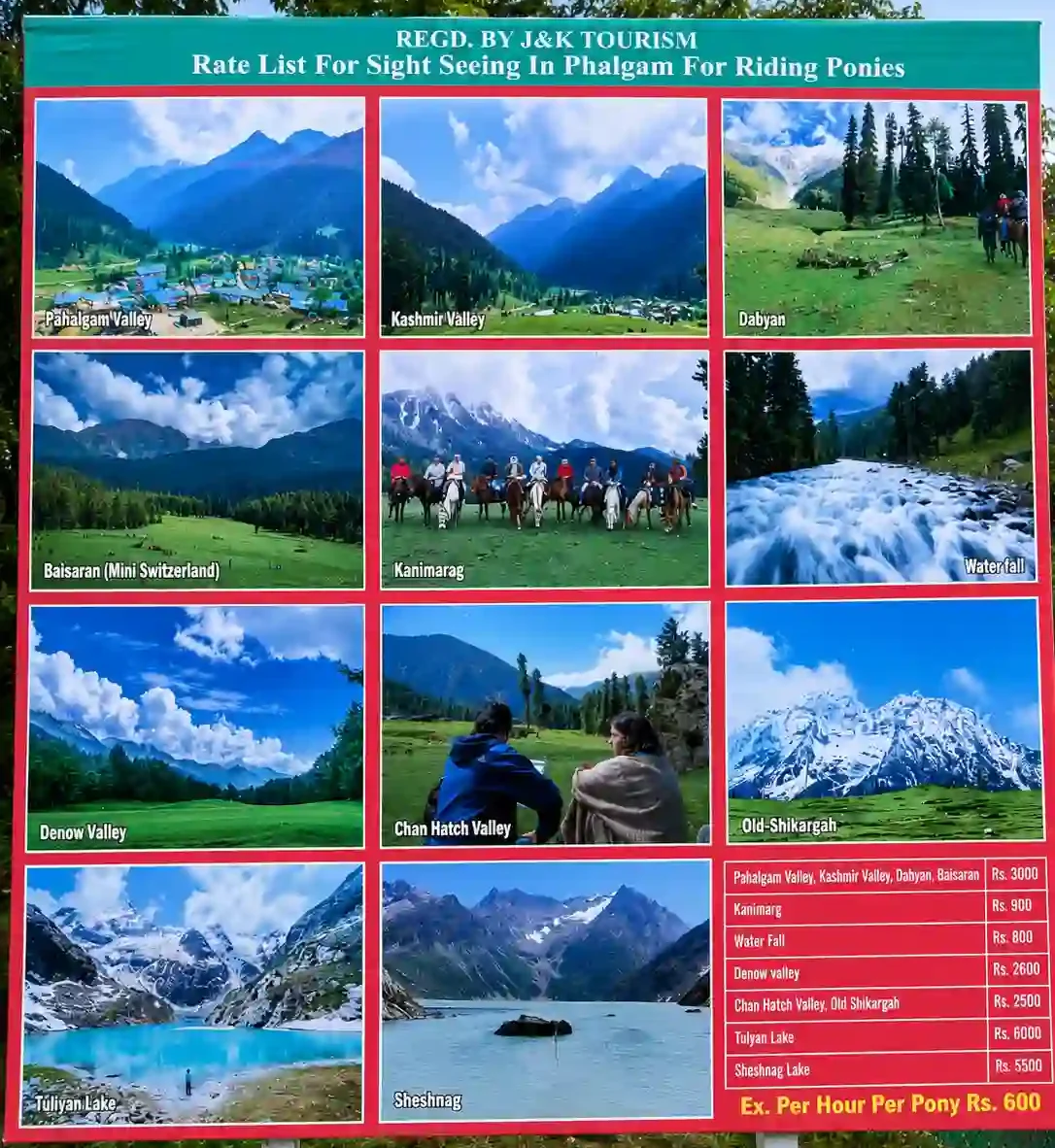
The figures below come directly from a rate board photographed at a Pahalgam pony stand, titled “Rate List For Sight Seeing In Pahalgam For Riding Ponies.” Status: verified from a supplied photograph of a local Pahalgam rate board. Treat this as a real, on-the-ground reference — but reconfirm the current price with the pony walla union before you ride, since these boards are updated from time to time and are not government-published online.
| Route | Price / person |
|---|---|
| Pahalgam Valley / Kashmir Valley / Dabyan | Rs. 3,000 |
| Tulian Lake | Rs. 6,000 |
| Sheshnag Lake | Rs. 5,500 |
| Denow Valley | Rs. 2,600 |
| Chan Hatch Valley / Old Shikargah | Rs. 2,500 |
| Kanimarg | Rs. 900 |
| Water Fall | Rs. 800 |
| Local hourly rate | Rs. 600 per pony, per hour |
Baisaran Valley Pony Ride — Mini Switzerland
Baisaran, nicknamed “Mini Switzerland” for its wide pine-fringed meadow and mountain backdrop, is the single most-visited pony destination out of Pahalgam. It’s a short, gentle climb suitable for first-time riders, children with an adult alongside, and anyone who wants a scenic ride without a long day in the saddle.
Pahalgam Valley, Kashmir Valley And Dabyan
This combined route links three viewpoints in one ride and is priced as a single fare on the local board (Rs. 3,000, as photographed). It’s a longer outing than the Baisaran-only ride and suits travellers who want a fuller sightseeing loop rather than a single stop.
Kanimarg
A shorter, lower-priced route on the local board, Kanimarg is a good option if you want the pony-riding experience without committing to a half-day trip.
Waterfall Route
The most affordable route on the Pahalgam board, this short ride to a nearby waterfall works well for families with young children or anyone short on time.
Denow Valley
A mid-range route by both price and distance, Denow Valley offers a quieter alternative to the busier Baisaran trail with fewer crowds along the way.
Chan Hatch Valley And Old Shikargah
This route (also listed as Old Shikargah) is a mid-priced ride into a less-photographed part of the Pahalgam valley system, appealing to travellers who’ve already done Baisaran on a previous trip.
Tulian Lake
The highest-priced route on the board and the most physically demanding — Tulian Lake is a high-altitude glacial lake and this is a serious, longer ride rather than a casual sightseeing trip. Fitness and comfort with several hours in the saddle matter here.
Sheshnag Lake
Also on the Amarnath Yatra route, Sheshnag is another high-altitude, full-day-style pony route, priced accordingly on the board. This is best suited to fit, experienced riders rather than first-timers.
Which Pahalgam Pony Route Is Best for Families?
Baisaran and the Waterfall route are the two most family-friendly options — shorter distances, gentler gradients, and lower fares make them easier with young children.
Which Pahalgam Pony Route Is Best for Couples?
Denow Valley or Chan Hatch Valley/Old Shikargah tend to be quieter and less crowded than Baisaran, which suits couples looking for a more private, unhurried ride.
Also see , kashmir taxi service
Gulmarg Pony Ride: 2026 – 2027 Routes And Local Rate Information
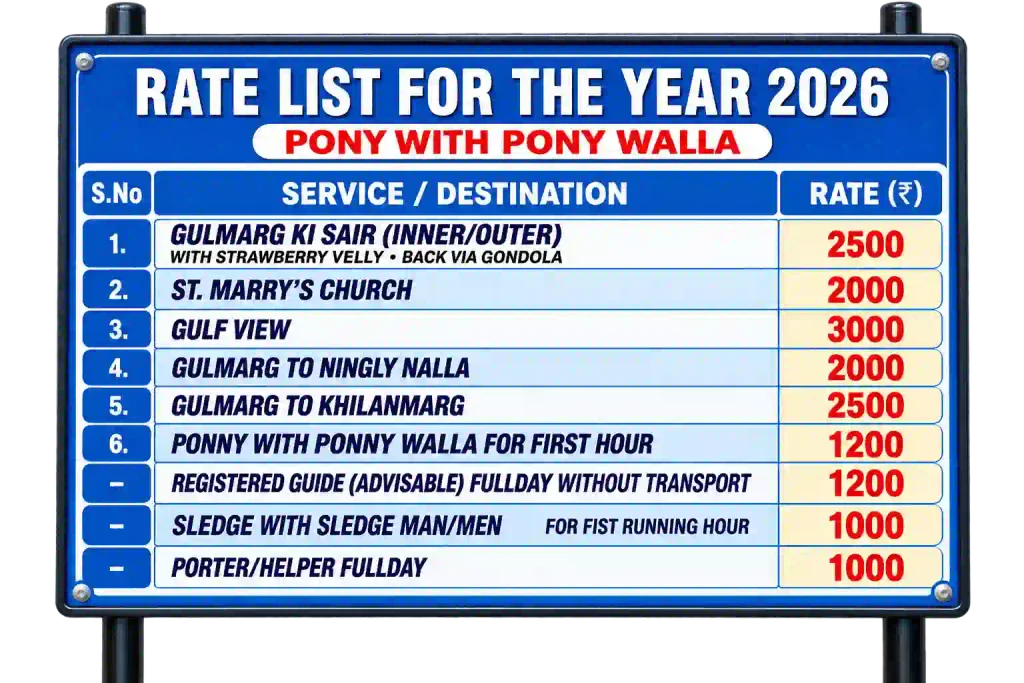
The details below come from a photograph of a Gulmarg pony-stand board explicitly titled “RATE LIST FOR THE YEAR 2026,” which also lists “Pony With Pony Walla” as a distinct line item. Status: verified from a supplied photograph of the 2026 Gulmarg rate board, though not every figure on the board was fully legible. Where a rate wasn’t clearly readable in the photograph, it isn’t stated below — reconfirm exact current pricing with the Gulmarg pony walla union or registered guide desk on arrival.
Gulmarg Sightseeing by Pony
Gulmarg’s meadows and viewpoints are spread across a wider, more open landscape than Pahalgam’s, and pony routes here typically combine two or three stops rather than a single destination.
Strawberry Valley
A quieter offbeat meadow away from the main Gondola crowds, Strawberry Valley is one of the listed routes on the 2026 board and suits travellers who want a calmer pony ride experience in Gulmarg.
St. Mary’s Church
This British-era church is a heritage stop that’s often combined with a short pony ride through Gulmarg’s pine-forest edges.
Gulf View
A scenic viewpoint route listed on the board, offering panoramic views over the Gulmarg valley.
Gulmarg to Ningle/Ningly Nalla
A mountain-stream route that takes riders through forested terrain to a scenic nallah, popular for its combination of greenery and running water.
Gulmarg to Khilanmarg
Khilanmarg is Gulmarg’s signature high-meadow pony destination, sitting above the Gondola’s first phase and offering wide views of the Apharwat range. It’s one of the more strenuous rides on the Gulmarg board given the altitude gain.
Pony With Pony Walla
Listed explicitly on the 2026 board as its own category, this confirms that Gulmarg pony fares — like Pahalgam and Sonamarg — include a guide/handler as standard rather than as an optional extra.
Pony Ride vs Gondola in Gulmarg
The Gondola and pony rides serve overlapping but different purposes in Gulmarg. The Gondola is a cable car that reaches higher altitudes (Kongdori and Apharwat) faster and works year-round, including in deep snow. Pony rides cover ground-level meadows like Khilanmarg and Strawberry Valley that the Gondola doesn’t service directly, and give a slower, closer view of the landscape. Many travellers combine both: Gondola for the high-altitude viewpoints, pony for the meadows.
You can also Book Gulmarg Gandola
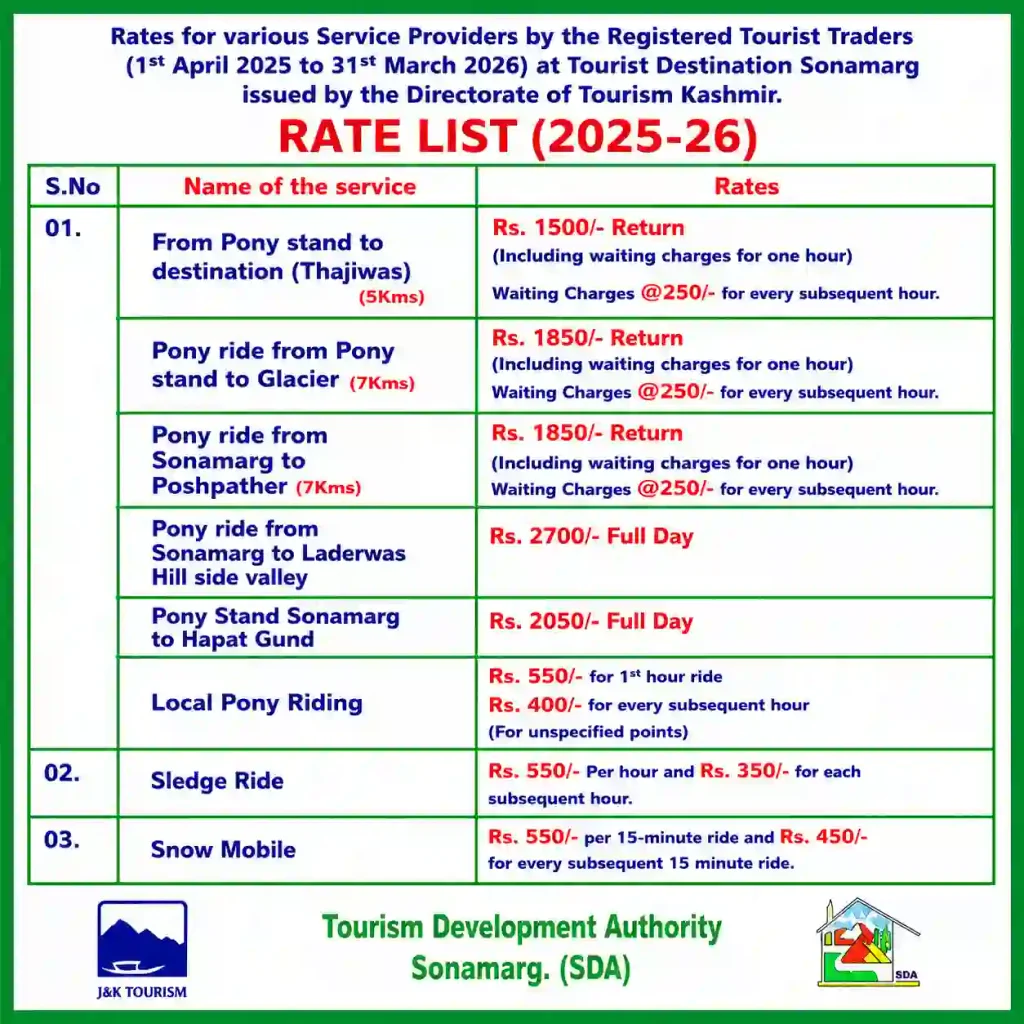
Sonamarg Pony Ride: Thajiwas Glacier And Other Routes
The figures below come from a photographed rate board headed “RATE LIST (2026-27),” valid from 1 April 2026 to 31 March 2027, issued in connection with the Tourism Development Authority Sonamarg / Directorate of Tourism Kashmir. Status: verified from a supplied photograph of the official 2026-27 Sonamarg board. Note the validity window carefully — this is a 2026-27 rate period, and a fresh board should be checked once the current validity period ends.
| Route | Price / person |
|---|---|
| Pony Stand to Thajiwas (5 km, return) | Rs. 1,500, includes 1 hour waiting; Rs. 250/hour after |
| Pony Stand to Glacier (7 km, return) | Rs. 1,850, includes 1 hour waiting; Rs. 250/hour after |
| Sonamarg to Poshpathar (7 km, return) | Rs. 1,850, includes 1 hour waiting; Rs. 250/hour after |
| Sonamarg to Laderwas hillside valley | Rs. 2,700, full day |
| Pony Stand Sonamarg to Hapat Gund | Rs. 2,050, full day |
| Local pony riding | Rs. 550 first hour, Rs. 400 each subsequent hour |
| Sledge ride | Rs. 550 first hour, Rs. 350 each subsequent hour |
| Snow mobile | Rs. 550 first 15 minutes, Rs. 450 each subsequent 15 minutes |
Sonamarg to Thajiwas
This is the standard, most-booked short route from the main pony stand, covering 5 km return with an included hour at the meadow.
Sonamarg to Thajiwas Glacier
The slightly longer 7 km version of the same route extends further toward the glacier itself, at a correspondingly higher fare.
Sonamarg to Poshpathar
Priced the same as the glacier route on the current board, Poshpathar is an alternative direction from the main stand for travellers who’ve already done Thajiwas on a previous visit.
Sonamarg to Laderwas
A full-day route into hillside valley terrain, priced separately from the shorter return trips and suited to travellers with a full day free rather than a quick stop.
Sonamarg to Hapat Gund
Another full-day route from the Sonamarg pony stand, offering a longer, more immersive outing than the standard Thajiwas trip.
Local Pony Riding
For travellers who just want a short, undirected ride near the main meadow without committing to a fixed route, the board lists a straightforward hourly local rate, separate from the destination-based fares.
Pony Ride vs Walking to Thajiwas
Thajiwas Glacier is roughly a 2–3 km walk from the main Sonamarg road depending on the exact starting point, and fit travellers can walk it, particularly in dry conditions. A pony ride is faster, easier on the legs at that altitude, and is the standard choice for children, older travellers, or anyone who’d rather save their energy for the glacier itself. In wet or muddy conditions the trail can be slippery, which is where a pony walla’s local knowledge of the safest footing matters most.
You can Also Book Shri amarnath yatra package .
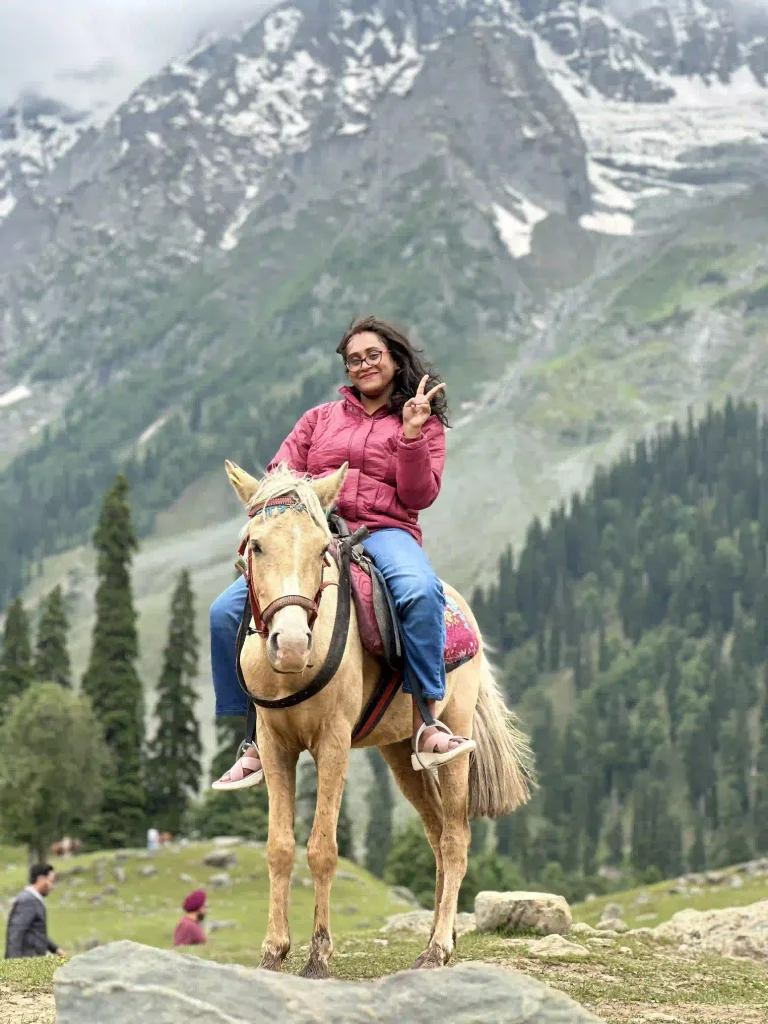
Pony Ride in Doodhpathri: Quiet Meadows and River Trails
Doodhpathri — the “Valley of Milk” — sits about 42 km from Srinagar and offers a noticeably quieter pony-riding experience than Pahalgam or Gulmarg. There is no single published rate board equivalent to the Pahalgam, Gulmarg or Sonamarg boards for this guide to draw on, so treat any Doodhpathri pony price you’re quoted locally as approximate and variable, and confirm it directly with the pony walla at the meadow before riding.
What to Expect From a Doodhpathri Pony Ride
Rides here typically move across open grassland rather than climbing steep mountain trails, which makes for a gentler, more relaxed pace than a Baisaran or Khilanmarg ride. The Doodh Ganga river runs through the meadow, giving much of the route a green, water-adjacent feel rather than the rockier high-altitude terrain around Thajiwas or Tulian Lake.
Meadows and River-Side Trails
The core Doodhpathri experience is riding through rolling meadowland alongside the Doodh Ganga, with pine forest visible on the surrounding slopes. It’s a photogenic, unhurried ride rather than an adventure-sport style trek.
Tangnar and Palmaidan
Tangnar and Palmaidan are two areas within the wider Doodhpathri meadow system that pony wallas commonly cover, each offering slightly different views of the surrounding hills and forest edge without significantly changing the difficulty of the ride.
Is Doodhpathri Good for Families?
Yes — the flatter terrain and shorter distances make Doodhpathri one of the more comfortable pony-riding destinations in Kashmir for young children or first-time riders who might find Baisaran’s climbs or Thajiwas’s altitude more demanding.
Best Time for Pony Riding in Doodhpathri
Late spring through summer (roughly May to September) is when the meadows are greenest and the river is at its most scenic; the same season that suits most of Kashmir’s high-meadow destinations works well here too.
Pony Ride in Yusmarg
Yusmarg is another of Kashmir’s quieter meadow destinations, less commercialised than Pahalgam or Gulmarg, and often visited by travellers looking for a slower-paced day out.
Meadows
Yusmarg’s open grasslands are its main draw for pony riding — wide, gently rolling terrain framed by pine forest and distant snow peaks.
Forest Trails
Beyond the open meadow, some routes take riders along the edge of dense pine forest, offering a shadier, cooler alternative on hot summer days.
Nilnag Area
Nilnag, an emerald-toned lake near Yusmarg, is a common reference point for pony routes in the area, though as with Doodhpathri, exact fares should be confirmed locally rather than assumed from any published list.
Why Yusmarg Feels Different From Pahalgam
Yusmarg sees a fraction of the visitor volume that Pahalgam does, which means shorter waits at the pony stand, less haggling pressure, and a noticeably calmer overall pace — the trade-off being fewer formal facilities and a less standardised pricing structure.
Which Is the Best Place for a Pony Ride in Kashmir?
There is no single “best” — the right destination depends on how much time you have, your fitness level, and whether you want a busy, well-organised experience or a quiet one.
| Destination | Best for | Typical ride length | Crowd level |
|---|---|---|---|
| Pahalgam (Baisaran) | First-time riders, families, short trips | 1–2 hours | High |
| Pahalgam (Tulian/Sheshnag) | Fit, experienced riders wanting a long ride | Half day+ | Moderate |
| Gulmarg (Khilanmarg) | Combining with the Gondola, mountain views | 2–3 hours | High |
| Sonamarg (Thajiwas) | Glacier sightseeing, snow-season visits | 2–3 hours | High |
| Doodhpathri | Families, quieter meadows, gentle terrain | 1–2 hours | Low |
| Yusmarg | Travellers wanting minimal crowds | 1–2 hours | Low |
How to Book a Pony Ride in Kashmir
Booking at the Pony Stand
At Pahalgam, Gulmarg and Sonamarg, organised pony stands operate at the base of each main route, with the current rate board displayed. You can walk up, choose a route from the board, and start riding the same day in most cases — though during peak season (May–August), waits at the busiest stands can run long.
Booking Through a Local Tour Operator
Arranging the pony ride as part of a wider Kashmir itinerary through a local operator can save time at the pony stand, particularly on a tight schedule, since routes and timing are pre-planned around the rest of the day’s sightseeing.
What to Confirm Before Paying
Before handing over payment, confirm: the exact route and stops included, whether the fare is per person or per pony, the included waiting time, and what the per-hour charge is for any additional waiting.
How to Avoid Confusion About Route and Fare
Point at the specific line on the rate board rather than relying only on a spoken number, and if a route isn’t listed on the board at all, treat the quoted price as negotiable rather than fixed.
Is Pony Ride in Kashmir Safe?
Pony riding in Kashmir is a well-established, guided activity — the pony walla walks alongside the pony for the entire route rather than leaving riders unsupervised — and it is generally safe when basic precautions are followed.
First-Time Riders
Sit centrally, hold the front of the saddle rather than the reins (the pony walla controls the pony), and keep your feet relaxed in the stirrups rather than gripping tightly with your knees.
Children
Children can ride, usually accompanied closely by an adult on foot or seated with an adult on longer routes; confirm the minimum age and any weight limit with the pony walla before starting, as these vary by stand.
Senior Citizens
Shorter, flatter routes such as the Waterfall route in Pahalgam or a local Doodhpathri ride are more comfortable choices than long, steep climbs like Tulian Lake or Khilanmarg. Anyone with back, hip or heart conditions should ask about the terrain and duration before committing to a longer route.
Rain and Slippery Trails
Wet weather makes stone and mud trails slippery for ponies as well as walkers. Pony wallas generally know which sections need extra care, but it’s reasonable to ask whether conditions are suitable before setting off if it has recently rained or snowed.
What to Check Before Mounting
Look at the pony’s general condition and the fit of the saddle, and don’t hesitate to ask for a different pony if something seems off — this is normal practice at busy stands and pony wallas are used to the request.
Can i Prebook Pony Ride in kashmir ?
For instant Booking contact call / whatsapp 7006982655 .
What to Wear and Carry for a Pony Ride
Wear closed shoes with a low heel or flat sole — sandals make it harder to keep your feet secure in the stirrups. Loose, comfortable trousers work better than tight jeans for a multi-hour ride. Carry a light jacket even in summer, since temperatures drop quickly at altitude; sunscreen and a hat for exposed meadow routes; water, since stands at the destination are informal at best; and cash in small denominations for the fare and any waiting charges, as card payment is not reliably available at pony stands.
Best Time for Pony Riding in Kashmir
Pahalgam and Gulmarg pony routes are generally accessible from April through October, with the greenest meadows in June and July. Sonamarg’s Thajiwas route is also snow-accessible earlier in the season, which is part of its appeal — pony rides here can include genuine snow underfoot even in early summer, while later-season visits (September–October) trade snow for clearer skies and thinner crowds. Doodhpathri and Yusmarg follow a similar window to Pahalgam and Gulmarg, roughly May to September for the fullest meadow greenery.
Pony Ride vs Walking vs Trekking vs Gondola
| Option | Best for | Physical effort | Typical cost |
|---|---|---|---|
| Pony ride | Reaching meadows/glaciers without a long climb | Low | Rs. 600–6,000+ depending on route |
| Walking | Fit travellers, budget trips, short distances | Moderate–high | Free |
| Trekking | Multi-day high-altitude routes (Tarsar, Kolahoi, etc.) | High | Varies widely |
| Gondola (Gulmarg only) | Fast, high-altitude access year-round | Very low | Separate cable-car ticket |
Pony riding sits between walking and full trekking — it covers the same ground as a moderate day hike but without the physical demand, which is why it remains the default choice for families, older travellers, and anyone visiting Kashmir on a tight schedule.
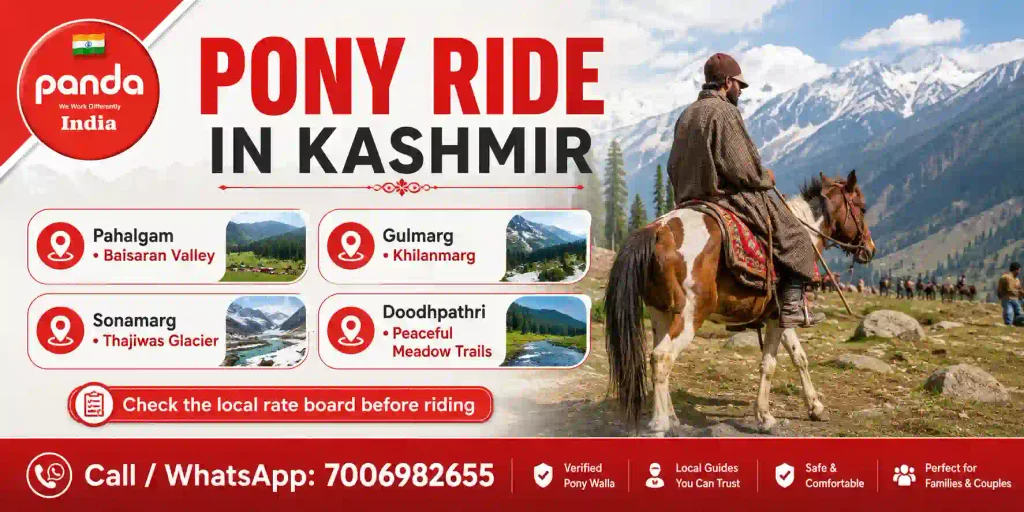
Responsible Pony Riding and Animal Welfare
Choosing a pony that looks well-fed, alert and free of visible sores or wounds is a reasonable and fair thing to ask for as a rider. Avoid overloading a single pony beyond one adult rider on standard routes, take the pony walla’s guidance on pacing rather than pushing for speed on steep sections, and consider that ponies working repeatedly on the same steep trails benefit from riders being mindful of rest breaks on longer full-day routes like Tulian Lake, Sheshnag Lake or Laderwas.
Local Tips Travellers Usually Learn Only After Reaching Kashmir
The number printed on a rate board is the reference price — pony wallas at less formal stands (especially in Doodhpathri and Yusmarg) may quote above it, and it’s normal to point to the board or ask directly if one is displayed. Waiting time is easy to lose track of once you’re at a viewpoint taking photos — agree a return time with the pony walla before you’re distracted by the view.
On the busiest Pahalgam and Gulmarg routes in peak season (June–August), arriving at the pony stand early in the morning means shorter queues and cooler riding conditions than a midday start. Finally, a route that looks short on a map, like Kanimarg or the Waterfall route, can still take over an hour once you account for the pony’s pace on uneven ground — don’t schedule a pony ride back-to-back with a tight onward commitment.

Our association with Panda Tours and Travels is quite memorable and amazing. It is quite apt for senior citizens to visit their dream destination by seeking assistance from Panda Tours and travels. They are patient, flexible and quite understanding towards your needs. Ahmed Sir is a gem of a person and the driver cum guide Irshad bhai served as a great company and gaurdian to travel with. As per our experience I will definitely recommend everyone to visit this beautiful destination with Irshad bhai. This would make your journey more meaningful and comfortable. Sharing some of the mesmerizing pics of kashmir - truly a heaven on earth.

Alpana Priya
3 weeks ago
⭐⭐⭐⭐⭐ FROM BANGLADESH 🇧🇩 MA ALIM Excellent experience with Panda Tours & Travels! The service was great, the team was friendly and helpful, and everything was very well organized. Our driver Mr Altaf was friendly, great nature and highly knowledgeable They made our Kashmir trip smooth, comfortable, and truly memorable. Highly recommended! ❤️🙏

Abdul Alim
3 weeks ago

Saiyadur Raiyan
3 weeks ago
⭐⭐⭐⭐⭐ A heartfelt thank you to Panda Tours & Travels and the entire team for their excellent service and support throughout our Kashmir trip. Everything was well organized, and the team was always helpful and responsive. We truly appreciate your efforts in making our trip smooth, comfortable, and memorable. Highly recommended! ❤️🙏

Asaduzzaman Nur
3 weeks ago
Top Local travels and tours agency in Srinagar Kashmir, Fully Fully Satisfied with the services and areangments.Start to finish all topnotch and hassle free, We are Senior citizens 70+ Aged and we hadn't find any any problem, Strongly strongly Recommended this local Kashmir based teavels agency for all and all visitors to Kashmir.Big thanks to Owner Mr Ahmad, Every evening was calling us and caring about like is all good same same. Thank you

Nandini Chakraborty
4 weeks ago
Huge thanks to [Mr Ahmad] at [Panda tour and travel] for planning our honeymoon to [kashmir sonmarg gulmarg pehalgam ]! They listened to exactly what we wanted—a mix of relaxation and adventure—and crafted the ultimate itinerary. The resort was breathtaking, and the private dinner surprise they arranged was the icing on the cake. We’ll definitely be booking our future trips with them!"Thank you panda family and Huge thanks to our driver Mr Ishfaq for making our trip so comfortable and safe! The vehicle was spotlessly clean, well-maintained, and spacious. He was consistently punctual, drove extremely safely across all routes, and knew all the best shortcuts and local food spots. Polite, friendly, and professional throughout—couldn't have asked for a better driver!"

Anayat Ali Jara
4 weeks ago
We book our srinagar complete tour with Panda tour & travel. All tour was excellent with hotels. Houseboat. Food and specialy car driver Ishfaq treat us as family members. He guide us at every point. We are very thankful to Panda tour &travel for such a amazing tour.Thanks.Davinder Mehta from ludhiana. Punjab

Davinder Mehta
4 weeks ago
I book panda tour travel packages 5 N 6 All hotels good and meal also and taxi Driver Mr Ishfaq Ahmad. Very good

Jiwan Lal
4 weeks ago
This teavel agency is Best among eqauals Srinagar Kashmir travel agency, Realy provided us top tour services and all was perfectly manager start to end of our Kashmir family tour package in sep 2026. We approached many other local teavel agencies but we found panda tours was top in assistance, Guidance, behavior of talking, and send us word to itinerary,So finally we booked Kashmir trip of 5N 6D with this local travels.Big THANKS to Mr ahmad Owner of Compand Driver Sam bhai and team also, every evening were calling us about trip and wellness.Strongly recommended this local travel agency for kashmir tour planners and who like to have stress free Kashmir tour.

Fazil Ahmad
1 month ago
Our Srinagar - Kashmir Tour experience was extensively glorious with Panda Tours And Travels... We got a warm welcome at Srinagar Airport and a great hospitality and services. Their services are really good for eg. car service, hotels etc. They are really helpful.... On our first night my husband was very sick and they immediately helped us with doctors, medicine and other needs... Ahmed sir came to our room as soon as he heard the news... He took up a great trouble for us... We also experienced a snow fall in our second day in Gulmarg... It was really a magnificent experience with them..... Lots of thanks to Panda Tours and Travels and their full team for their full support and services....

Manjushri Karan Sau
1 month ago
Frequently Asked Questions About Pony Ride in Kashmir
What is a pony ride in Kashmir?
A pony ride in Kashmir is a popular way to explore mountain meadows, valleys, viewpoints and trails that are difficult to reach by regular vehicles. Pahalgam, Gulmarg, Sonamarg, Doodhpathri and Yusmarg are among the places where travellers can experience pony riding.
How much does a pony ride cost in Kashmir?
There is no single fixed price for every place in Kashmir because the fare depends on the destination, route, duration and local rate board. The rate boards supplied for this guide show different rates for Pahalgam, Gulmarg and Sonamarg, so travellers should check the rate for their exact route before starting the ride.
What is the pony ride price in Pahalgam?
The Pahalgam rate board supplied for this guide shows route-wise rates including ₹3,000 for Pahalgam Valley/Kashmir Valley/Dabyan, ₹900 for Kanimarg, ₹800 for Waterfall, ₹2,600 for Denow Valley, ₹2,500 for Chan Hatch Valley/Old Shikargah, ₹6,000 for Tulian Lake and ₹5,500 for Sheshnag Lake. The same board also shows a rate of ₹600 per hour per pony. Because fares can be revised, confirm the current rate and route at the pony stand before riding.
How much does a pony ride to Baisaran Valley cost?
The Baisaran fare should be confirmed at the Pahalgam pony stand for the date of your visit because route access and local tariffs can change. Do not assume that a price quoted for one Pahalgam route automatically applies to Baisaran.
Is Baisaran Valley the same as Mini Switzerland?
Yes. Baisaran Valley is widely known by the nickname “Mini Switzerland of Kashmir” because of its open green meadow, surrounding pine forests and mountain scenery.
How long does a pony ride to Baisaran take?
The actual time depends on the route, stops and waiting time. A pony ride is not simply a point-to-point transfer because travellers may stop at viewpoints and other attractions along the trail.
Can I visit Baisaran without taking a pony?
Yes, depending on the current access conditions, Baisaran can also be approached on foot. However, the trail is hilly and can take considerably more effort than travelling by pony. Always check the latest local access status before planning the visit.
What is the pony ride rate in Gulmarg in 2026?
The 2026 Gulmarg rate board lists ₹2,500 for Gulmarg Ki Sair (Inner/Outer) with Strawberry Valley and back via Gondola, ₹2,000 for St. Mary’s Church, ₹3,000 for Gulf View, ₹2,000 for Gulmarg to Ningly Nalla, and ₹2,500 for Gulmarg to Khilanmarg. A pony with pony walla is listed at ₹1,200 for the first hour. These are the rates displayed on the 2026 Gulmarg rate board and should be reconfirmed locally before the ride.
Can I take a pony ride to Khilanmarg from Gulmarg?
Yes, Khilanmarg is one of the well-known pony routes associated with Gulmarg. The 2026 rate board you supplied specifically lists the Gulmarg-to-Khilanmarg route.
What places can I visit by pony in Gulmarg?
Depending on the route and local availability, pony rides can cover places and viewpoints such as Strawberry Valley, St. Mary’s Church, Gulf View, Ningly/Ningle Nalla and Khilanmarg. Before starting, ask exactly which places are included in the quoted fare.
What is the pony ride price in Sonamarg?
The supplied Sonamarg Tourism Development Authority rate board for 1 April 2026 to 31 March 2027 lists ₹1,500 return from the pony stand to Thajiwas, ₹1,850 return to the glacier and ₹1,850 return from Sonamarg to Poshpathar. It also lists full-day routes to Laderwas at ₹2,700 and Hapat Gund at ₹2,050.
How much does a pony ride to Thajiwas Glacier cost?
According to the Sonamarg rate board supplied for this guide, the pony ride from the pony stand to Thajiwas is ₹1,500 return for the 5-km route, including one hour of waiting. An additional waiting charge of ₹250 applies for each subsequent hour according to that board.
How much does a pony ride from Sonamarg to the glacier cost?
The supplied Sonamarg rate board lists ₹1,850 return for the 7-km pony ride from the pony stand to the glacier, including one hour of waiting. Subsequent waiting is listed at ₹250 per hour.
Is waiting included in the Sonamarg pony fare?
For the routes shown on the supplied Sonamarg board, one hour of waiting is included in the listed return fare. The board states an additional ₹250 waiting charge for every subsequent hour.
How much is local pony riding in Sonamarg?
The supplied Sonamarg rate board lists ₹550 for the first hour of local pony riding and ₹400 for every subsequent hour. The final amount can depend on the exact service being provided, so confirm the local rate before starting.
Can I take a pony from Sonamarg to Poshpathar?
Yes. The supplied Sonamarg rate board lists a 7-km return pony ride from Sonamarg to Poshpathar at ₹1,850, including one hour of waiting.
Is pony riding available in Doodhpathri?
Yes, pony riding can be available in Doodhpathri as a local sightseeing and meadow-trail activity. Doodhpathri is particularly appealing for travellers who want a quieter experience surrounded by green meadows, streams and mountain scenery. Pony availability and route options should be confirmed locally on the day of travel.
What can I see during a pony ride in Doodhpathri?
A pony ride in Doodhpathri can take you through open meadows and scenic trails around the valley, with areas such as Tangnar and Palmaidan offering opportunities to enjoy the landscape away from the busier tourist centres. The exact route depends on local arrangements and trail conditions.
Is pony riding available in Yusmarg?
Yes, pony riding can be arranged around Yusmarg’s meadows and forested trails. It is a good option for travellers who prefer a quieter landscape and want to explore parts of the area without walking the entire route.
Which place is best for a pony ride in Kashmir?
For many first-time visitors, Pahalgam is the most recognisable choice because of its mountain trails and famous meadow routes. Sonamarg is particularly attractive for Thajiwas, Gulmarg offers meadow and mountain routes, while Doodhpathri and Yusmarg are better suited to travellers looking for a more peaceful experience.
Is pony riding in Kashmir safe?
Pony riding can be a safe and enjoyable activity when travellers use suitable trails, follow the handler’s instructions and take normal precautions. Mountain trails can include steep, uneven or slippery sections, so safety depends on the weather, trail conditions, animal condition and rider behaviour.
Do I need previous horse-riding experience for a pony ride in Kashmir?
No, previous horse-riding experience is generally not required for normal sightseeing pony rides. A pony walla or handler usually accompanies the ride and guides the animal along the established trail.
Can children take a pony ride in Kashmir?
Children can take pony rides in many tourist areas, but parents should choose a suitable route and make sure the child is comfortable before starting. For younger children, always discuss the arrangement with the local handler and follow the safety instructions.
Can senior citizens take a pony ride in Kashmir?
Senior citizens can use pony rides as an alternative to walking on some mountain trails, but the decision should depend on their mobility, balance and comfort with uneven terrain. Routes with steep or difficult sections should be discussed with the local handler before booking.
Is a pony walla included in the pony ride?
A pony walla is the local handler who manages the pony and helps guide it along the trail. Whether the handler is included in the quoted price depends on the destination and rate structure, so confirm this before starting the ride.
What should I ask before booking a pony ride in Kashmir?
Before paying, ask the exact route, total fare, whether the rate is return or one-way, whether a pony walla is included, how much waiting time is included and what happens if you spend extra time at the destination. This avoids confusion once the ride has started.
Are pony ride prices in Kashmir fixed?
Rates can be governed by local associations, destination authorities or displayed rate boards, but the exact pricing system differs between destinations. The best practice is to check the current rate board and confirm the complete fare for your chosen route before mounting the pony.
Can I book a pony ride in Kashmir in advance?
Yes, you can arrange pony-ride assistance through a local tour operator, while many travellers also book directly at the pony stand after reaching the destination. Advance coordination can be useful during busy travel periods, especially when you already know the route you want.
Is it better to book a pony ride online or at the pony stand?
Both options can work. Booking at the local pony stand lets you see the rate board and discuss the exact route directly, while booking through a local tour operator can be more convenient when you want help coordinating the activity with your Kashmir itinerary.
What is the best time for a pony ride in Kashmir?
The best time depends on the destination and the type of scenery you want to experience. Spring and summer are popular for green meadows, while autumn offers a different landscape and winter conditions can make some trails more difficult or seasonally unavailable.
What should I wear for a pony ride in Kashmir?
Wear comfortable clothes, closed shoes with good grip and layers that can handle changing mountain weather. Carry a light rain layer and sun protection, especially when travelling to exposed meadow and mountain areas.
Is pony riding better than walking in Kashmir?
It depends on your fitness level, time and the route. Walking gives you more freedom to stop and explore at your own pace, while a pony ride can reduce the physical effort required on steep mountain trails.
Is pony riding better than taking the Gondola in Gulmarg?
They are different experiences. The Gondola gives you an aerial mountain journey and access to higher elevations, while a pony ride gives you a slower trail-based experience through meadows and local sightseeing routes. Your choice should depend on what you want to see and how you prefer to travel.
Should I take a pony ride or trek to explore Kashmir?
A pony ride is useful when you want to cover a hilly trail with less physical effort, whereas trekking is better for travellers who enjoy walking and want more control over their pace. For families, older travellers or visitors with limited walking ability, a pony may be the more practical option on suitable routes.
Are pony rides available throughout Kashmir?
Pony rides are not available in exactly the same way at every destination. They are more commonly associated with tourist and mountain areas such as Pahalgam, Gulmarg, Sonamarg, Doodhpathri and Yusmarg, with routes and availability varying by location and season.
How can I avoid being overcharged for a pony ride in Kashmir?
The simplest way is to ask for the exact route and total fare before starting and, where available, check the rate board at the pony stand. Do not agree to a vague price such as “sightseeing” without asking which places are included and whether waiting or handler charges are separate.
Does the pony ride price include waiting charges?
It depends on the destination and route. For example, the supplied Sonamarg rate board clearly states that one hour of waiting is included for several return routes and that subsequent waiting is charged separately. Always check the specific rate board for your destination.
Can I stop for photographs during a pony ride?
Yes, but ask the pony walla where it is safe to stop. Mountain trails can be narrow, steep or busy, so photography should never interfere with the animal, handler or other visitors using the trail.
What happens if it rains during a pony ride?
Mountain weather can change quickly, and wet trails may become slippery. Follow the handler’s instructions, avoid rushing and ask whether continuing the route is safe under the prevailing conditions.
What is the most important thing to confirm before taking a pony ride in Kashmir?
Confirm the exact route, total fare, waiting time, what is included and where the ride ends before you mount the pony. This one step can prevent most misunderstandings about pony-ride charges.
Contact number of Pony ride in kashmir
Call / Whatsapp 7006982655 for instant Booking .