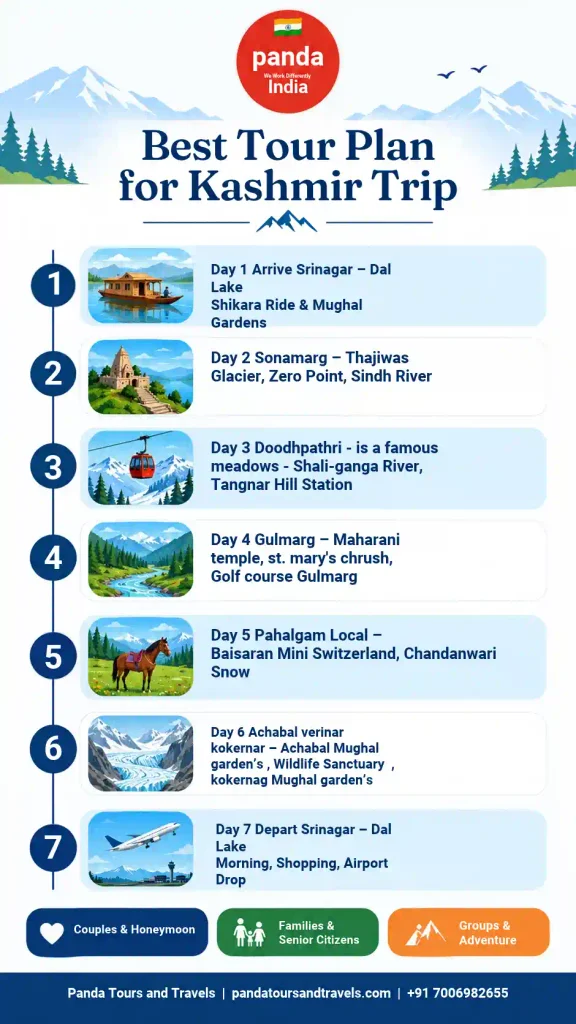
Best tour plan for Kashmir trip is a 6 Nights 7 Days itinerary covering Srinagar, Gulmarg, Pahalgam, Doodhpathri , Sonamarg, Achabla, Verinag and Kokernag — giving you enough time to explore each destination without feeling rushed. If you have less time, a 4 Nights 5 Days or 5 Nights 6 Days plan also works well depending on which season you visit and whether you’re travelling as a couple, family, or group.
Planning a Kashmir trip is exciting — but it can also feel overwhelming. Which places should you include? How many days is enough? Is Sonamarg worth visiting in summer? Should you book a houseboat or a hotel? If these questions are swirling in your head, you are in the right place.
We are Panda Tours and Travels, a Srinagar-based tour operator with years of on-ground experience planning Kashmir trips for families, honeymooners, senior citizens, groups, adventure travellers, and foreign tourists. In this guide, we’ll share exactly what a well-planned Kashmir itinerary looks like — including common planning mistakes most articles never mention.
Government Registration Number: JKEA00006046
GSTIN (GST Number): 01BDCPA2043R1ZY
Why 6 Nights 7 Days Is the Best Kashmir Tour Plan
Most travellers ask us: “Can’t we do Kashmir in 4 days?“ Technically, yes. But rushing through Kashmir is one of the biggest regrets travellers share with us after returning home.
Here’s why 6N/7D works best:
- Kashmir’s top destinations — Srinagar, Gulmarg, Pahalgam, Sonamarg — are spread across the valley. Each one requires at least a full day (often more) to experience properly.
- Weather delays are real. A single landslide on the Srinagar–Pahalgam road or heavy snowfall near Sonamarg can add half a day to your travel. A tight 4-day itinerary gets disrupted; a 7-day plan absorbs it.
- Rushing kills the experience. A shikara ride on Dal Lake at sunset, a leisurely morning at Betaab Valley, or a slow Wazwan dinner — these moments disappear when you’re watching the clock.
- Senior citizens and families with children need buffer time. Not everyone can run from Pahalgam to Gulmarg on the same day.
That said, if your leave or budget is limited, a 4N/5D or 5N/6D plan still gives you a meaningful Kashmir experience — we’ll cover those options too.
Complete 6 Nights 7 Days Kashmir Itinerary (Day by Day)
This is our most-booked Kashmir tour plan at Panda Tours and Travels. It covers all four major destinations without feeling hurried.
4 Nights 5 Days Kashmir Itinerary (Short Trip)
Not everyone has 7 days. A 4N/5D plan is ideal for those who want to see Kashmir’s highlights without taking extended leave from work.
| Day | Plan |
|---|---|
| Day 1 | Pick up – Srinagar Airport / Srinagar Railway To Srinagar Full Sightseen ( Srinagar hotel stay ) |
| Day 2 | Srinagar To Sonamarg – Full Sightseen ( Srinagar Houseboat Stay ) |
| Day 3 | Srinagar To Gulmarg – Full Sightseen ( Gulmarg Hotel Stay ) |
| Day 4 | Gulmarg To Pahalgam – Full Sightseen ( Pahalgam Hotel Stay ) |
| Day 5 | Pahalgam To Srinagar Airport / Railway – Drop |
5 Nights 6 Days Kashmir Itinerary
The 5N/6D plan is the sweet spot for most travellers who can’t do a full 7-day trip but still want to include Sonamarg.
| Day | Plan |
|---|---|
| Day 1 | Pick up – Srinagar Airport / Srinagar Railway To Srinagar Full Sightseen ( Srinagar hotel stay ) |
| Day 2 | Srinagar To Sonamarg – Full Sightseen ( Srinagar Houseboat Stay ) |
| Day 3 | Srinagar To Gulmarg – Full Sightseen ( Gulmarg Hotel Stay ) |
| Day 4 | Gulmarg To Doodhpathri – Full Sightseen To Pahalgam |
| Day 5 | Pahalgam – Full Sightseen To Srinagar |
| Day 6 | Srinagar Housboat To Srinagar Airport / Railway – Drop |
This plan covers all four major destinations. The trade-off is that Gulmarg is a day trip (not an overnight), which means you miss the magical early morning and sunset views from Gulmarg’s meadows. For honeymooners or those who want to soak in Gulmarg’s atmosphere, the full 6N/7D plan is worth the extra day.
Best Time to Visit Kashmir
This is where most Kashmir travel articles are either vague or misleading. Here’s what actually happens season by season:
| Season | Months | What to Expect | Best For |
|---|---|---|---|
| Spring | March – May | Tulips bloom (Asia’s largest tulip garden in Srinagar is open in April). Mustard fields yellow in March. Roads clear. Pleasant weather (8°C–22°C). Srinagar Tulip Festival in April. | Families, couples, photographers, first-time visitors |
| Early Summer | June – July | Lush green valleys. Snow still at Gulmarg Phase 2 and Zero Point in June. Sonamarg Zero Point accessible. Slight crowds peak in June. Temperatures 15°C–28°C in valley. | All traveller types. Best month overall: June |
| Monsoon / Late Summer | August | Kashmir gets rain but much lighter than peninsular India. Roads can get disrupted. Fewer tourists. Better deals on hotels. Greenery at its peak. | Budget travellers, those flexible with plans |
| Autumn | September – November | Chinar trees turn gold and red (October is spectacular). Apple orchards in full harvest. Saffron blooms in Pampore (October–November). Crisp, clear weather. One of the best times to visit. | Photographers, couples, senior citizens, repeat visitors |
| Winter | December – February | Heavy snow. Gulmarg becomes a ski resort. Pahalgam and Sonamarg roads may close. Dal Lake partially freezes. Extremely cold (-10°C to -20°C at nights). Many hotels shut. Not for everyone. | Skiing enthusiasts, adventure travellers, those who have visited before |
Critical Note for Winter Travellers: The Zojila Pass (Srinagar to Sonamarg and Ladakh) closes from November to April due to heavy snowfall. The Mughal Road (connecting Shopian to Banihal) also closes in winter. Always check road status before confirming itineraries in November–March. We update our travellers in real time about road conditions — contact us before your trip.
The Best Kashmir Tour Plan by Traveller Type
There is no single “best” Kashmir itinerary because different travellers want different things. Here’s what we recommend for each group:
Best Kashmir Tour Plan for Couples / Honeymooners
Honeymooners are our most common booking. What works for couples:
- Stay in a houseboat on Dal Lake for at least one night — the privacy, the lake view, and the wooden craftsmanship create an unforgettable atmosphere.
- Gulmarg for the Gondola and meadow walks — the landscape feels romantic at sunrise before the crowds arrive.
- Pahalgam’s Aru Valley is quieter and more intimate than Betaab Valley. A walk along the river here feels like something out of a film.
- Book a private vehicle — shared cabs disrupt romantic moments and create timeline pressure.
- Best months: April–May (tulips and flowers) or October (chinar colours and clear skies).
Best Kashmir Tour Plan for Families with Children
- Children love snow activities in Gulmarg (best between January and May).
- Baisaran (Mini Switzerland) via pony ride is a hit with kids of all ages.
- Shikara rides on Dal Lake keep children engaged and excited.
- Avoid very long driving days — children get restless. Break Pahalgam–Sonamarg drives with stops.
- Stay in proper hotels (not homestays) for reliable hot water, heating, and food options.
Recommended plan: 5 Nights 6 Days or 6 Nights 7 Days. Include Gulmarg overnight if visiting in winter/spring for snow.
How many days do families need for a Kashmir trip? For a relaxed family holiday with children under 12 or grandparents in the group, we recommend a minimum of 6 nights and 7 days.
Best Kashmir Tour Plan for Senior Citizens
Senior travellers tell us that Kashmir was “even better than we imagined” — but they also need a more thoughtful plan.
- Avoid Zero Point if there are heart or altitude-related health conditions. Sonamarg town itself (at 2,730m) is manageable for most healthy seniors.
- Shankaracharya Temple has 243 steps — skip the climb if it’s difficult. The view is also excellent from the base.
- Book hotels closer to sightseeing spots to minimize walking distances.
- Prefer heated hotels over houseboats in October–November (houseboats can get cold at night).
- Travel by private vehicle with a reliable, patient driver — not by shared taxis or public transport.
Recommended plan: 6 Nights 7 Days with a relaxed pace, no Zero Point, and well-researched hotel selections. We handle all of this for our senior travellers — enquire here.
Best Kashmir Tour Plan for Adventure Travellers
- Kashmir Great Lakes Trek (7–8 days): One of India’s most scenic high-altitude treks, passing through alpine lakes like Vishansar, Krishansar, Gadsar, and Satsar. Note: As of 2025–2026, trekking clearances in some areas are subject to administrative review — confirm availability before booking.
- River rafting in Lidder River, Pahalgam — Grade I to III rapids, suitable for beginners.
- Skiing in Gulmarg (December to March) — Equipment rental available on-site.
- Mountain biking in Yusmarg or Doodhpathri — offbeat destinations perfect for cyclists.
Recommended plan: 7 to 10 days, customised around the specific adventure activity.
Best Kashmir Tour Plan for Groups
- Groups of 10+ benefit from tempo travellers or mini-coaches rather than individual cabs — more economical and keeps the group together.
- Book hotels with large dining halls that can accommodate group meals.
- Group bookings often get better room rates and flexibility on check-in/check-out times — we negotiate these on your behalf.
- Plan for one “free evening” per destination so group members can explore independently.
Best Kashmir Tour Plan for Offbeat Travellers
If you’ve already done Srinagar, Gulmarg, and Pahalgam, Kashmir has so much more:
- Doodhpathri (“Valley of Milk”): 42 km from Srinagar — a wide, pristine meadow with clear streams. Barely any tourist infrastructure, which is exactly the point.
- Yusmarg: 47 km from Srinagar — less visited than Gulmarg, equally beautiful.
- Lolab Valley: In Kupwara district — forests, streams, and near-zero tourist footfall.
- Bangus Valley: One of Kashmir’s most remote and beautiful meadows. Accessible only in summer.
- Tulail Valley (Gurez): Near the Line of Control — dramatic landscapes, traditional Dard-Shin villages, and permit-required access. Utterly different from mainstream Kashmir.
Note for Offbeat Travellers: Some of these areas require coordination with local authorities and are best done with an experienced local operator. We have first-hand knowledge of these routes. Talk to us before planning an offbeat itinerary.
Best Kashmir Tour Plan for Foreign Tourists
- Foreign tourists do not need special permits for standard Kashmir tourist circuits (Srinagar, Gulmarg, Pahalgam, Sonamarg). Carry your passport at all times — ID checks are routine.
- Srinagar has good connectivity from Dubai, Muscat, and Delhi. Direct international flights have been increasing.
- English is widely spoken in the tourism industry. Most hotel staff, guides, and drivers in tourist areas are comfortable with English.
- Currency exchange and ATMs are available in Srinagar. Internet is available but can be slow in remote areas.
- Recommended add-on: A day in Srinagar’s old city to explore Sufi shrines, traditional wood-carving workshops, and Kashmiri cuisine — experiences that go beyond the standard sightseeing list.
Kashmir Tour Plan from Delhi, Kolkata, Mumbai And Other Cities
Kashmir Trip from Delhi
Delhi to Srinagar is the most common route for Kashmir visitors.
- By Air: Multiple flights daily from Delhi (IGI) to Srinagar (SXR). Flight time is about 1 hour 20 minutes. Airlines: IndiGo, Air India, SpiceJet. Book 6–8 weeks in advance for best fares — prices spike in May–June and December.
- By Road (for road trip enthusiasts): Delhi → Jammu → Srinagar via the Jammu–Srinagar National Highway (NH44). Total distance: approximately 880 km. Drive time: 12–14 hours. The Banihal Tunnel (Jawahar Tunnel) and newer road infrastructure have made this route faster. However, this is only for travellers with road-trip experience — the mountain roads are not suitable for new drivers or driving at night.
- Add-on recommendation: Travellers from Delhi often combine a Kashmir trip with 2–3 days in Jammu (Vaishno Devi pilgrimage) either at the start or end of the tour.
Suggested Kashmir trip plan from Delhi: Fly into Srinagar, follow the 6N/7D itinerary above, fly back to Delhi. Total trip duration from Delhi: 8–9 days (including travel days).
Kashmir Trip from Kolkata
Kolkata (Netaji Subhas Chandra Bose International Airport, CCU) to Srinagar has direct and one-stop options.
- Direct flights: IndiGo and Air India occasionally run Kolkata–Srinagar direct. Flight time is about 3 hours.
- Via Delhi: More frequent, with a connecting flight through Delhi. Total travel time: 4–5 hours.
- Kolkata travellers tend to visit in October–November (Durga Puja season ends and weather in Kashmir is stunning). Autumn Kashmir is a particularly well-loved combination.
Kashmir Trip from Mumbai, Hyderabad, Bengaluru, Chennai
All major South and West Indian cities connect to Srinagar via Delhi. Plan for a travel day in each direction. Flights are typically 3–5 hours with a connection. We suggest arriving in Srinagar no later than noon on Day 1 to make the most of your first afternoon.
How to Reach Srinagar
Srinagar is the gateway to Kashmir. Here is every realistic way to get here, with honest pros and cons for each.
By Air
Srinagar International Airport (IATA: SXR) is well connected to major Indian cities. This is how the majority of our travellers arrive.
| From | Flight Time | Airlines | Approximate Fare (Economy) |
|---|---|---|---|
| Delhi (DEL) | ~1 hr 20 min | IndiGo, Air India, SpiceJet, Vistara | ₹3,500–₹9,000 one way |
| Mumbai (BOM) | ~2 hrs 30 min | IndiGo, Air India (via Delhi mostly) | ₹5,000–₹14,000 one way |
| Kolkata (CCU) | ~3 hrs (via Delhi) | IndiGo, Air India | ₹5,500–₹13,000 one way |
| Bengaluru (BLR) | ~3 hrs 30 min (via Delhi) | IndiGo, Air India | ₹6,000–₹15,000 one way |
| Hyderabad (HYD) | ~3 hrs (via Delhi) | IndiGo, Air India | ₹5,500–₹14,000 one way |
Booking Tip: Fares spike significantly in May, June, and December — book flights 6–8 weeks in advance for these months. The cheapest window for Srinagar flights is usually August to early September and October to November.
By Train (Up to Katra / Udhampur / Banihal)
There is no direct train to Srinagar yet, though the Udhampur–Srinagar–Baramulla Rail Link (USBRL) project — one of India’s most ambitious rail projects — is under construction. The Banihal–Baramulla section is already operational for local travel within the valley.
For travellers coming from North India who prefer trains:
- Take a train to Katra (for Vaishno Devi pilgrims) or Udhampur from Delhi, Amritsar, or Jammu Tawi railway station.
- From Katra or Udhampur, hire a cab to Srinagar — approximately 3.5 to 4.5 hours depending on the route and traffic.
- Popular trains from Delhi to Jammu Tawi: Jammu Mail, Shatabdi Express, Duronto Express.
Note: The train + road combination adds a full travel day compared to flying. It works well if you enjoy the journey, are on a tight budget, or want to visit Vaishno Devi en route — but it is not ideal if your leave is limited.
By Road (For Road Trip Enthusiasts)
The Jammu–Srinagar National Highway (NH44) is the main road artery into the Kashmir Valley.
- Delhi to Srinagar by road: Approximately 880 km. Drive time: 13–16 hours. Best done over two days with a night halt in Jammu or Patnitop.
- The Banihal Tunnel (Jawahar Tunnel, 2.5 km) and the newer Banihal–Qazigund Road Tunnel have reduced travel time and weather-related blockages significantly.
- The highway is subject to closure due to landslides (July–September) and snowfall (November–March). Always check road status before starting the drive.
- This route is only for experienced drivers comfortable with mountain roads. Night driving on this highway is strongly discouraged.
The Mughal Road (Alternate Route — Seasonal)
The Mughal Road connects Shopian in Kashmir with Banihal in Jammu, passing through Peer Ki Gali (3,490m). It is open only from May to October and offers a scenic alternative to the NH44 for those who want a different driving experience. Not recommended as the primary route — use it as an alternative if NH44 is blocked.
Documents Required for a Kashmir Trip
One of the most searched planning questions — and one that causes unnecessary last-minute panic. Here is the complete, clear answer.
For Indian Citizens
Most Indian travellers do not need any special permits for a standard Kashmir itinerary covering Srinagar, Gulmarg, Pahalgam, and Sonamarg. What you must carry:
- Original government-issued photo ID — Aadhaar Card, Voter ID, Passport, or Driving Licence. Physical original required at checkpoints and hotel check-ins. Phone screenshots are not accepted at all checkpoints.
- Photocopies of your ID — carry 4–5 copies. You will submit copies at hotel check-ins and some checkpoints.
- Hotel booking confirmations — either printed or clearly accessible on your phone.
- Flight / train tickets showing your travel dates.
Important: ID checks at checkpoints on Kashmir highways are routine security procedure — not something to be alarmed about. Stay calm, keep your documents accessible, and the process takes 2–3 minutes. Our drivers handle this smoothly for all our travellers.
For Foreign Nationals
- Valid Passport — carry it at all times. Hotels are legally required to register foreign guests and will record your passport details.
- Valid Indian Visa — a standard tourist visa covers all mainstream Kashmir tourist destinations.
- No Inner Line Permit (ILP) required for Srinagar, Gulmarg, Pahalgam, or Sonamarg. Permits are only required for specific restricted border areas that are not part of any standard tourist itinerary.
- Pakistani nationals and nationals of some other countries may have restrictions — check with the Indian embassy in your country before planning.
For Restricted / Offbeat Areas (Gurez Valley, Lolab Valley, etc.)
Some offbeat destinations near sensitive areas require a permit from the District Commissioner’s office or the Army. These are not part of a standard Kashmir tour plan. If you are planning an offbeat itinerary that includes these areas, we help our travellers obtain the required permissions in advance — contact us early as this can take 2–5 days to arrange.
What to Eat in Kashmir — A Genuine Food Guide
Kashmiri food is one of the most distinct and celebrated cuisines in India — and most travellers leave wishing they had eaten more of it. Here is what to try, where to try it, and what to know if you are vegetarian.
Wazwan — The Traditional Kashmiri Feast
Wazwan is a multi-course ceremonial meal that is the centrepiece of Kashmiri culinary culture. A full Wazwan can have 36 courses, though at restaurants you will typically experience a curated version of 7–10 dishes served on a large copper plate (trami) shared between 4 people. The must-try dishes within a Wazwan:
- Rogan Josh: Slow-cooked lamb in a rich, aromatic gravy coloured deep red with Kashmiri dried red chillies (not as spicy as it looks). This is Kashmir’s most famous dish — and it tastes nothing like the version you may have had at an Indian restaurant elsewhere.
- Yakhni: Lamb cooked in yoghurt-based gravy with fennel and dry ginger. Subtle, fragrant, and completely different from spicy Indian curries.
- Tabak Maaz: Deep-fried ribs of lamb — crispy outside, tender inside. Addictive.
- Gushtaba: Large meatballs in a creamy yoghurt sauce, traditionally served as the final savoury dish in a Wazwan. It signals the meal is coming to an end.
- Haak (Saag): Kashmiri collard greens cooked simply with oil and dried red chillies. One of the few naturally vegetarian staples in a traditional Wazwan.
Where to Have Wazwan in Srinagar: Ahdoos Restaurant (near Residency Road) and Mughal Darbar (multiple outlets) are long-established and consistently good. For a more authentic, home-style experience, ask us to arrange a Wazwan dinner through a local family — it is an entirely different and more memorable experience than a restaurant.
Street Food and Breakfast Culture
Kashmir’s street food and breakfast culture is wildly underrated. Start your Srinagar mornings with:
- Nun Chai (Pink Tea / Sheer Chai): A salty, creamy pink tea made with special Kashmiri green tea leaves, milk, salt, and baking soda. The pink colour is natural. It tastes unusual the first sip and addictive by the third.
- Lavasa and Kulcha: Traditional Kashmiri breads, baked in a tandoor. Sold at local bakeries (kandurs) across Srinagar from early morning. Buy a few and eat them warm — they are extraordinary.
- Sheermal: A mildly sweet saffron-infused flatbread. Excellent with Nun Chai.
- Kehwa: Green tea brewed with saffron, cardamom, cinnamon, and almonds. Every houseboat serves it as a welcome drink. Accept every cup offered to you.
For Vegetarian Travellers
Traditional Kashmiri cuisine is heavily meat-based, which surprises many vegetarian travellers from South India. But you will not go hungry. Every restaurant in the tourist circuit serves a full vegetarian menu — paneer dishes, dal, rajma (a Kashmir staple), rice, and roti are available everywhere. The Mughal Gardens area in Srinagar has several vegetarian-friendly restaurants. In Gulmarg and Pahalgam, hotel restaurants cater to all dietary preferences. Just communicate your requirement clearly when ordering.
Other Things Worth Trying
- Kashmir Saffron: Buy it from Pampore (the saffron town, 15 km from Srinagar) directly from farms or certified sellers. Srinagar market saffron is often diluted. Genuine Kashmiri saffron (Mongra grade) has a distinct deep crimson colour and an intense aroma.
- Dry fruits from Srinagar market: Walnuts, almonds, dried apricots, and pine nuts (chilgoza) — all local, all excellent quality, and significantly cheaper than in other Indian cities.
- Phirni: A chilled rice pudding dessert flavoured with rose water, served in small clay pots. A perfect end to a Kashmiri meal.
What to Pack for a Kashmir Trip — Season-Wise Checklist
Most travellers from South India, coastal cities, and hot plains underestimate how cold Kashmir gets — even in summer. Here is a practical, honest packing list based on what our travellers most commonly forget or wish they had brought.
Clothing — What to Actually Pack
| Season | Daytime | Evenings / Nights | Must Carry |
|---|---|---|---|
| March–April (Spring) | Light layers, full-sleeve shirts | Fleece jacket or sweater (10–15°C) | Waterproof jacket (unexpected rain), comfortable walking shoes |
| May–June (Early Summer) | Light cotton / linen, T-shirts fine in the valley | Warm layer essential (Gulmarg / Pahalgam dip to 8–12°C) | Sunscreen SPF 50+ (UV intensity is high at altitude), sunglasses |
| July–August | Light clothing, rain jacket | Warm fleece for Pahalgam and Sonamarg nights | Waterproof shoes or trekking sandals (wet trails) |
| September–October (Autumn) | Light jacket during the day | Warm jacket essential (Pahalgam 5–8°C in October) | Thermal inner layer for October trips |
| November–February (Winter) | Heavy winter jacket, thermal layers | Extremely cold (-5°C to -15°C at night in Gulmarg) | Thermal innerwear, gloves, woollen cap, snow boots, hand warmers |
Health and Medication
- Altitude sickness tablets (Diamox / Acetazolamide): Consult your doctor before travel if you are visiting Sonamarg, Zero Point, or Gulmarg Phase 2. Not everyone needs these, but they are worth having if you are sensitive to altitude.
- Personal prescription medicines: Pharmacies are available in Srinagar but may not stock specific brands. Carry sufficient supply for your entire trip plus a few extra days buffer.
- Basic first aid kit: Band-aids, antiseptic cream, ORS sachets, paracetamol, antacid. Mountain travel can be rough on stomachs unfamiliar with local water.
- Lip balm and moisturiser: The mountain air is extremely dry, especially at altitude. This is one of the most commonly forgotten items our travellers mention.
Practical Items
- Power bank: Charging points can be unreliable in remote areas and on long drives.
- Cash: ATMs are available in Srinagar and Pahalgam but can be unreliable in Gulmarg and Sonamarg. Carry sufficient cash before leaving Srinagar each morning.
- Offline Google Maps: Download Srinagar, Gulmarg, Pahalgam, and Sonamarg maps before leaving home. Network is patchy beyond main towns.
- Small daypack: For day excursions where you leave your main luggage at the hotel.
- Reusable water bottle: Hydration is critical at high altitude. Packaged water is available everywhere but carrying your own is more sustainable and cheaper.
One Thing Most People Forget: A good pair of comfortable walking shoes or light trekking shoes. Almost every Kashmir activity involves walking on uneven terrain — meadows, glacier edges, temple steps, river banks. Fashion footwear is a genuine problem we see regularly. Bring shoes you have already broken in.



Frequently Asked Questions About Kashmir Tour Plans
What is the best tour plan for a Kashmir trip for a couple?
For couples, the best Kashmir tour plan is 6 Nights 7 Days, starting with a houseboat stay on Dal Lake in Srinagar, followed by Gulmarg (overnight), Pahalgam (2 nights), and Sonamarg. April–May and September–October are the most romantic months to visit. Gulmarg’s sunrise, Aru Valley’s riverside walks, and a shikara ride at sunset are highlights no couple should miss.
What is the best tour plan for a Kashmir trip from Delhi?
From Delhi, fly directly to Srinagar (flight time: ~1 hour 20 minutes). Multiple daily flights are available on IndiGo, Air India, and SpiceJet. Allow 8–9 days total from Delhi (including travel days) and follow the 6N/7D Kashmir itinerary. Alternatively, road trip enthusiasts can drive via Jammu (~880 km), which adds 2 extra days to the journey.
What is the best 4 Nights 5 Days itinerary from Srinagar?
For a 4 Nights 5 Days Kashmir trip from Srinagar, a practical route is Srinagar → Sonamarg → Srinagar → Gulmarg → Pahalgam → Srinagar. This itinerary covers Srinagar, Sonamarg, Gulmarg and Pahalgam while allowing overnight stays in Srinagar, Gulmarg and Pahalgam.
How many days are required for a Kashmir trip for a family?
For a family with children or elderly members, we recommend a minimum of 6 Nights and 7 Days. This gives enough time for unhurried sightseeing, travel between destinations, and flexibility for weather-related delays. Families often underestimate how much children slow the pace (in a good way) — you’ll want more time, not less.
What is a good 6-day Kashmir itinerary?
A good 5 nights 6 days Kashmir itinerary from Srinagar can cover Srinagar, Sonamarg, Gulmarg, Doodhpathri and Pahalgam. A practical route is Srinagar → Sonamarg → Srinagar → Gulmarg → Doodhpathri → Pahalgam → Srinagar, with overnight stays in Srinagar, Gulmarg and Pahalgam.