Kashmir tour packages from Mauritius typically combine an international flight connection through an Indian gateway city, a short domestic hop to Srinagar, and a locally organised land itinerary covering Srinagar, Gulmarg, Pahalgam and Sonamarg over five to eight days. There is no nonstop service between Mauritius and Kashmir, so most travellers connect through Delhi, Mumbai or another major Indian hub before flying on to Sheikh ul-Alam International Airport (SXR). Because the journey involves two flights, an Indian e-Visa, a currency change and a fairly big climate shift, working with a Srinagar-based operator who can coordinate pickups, hotels, houseboats and private transport tends to make the trip far less stressful for a first-time visitor.
Mauritius is a small tropical island where the temperature rarely swings far outside 20–30°C. Kashmir sits in the western Himalayas, where a single week can move you from a warm lakeside afternoon in Srinagar to snow at the Gulmarg Gondola’s upper station. That contrast is exactly why Kashmir tour packages from Mauritius have grown in popularity — Mauritian travellers who already love mountains, lakes and cooler climates from trips to Europe or South Africa find Kashmir gives them a similar experience much closer to home, at a fraction of the cost.
Panda Tours and Travels Srinagar-based local tour operator that plans Jammu And Kashmir holidays for travellers from across India and abroad, including first-time international visitors from countries like Mauritius. The rest of this guide walks through everything a Mauritian traveller actually needs to know before booking — routes, visa rules, train and road options, costs, weather, packing, and a full destination-by-destination breakdown.
What Are the Best Kashmir Tour Packages From Mauritius?
A well-built Kashmir tour package from Mauritius is really two things stitched together: the international flight arrangement (Mauritius to an Indian gateway, then on to Srinagar) and a land package that a local operator runs once you arrive. The land package is where most of the trip planning actually happens, and it is what determines your comfort, pace and cost.
Most Kashmir travel packages for Mauritian travellers fall into a few standard shapes:
- Duration: 4N/5D for a quick introduction, 5N/6D as the most popular balance, 6N/7D or 7N/8D for a relaxed, first-time trip that includes an offbeat destination.
- Destinations: Srinagar, Gulmarg, Pahalgam and Sonamarg form the core circuit. Longer packages add Doodhpathri, Yusmarg or a day trip toward Achabal, Verinag and Kokernag.
- Accommodation: A mix of houseboat (usually one or two nights in Srinagar) plus hotels rated 3-star, 4-star or 5-star depending on budget.
- Transport: Private vehicle for the whole trip, with airport pickup and drop included.
- Inclusions: Daily breakfast at minimum, sometimes half-board; sightseeing as per itinerary; driver-cum-guide support.
- Customisation: Since Mauritian travellers are arriving from a long distance, most operators build in a lighter first day and avoid overly ambitious back-to-back long drives.
A private, customised Kashmir tour package tends to suit Mauritian travellers better than a fixed group departure, because your international flight timing, jet lag, and preference for a slower or faster pace can all be built into the plan from day one. If you want a ready starting point, Panda Tours and Travels Kashmir 5 Nights 6 Days Tour Package is a commonly booked structure that can be adjusted to fit an international arrival schedule.
How Do You Travel From Mauritius to Kashmir?
The journey from Mauritius to Kashmir happens in two stages: an international flight from Mauritius (SSR – Sir Seewoosagur Ramgoolam International Airport) to a major Indian gateway city, followed by a domestic flight to Srinagar. There is no realistic way to reach Kashmir from Mauritius without transiting through at least one Indian city.
Common routing options include:
- Mauritius → Delhi → Srinagar
- Mauritius → Mumbai → Srinagar
- Mauritius → Bengaluru or another hub → connecting flight to Srinagar
Delhi tends to be the most frequently used gateway because it has the widest range of domestic connections on to Srinagar, but Mumbai is also viable depending on which airline you are flying from Mauritius. Flight routings and codeshare partnerships change fairly often, so always confirm the current routing and any visa-transit requirements with your airline or booking agent before finalising dates.
Is There a Direct Flight From Mauritius to Kashmir?
No regular nonstop service between Mauritius and Srinagar should be assumed. Travellers normally fly from Mauritius to an Indian international gateway such as Delhi or Mumbai, clear immigration and collect baggage there, and then take a separate domestic flight to Srinagar. Airline schedules change over time, so current routings and connection times should always be verified directly with the airline or a travel agent before booking.
Because this is a two-flight journey, a few practical points matter:
- You will go through Indian immigration and customs at your first port of entry (Delhi, Mumbai, etc.), not in Srinagar, even though Srinagar’s airport also handles limited international traffic.
- If your international and domestic tickets are on separate bookings, you will need to collect your checked baggage and re-check it for the domestic leg.
- Build in a realistic connection buffer — three to four hours minimum for a same-day connection, more if it is your first time navigating an Indian international terminal.
- An overnight connection in Delhi or Mumbai is a reasonable option if your Mauritius flight lands in the evening, since it removes the pressure of a tight same-day transfer.
What Is the Exact Name of Srinagar Airport?
Srinagar’s airport is officially named Sheikh ul-Alam International Airport (IATA code: SXR), named after the 14th-century Kashmiri Sufi saint Sheikh Noor-ud-Din Wali. It sits in Humhama, Badgam district, roughly 12–15 km from Srinagar city centre and from the main Dal Lake hotel area, and the drive typically takes 30–50 minutes depending on traffic. The airport has a single integrated terminal that handles both domestic flights and a limited number of seasonal international routes, and it holds official international airport status, though the bulk of daily traffic is domestic.
How Long Does It Take to Travel From Mauritius to Srinagar?
There is no single fixed duration for a Mauritius-to-Kashmir trip because it depends on your routing, layover length, and which Indian gateway you fly through. As a rough guide:
- The Mauritius-to-Delhi (or Mumbai) international sector alone typically runs in the range of 6–9 hours of flight time, depending on the exact route and airline.
- Immigration, baggage collection and the transfer to a domestic terminal or check-in counter can take anywhere from 1.5 to 4 hours depending on airport, time of day and how well-connected your booking is.
- The domestic flight from Delhi or Mumbai to Srinagar is usually a 1.5 to 2.5-hour sector.
Put together, a door-to-door journey from Mauritius to Srinagar commonly falls somewhere between 12 and 20 hours including layovers, though this can be longer with an overnight stopover. Because of jet lag and the length of the journey, most Kashmir tour packages from Mauritius are designed with a light first day in Srinagar — arrival, houseboat or hotel check-in, and an easy evening Shikara ride rather than a full sightseeing schedule.
Can You Reach Kashmir by Train From Mauritius?
Mauritius has no rail connection of any kind to India, so a Mauritian traveller must first fly into India before any train journey to Kashmir becomes relevant. Once you are in India, though, the rail option to Kashmir has changed significantly in the last couple of years and is worth knowing about, particularly if you plan to combine Kashmir with a stop in Jammu, Katra (Vaishno Devi) or Delhi.
What Is the Exact Railway Station Name for Srinagar?
Srinagar now has a functioning railway station on the Kashmir Valley rail network, part of the Udhampur–Srinagar–Baramulla Rail Link (USBRL), which was completed and formally inaugurated in June 2025. This project connected the Kashmir Valley to the rest of India’s rail network for the first time, via the Chenab Rail Bridge — the world’s highest railway arch bridge — and the Anji Khad cable-stayed bridge.
Which Train Should Mauritian Travellers Take to Reach Kashmir?
The Vande Bharat Express currently runs between Srinagar and Jammu Tawi, calling at Banihal and Shri Mata Vaishno Devi Katra en route, covering roughly 270 km in around 4 hours 45 minutes, six days a week. This service was extended from its original Katra–Srinagar route to run all the way to Jammu Tawi. Because train schedules, halts and frequencies are revised periodically by Indian Railways, always check the current timetable on the official IRCTC platform before booking, rather than relying on a fixed schedule from an older source.
For a Mauritian traveller, the practical use of this train is usually not as a way to reach Kashmir directly from outside India — flying remains far faster for that — but as an option if you want to extend your trip to include Jammu or the Vaishno Devi shrine at Katra, or if you simply want a scenic Himalayan rail journey as part of your holiday. A same-day train connection straight off an international flight is not realistic; it works better as a planned add-on once you are already in the region.
Can You Reach Kashmir by Road After Arriving in India?
Yes, and this is the route many domestic Indian travellers use, though it is a long drive and less practical for someone who has already spent a full day flying in from Mauritius.
- Delhi to Srinagar by road: roughly 800 km, generally taking 15–20 hours of driving depending on route, weather and traffic, usually broken into an overnight halt.
- Jammu to Srinagar by road: approximately 270–300 km via the Jammu–Srinagar National Highway, typically 7–10 hours depending on road conditions, weather, and any closures through the Banihal stretch.
- Katra to Srinagar by road: similar route as above, joining the highway after Udhampur.
Road travel time in Kashmir depends heavily on factors outside anyone’s control — landslides, snow closures in winter, highway maintenance work, and general traffic near Banihal. A private taxi is far more comfortable than a shared vehicle for this stretch, and most Mauritian travellers choose to fly into Srinagar and use road transport only for local sightseeing rather than for the long inter-city leg from Jammu.
Why Should You Visit Kashmir From Mauritius?
Mauritius gives you beaches, lagoons and a warm ocean climate year-round. Kashmir offers something almost entirely different — snow-capped peaks, alpine meadows, pine forests, glacial rivers and a valley culture shaped by centuries of Persian, Central Asian and South Asian influence.
For a Mauritian traveller, the appeal usually comes down to a few specific things:
- Landscape contrast. Houseboats on Dal Lake, Mughal-era gardens, and snow at Gulmarg are experiences you simply cannot get on a tropical island.
- A genuine change of climate. Even in summer, Kashmir is noticeably cooler than Mauritius, and winter brings real snowfall — something most Mauritians have only seen abroad.
- Photography. Chinar trees in autumn, saffron fields near Pampore, and the Himalayan backdrop around Sonamarg and Pahalgam are highly photogenic.
- Food. Kashmiri Wazwan cuisine, Kahwa tea and Kashmiri bakery items are a distinct culinary experience compared to Mauritian-Creole or Indo-Mauritian food.
- Value. Once you are in India, a Kashmir holiday is considerably more affordable than a comparable mountain destination in Europe.
- Honeymoon and family appeal. Kashmir has long been positioned as one of India’s classic honeymoon destinations, and it also works well for families thanks to gentle sightseeing, gondola rides and houseboat stays that appeal to children and grandparents alike.
Which Places Should You Visit on Kashmir Tour Packages From Mauritius?
Srinagar
Srinagar is the summer capital of Jammu and Kashmir and the natural starting point of almost every itinerary. Dal Lake is the centrepiece — a Shikara ride at sunset and at least one night in a traditional houseboat are near-essential experiences. Around the lake and city, the Mughal Gardens (Nishat Bagh and Shalimar Bagh) offer terraced lawns, fountains and chinar trees; Chashme Shahi is a smaller, quieter garden built around a natural spring; and Pari Mahal, a former Sufi observatory on a hillside, gives sweeping views over the lake.
Shankaracharya Temple sits on a hilltop overlooking the city, and Hazratbal Shrine on the lake’s northern shore is an important pilgrimage site. The Old City’s wooden mosques, narrow lanes and handicraft workshops — papier-mâché, walnut wood carving, Pashmina weaving — are worth a half-day for anyone interested in local craft traditions.
Gulmarg
Around an hour and a half from Srinagar, Gulmarg is Kashmir’s best-known hill resort and one of Asia’s highest cable car systems, the Gulmarg Gondola, which runs in two phases up toward Kongdoori and Apharwat Peak. In winter this is India’s premier skiing destination; in summer, the same meadows turn green and are popular for gentle walks, pony rides and photography against a backdrop of pine forest and snow-streaked peaks.
Pahalgam
Set along the Lidder River, Pahalgam is quieter and greener than Gulmarg, and it serves as the base camp for the Amarnath Yatra pilgrimage each year. From the town, short excursions reach Betaab Valley (named after a Bollywood film shot there), Aru Valley, and Chandanwari, the traditional starting point for the Amarnath trek. Pony rides, river-side picnics and short treks are the main activities here.
Sonamarg
Roughly 80 km from Srinagar, Sonamarg — “the meadow of gold” — sits close to Thajiwas Glacier and the Sindh River. It’s a common day-trip or overnight stop for travellers who want glacier views, pony rides to the glacier base, and some of Kashmir’s most dramatic alpine scenery. Snow activities here are strongly seasonal and depend on current conditions.
Doodhpathri
A quieter alternative to the main circuit, Doodhpathri (“valley of milk”) is a high-altitude meadow with a milky-white stream running through it, roughly 40 km from Srinagar. It suits travellers who have already seen Gulmarg and Pahalgam and want a less crowded, more peaceful landscape.
Yusmarg
Another offbeat meadow destination southwest of Srinagar, Yusmarg is framed by pine forests and is popular for short treks and picnics, appealing to travellers who prefer a slower, less commercial atmosphere than Gulmarg.
Gurez Valley
Gurez is a remote, high-altitude valley in northern Kashmir near the Line of Control, reached from Srinagar via Bandipora and the Razdan Pass. It includes Dawar (the main town), Tulail Valley, the Kishanganga River, and Habba Khatoon Peak, named after the 16th-century Kashmiri poetess. Gurez is only accessible seasonally, generally from around May to October, when the Razdan Pass is open; it is largely cut off in winter. Panda Tours and Travels runs a dedicated Gurez Valley Tour for travellers who want to see this part of Kashmir beyond the standard circuit.
Bangus Valley
Sometimes called the “meadow of meadows,” Bangus Valley in Kupwara district is a large, sweeping grassland ringed by pine forest, still relatively undeveloped for tourism and best suited to travellers comfortable with basic infrastructure.
Keran Valley
Keran lies along the Kishanganga River near the Line of Control, and access can be subject to local permissions and current security conditions. It is best visited as part of a locally guided itinerary rather than independently, since accessibility can change.
Achabal, Verinag and Kokernag
These three sites in South Kashmir are often combined into one day. Achabal is a Mughal-era garden built around a natural spring; Verinag is considered by some historians to be the traditional source of the Jhelum River, also set within a Mughal garden; Kokernag is known for its trout farms and freshwater springs.
Pampore (Saffron Fields)
Pampore, just outside Srinagar, is the centre of Kashmir’s saffron cultivation. The fields bloom for a short window in late October to early November, making this a narrow but spectacular photography opportunity for travellers visiting in autumn.
Aharbal and Peer Ki Gali
Aharbal is home to a scenic waterfall on the Veshaw River, sometimes called the “Niagara of Kashmir,” while Peer Ki Gali is a high mountain pass connecting the Kashmir Valley to the Mughal Road toward Poonch, offering dramatic high-altitude views but requiring good road conditions to access.
What Are the Best Offbeat Places to Visit in Kashmir?
Mauritian travellers who have a bit more time, or who are visiting for a second time, often want to move beyond the Srinagar–Gulmarg–Pahalgam circuit. The table below summarises the main offbeat options.
| Destination | Best For | Ideal Season | Suggested Stay |
|---|---|---|---|
| Gurez Valley | Remote Himalayan scenery, culture | May – October | 2–3 nights |
| Bangus Valley | Untouched grasslands, solitude | June – September | 1–2 nights |
| Keran Valley | Riverside villages, LoC scenery | May – September | Day trip / 1 night |
| Doodhpathri | Easy meadow escape from Srinagar | April – October | Day trip |
| Yusmarg | Pine forest walks, picnics | April – October | Day trip |
| Aharbal | Waterfall, short trek | March – October | Day trip |
| Achabal | Mughal garden, spring | March – November | Half day |
| Kokernag | Springs, trout farms | March – November | Half day |
| Verinag | Mughal garden, river source | March – November | Half day |
| Peer Ki Gali | High-altitude pass views | May – September | Day trip |
Access to Gurez, Bangus and Keran can be affected by weather, road conditions and, in some cases, local permissions — this should always be confirmed with a local operator rather than assumed fixed on any given date.
What Activities Can You Do During a Kashmir Trip From Mauritius?
- Shikara ride on Dal Lake, usually included at sunset
- Houseboat stay, typically one or two nights in Srinagar
- Gulmarg Gondola (Phase 1 and Phase 2) for cable car views over the valley
- Skiing and snowboarding in Gulmarg, seasonal (roughly December–March)
- Sledging for families and casual visitors, also seasonal
- Pony riding in Pahalgam, Sonamarg and Gulmarg
- Short treks, including toward Thajiwas Glacier from Sonamarg
- River rafting on the Lidder River near Pahalgam, where operators permit it
- Photography excursions, particularly chinar trees in autumn and tulip fields in spring
- Local food experiences, including a traditional Wazwan meal and Kahwa tasting
- Handicraft shopping in Srinagar’s Old City and lakeside markets
- Tulip Garden visit, seasonal — Asia’s largest tulip garden blooms for a few weeks in spring, usually late March to April
Several of these activities are weather-dependent, seasonal or subject to separate entry or equipment charges, so it’s worth confirming current availability with your operator when finalising dates rather than assuming every activity is available year-round.
Is 6 Nights 7 Days Enough for a Kashmir Holiday From Mauritius?
Yes — a 6N/7D itinerary is a good middle ground for Mauritian travellers who want a slightly less rushed pace than the 5N/6D circuit, or who want to add one extra destination such as Achabal, Verinag and Kokernag as a South Kashmir day trip. A typical structure adds a spare day either in Srinagar (for shopping and a second lake experience) or as a dedicated day for Doodhpathri or the South Kashmir springs, alongside the core Srinagar–Gulmarg–Pahalgam–Sonamarg circuit. Panda Tours and Travels Kashmir 6 Nights 7 Days Tour Package follows this pattern and is a common choice for both couples and families.
Is 7 Nights 8 Days Better for First-Time Mauritian Travellers?
For a first-time visitor coming from as far as Mauritius, a 7N/8D Kashmir tour package is often the more comfortable choice, even though it costs a little more. The extra time allows for:
- Slower travel between destinations rather than tight back-to-back driving days
- Better acclimatisation to the altitude and cooler climate after a long flight
- Room to add one offbeat destination, such as Gurez Valley or Doodhpathri, without cutting into the core circuit
- A buffer day in case of weather delays, which are common in the mountains, particularly around Gulmarg and Sonamarg in winter
- A more relaxed sightseeing pace overall, rather than feeling rushed through each stop
Panda Tours and Travels Kashmir 7 Nights 8 Days Package is built with this kind of buffer in mind and is worth considering for travellers who are visiting Kashmir — and often India — for the first time.
Which Kashmir Tour Package Is Best for Families From Mauritius?
Family-friendly Kashmir tour packages generally differ from couple or solo itineraries in a few specific ways: shorter driving days, hotels with larger or connecting rooms, a private vehicle rather than shared transport, and sightseeing that leaves room for children and senior citizens to rest between activities. Gulmarg’s Gondola, the Dal Lake Shikara ride, and gentle pony rides in Pahalgam tend to work well across age groups. Meal flexibility also matters — confirming vegetarian options and any dietary requirements in advance makes the trip smoother, especially with young children. A 6N/7D structure such as the Kashmir 6 Nights 7 Days Family Package is commonly used as a base and then adjusted for a family’s specific pace and preferences.
What Is the Best Kashmir Honeymoon Package From Mauritius?
Kashmir has been positioned as one of India’s classic honeymoon destinations for generations, largely because of the combination of houseboat stays, Shikara rides, Mughal gardens and mountain scenery. A typical Kashmir honeymoon package from Mauritius centres on:
- A houseboat stay on Dal Lake with a private Shikara ride, often timed for sunset
- Gulmarg for mountain views and, in season, snow experiences
- Pahalgam for quieter, riverside time away from the busier Srinagar sightseeing circuit
- Private transfers throughout, rather than shared transport
- A hotel category (3-star to 5-star) chosen to match the couple’s budget
Because a honeymoon itinerary usually prioritises comfort and privacy over covering the maximum number of sights, it’s worth discussing pacing directly with your operator so the trip doesn’t feel rushed. Panda Tours and Travels regularly plans Kashmir honeymoon packages for couples and can build one around a Mauritian couple’s travel dates and preferred hotel category.
Are Luxury Kashmir Tour Packages Worth It for Mauritian Travellers?
For travellers who want a higher level of comfort after a long international journey, a luxury Kashmir tour package generally adds:
- 5-star hotels and premium, well-appointed houseboats rather than standard categories
- A private vehicle with a more experienced driver, sometimes an SUV rather than a sedan
- Personalised itinerary planning, including the option to skip crowded time slots at popular sights
- Upgraded dining, including reserved Wazwan experiences
- More responsive, concierge-style local assistance for anything that comes up mid-trip
Whether this is “worth it” really depends on your priorities. For a first Kashmir trip after a long flight from Mauritius, some travellers find the extra comfort genuinely improves the experience, particularly around houseboat quality and vehicle comfort on longer mountain drives; others are happy with a well-run 3-star or 4-star package. Panda Tours and Travels can quote both standard and premium versions of the same itinerary so you can compare directly.
Where Should Mauritian Travellers Stay in Kashmir?
Srinagar hotels range from simple 3-star lakeside properties to premium 5-star options, generally clustered near Dal Lake, Boulevard Road, or the Old City.
Dal Lake houseboats are a signature Kashmir experience and come in budget, mid-range and deluxe categories — a deluxe houseboat typically has more spacious rooms, better heating in colder months, and a more refined dining setup.
Gulmarg hotels sit at a higher altitude and tend to be smaller in number than Srinagar’s options, so booking early matters, particularly in peak winter (skiing season) and peak summer.
Pahalgam hotels are generally set along or near the Lidder River, ranging from simple guesthouses to well-appointed resorts.
Sonamarg stays are more limited, since many visitors treat it as a day trip rather than an overnight stop; those who do stay overnight usually choose mid-range hotels or cottages.
Offbeat valley accommodation — in Gurez, Doodhpathri or Yusmarg — is typically simpler, with guesthouses or basic hotels rather than international-standard properties, which is part of the appeal for travellers seeking an authentic, less commercial experience.
Specific hotel or houseboat names should only be confirmed once availability for your exact travel dates has been checked, since inventory shifts quickly during peak season.
Which Month Is Best for Kashmir Tour Packages From Mauritius?
Kashmir has four distinct seasons, and the “best” month really depends on what you want from the trip.
| Month | Highlights |
|---|---|
| March | Early spring, blossoms beginning, fewer crowds |
| April | Tulip Garden season, mild weather |
| May | Pleasant temperatures, full greenery |
| June | Peak summer season, all sightseeing open |
| July | Warm valley weather, good for offbeat travel |
| August | Continued summer season, occasional rain |
| September | Cooling weather, early autumn colours starting |
| October | Chinar foliage, saffron harvest near Pampore |
| November | Late autumn, colder, fewer tourists |
| December | Early winter, snowfall in Gulmarg possible |
| January | Peak winter, coldest month, best skiing conditions |
| February | Winter continuing, snow at higher altitudes |
Is Kashmir Good in Spring?
Spring (March–May) brings blossoming almond and cherry trees, the famous Tulip Garden in April, and generally mild, comfortable sightseeing weather — a good period for travellers who want pleasant conditions without peak-summer crowds.
Is Kashmir Good in Summer?
Summer (June–August) is Kashmir’s most popular tourist season thanks to lush green valleys and comfortable daytime temperatures, making it ideal for families and for travellers who want to add offbeat destinations like Gurez or Bangus, which are only accessible during these months.
Is Kashmir Good in Autumn?
Autumn (September–November) is often considered Kashmir’s most photogenic season, with chinar trees turning shades of red and gold, the Pampore saffron harvest, and noticeably cooler, crisper weather — a strong choice for travellers prioritising photography and fewer crowds.
Is Kashmir Good for Snow in Winter?
Winter (December–February) is when Gulmarg becomes a genuine skiing and snowboarding destination, with reliable snow cover at higher altitudes. Snowfall timing and intensity vary year to year and cannot be guaranteed for a specific date, so travellers chasing snow should build some flexibility into their itinerary and confirm current conditions closer to their travel dates.
What Is Kashmir Weather Like for Travellers From Mauritius?
Coming from a tropical island climate, the temperature swing in Kashmir can be significant, and it varies noticeably between destinations even within the same trip. Srinagar, sitting at a lower elevation in the valley, is generally milder than Gulmarg or Sonamarg, which sit at higher altitudes and can be considerably colder, especially in the early morning and evening. Summer days in Srinagar are typically warm and pleasant, while nights can still turn cool. Winter brings sub-zero temperatures at higher altitudes and regular snowfall in Gulmarg, with Srinagar itself experiencing cold, sometimes foggy conditions. Because conditions shift quickly in the mountains, checking a short-range forecast a few days before travel is more useful than relying on general seasonal averages alone.
Do Mauritian Citizens Need a Visa to Visit Kashmir?
Yes. Kashmir is part of India, so entry rules follow India’s national visa and immigration requirements — there is no separate Kashmir-specific visa. Mauritian citizens are not covered by a visa-waiver arrangement with India, so a valid Indian visa is required before travel. Mauritian passport holders are eligible to apply for India’s e-Visa, which is processed online rather than requiring an in-person embassy visit, and the tourist e-Visa is generally the relevant category for a holiday trip.
Requirements typically include a passport valid for at least six months beyond your arrival date, at least two blank visa pages, a scanned passport bio-page, and a digital photograph meeting the portal’s specifications; processing has commonly taken a few business days, though this can vary.
Because visa rules, processing times and eligible categories can change, Mauritian travellers should always check the current requirements directly on India’s official e-Visa portal before booking flights, and apply with enough lead time before departure. Travel insurance covering medical treatment and trip interruption is also worth arranging separately, since it is not part of the visa process itself.
What Currency Should Mauritian Travellers Carry in Kashmir?
India’s currency is the Indian Rupee (INR), and Mauritian Rupees cannot be spent directly anywhere in Kashmir — you will need to exchange currency or withdraw INR locally. Major hotels, houseboats and larger shops in Srinagar generally accept international cards, and ATMs are widely available in Srinagar, Gulmarg and Pahalgam town centres. That said, smaller shops, local eateries, offbeat valleys like Gurez or Doodhpathri, and many drivers still operate primarily on cash, so it’s sensible to carry a reasonable amount of smaller-denomination notes for day-to-day expenses, tips and shopping.
Digital payment apps are common among urban vendors in India generally, but a foreign traveller’s card may not always work with every local app, so cash remains the more dependable backup, particularly outside the main towns.
How Much Does a Kashmir Trip From Mauritius Cost?
There is no single accurate figure for “the cost of a Kashmir trip from Mauritius,” because total spend depends on your travel dates, hotel category, group size, room configuration, chosen vehicle, itinerary length, activities, meals, whether you include a houseboat night, visa fees, insurance and shopping. It’s more useful to think about the trip in separate cost categories:
- International airfare (Mauritius to an Indian gateway and back) — varies significantly by season, airline and how far in advance you book.
- Domestic airfare (gateway city to Srinagar and back) — a separate cost unless bundled into your ticket.
- Kashmir land package (accommodation, transport, sightseeing) — this is the part a local operator like Panda Tours and Travels quotes directly, and it scales with duration and hotel category.
- Hotels/houseboat — 3-star, 4-star, 5-star and premium houseboat categories all carry different price points, and prices rise in peak season (April–July and the December holiday period).
- Activities — Gondola tickets, skiing equipment rental, pony rides and similar extras are usually paid on the spot and not always bundled into the base package price.
- Food — meals outside what’s included in your package.
- Personal expenses — shopping, tips, incidental costs.
- Visa and insurance — the e-Visa fee and any travel insurance you arrange separately.
If you would like an actual quote in Indian Rupees for your specific dates, group size and hotel preference, it’s best to share those details directly with Panda Tours and Travels via WhatsApp rather than relying on a generic figure, since Kashmir package pricing shifts with season and availability. A useful starting reference for how land-package pricing is typically structured is Panda Tours and Travels Jammu Kashmir Tour Package Price guide.
What Is the Best Way to Travel Around Kashmir?
Private taxi is the most common and generally the most convenient option for international families and couples, since it allows door-to-door pickup, flexible stops for photography, and a fixed, known cost for the whole trip rather than negotiating separately at each leg.
Shared taxi is cheaper but less flexible, running on fixed routes between towns and not really suited to a multi-stop sightseeing itinerary.
Local buses exist between major towns but are aimed at local commuters rather than tourists and don’t offer sightseeing stops.
Self-drive is technically possible but rarely recommended for first-time foreign visitors, given unfamiliar mountain roads, variable weather and the value of a driver who knows current road conditions.
For a Mauritian traveller managing an international itinerary, jet lag and unfamiliar surroundings, a private vehicle for the full trip — arranged in advance through a local operator such as Panda Tours and Travels Kashmir Taxi Service — removes a significant amount of friction from the trip.
How Do You Get From Srinagar Airport to Your Hotel?
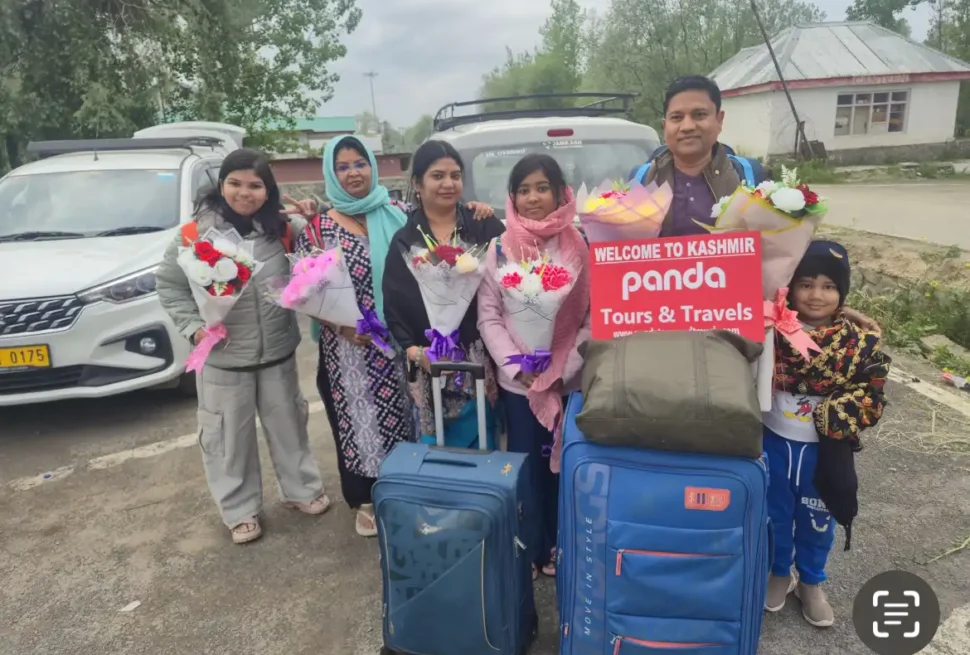
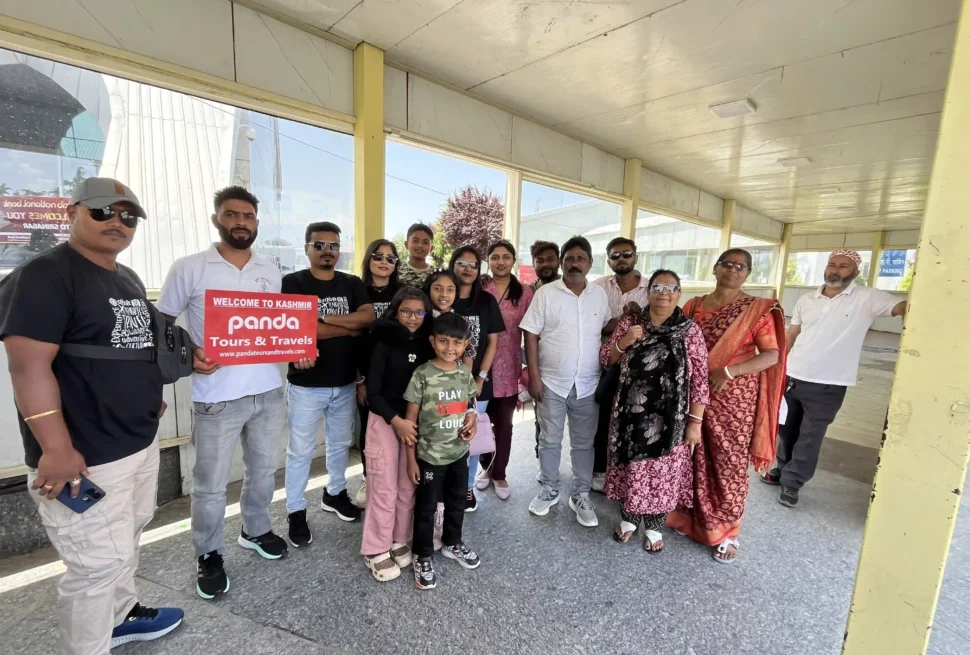
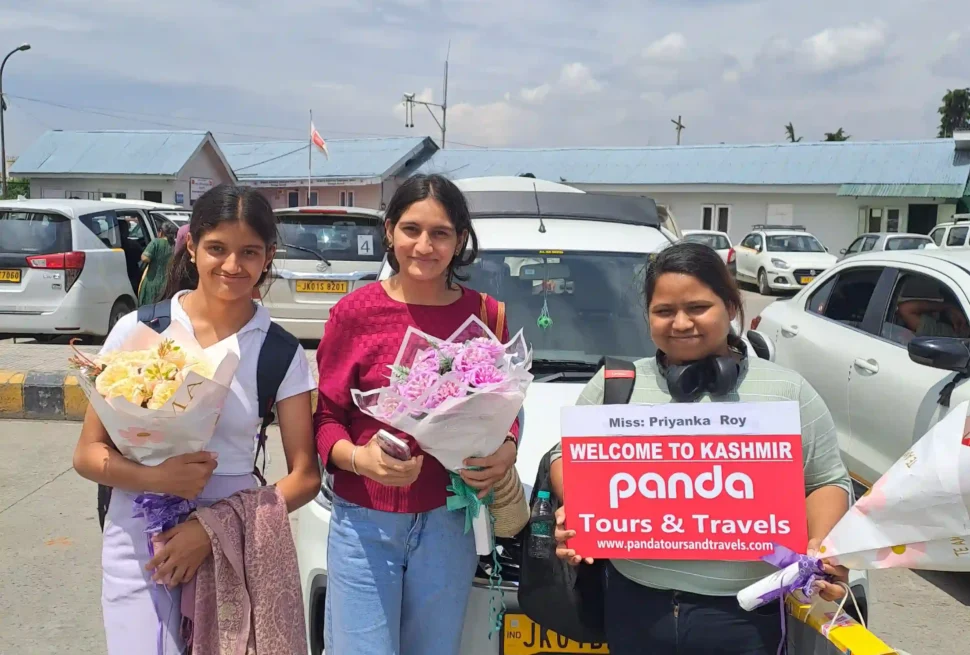
After landing at Sheikh ul-Alam International Airport, you’ll clear security formalities inside the terminal, collect your luggage, and exit to the arrivals area, where a pre-arranged driver can meet you holding a name board if you’ve booked airport pickup through your operator. The drive to central Srinagar or the Dal Lake area typically takes 30–50 minutes depending on traffic and your exact hotel or houseboat location. Booking airport pickup in advance is particularly useful for a first-time international arrival, since it removes the need to negotiate a taxi fare or navigate an unfamiliar city immediately after a long flight.
What Should You Pack for Kashmir From Mauritius?
Packing for Kashmir requires more layers than most Mauritian travellers are used to, and the right list changes noticeably by season.
Year-round essentials:
- Layered clothing (t-shirt, sweater/fleece, jacket) that can be added or removed through the day
- Comfortable walking shoes with good grip
- Sunglasses and sunscreen — sun exposure at altitude is stronger than it feels
- Lip balm, given the drier mountain air
- Any personal medicines, since pharmacy availability outside main towns is limited
- Power bank and a universal travel adapter (India uses Type C/D/M sockets)
- Reusable water bottle
- Passport, visa printout, travel insurance documents
- A small day backpack for sightseeing
Additional for spring/autumn (March–May, September–November):
- A proper waterproof jacket, since rain is more likely in these shoulder seasons
- A mid-weight sweater for cooler mornings and evenings
Additional for winter (December–February):
- Thermal base layers
- A heavy insulated jacket
- Waterproof, insulated footwear suitable for snow
- Gloves, a warm hat and a scarf
Additional for summer (June–August):
- Lighter layers for daytime warmth in Srinagar, but still keep one warm layer for Gulmarg or Sonamarg evenings
What Food Should Mauritian Travellers Try in Kashmir?
Kashmiri cuisine centres on a rich, meat-forward tradition known as Wazwan, traditionally served at celebrations but widely available to tourists through hotels and restaurants. Signature dishes include Rogan Josh (a slow-cooked, spiced lamb curry), Yakhni (a yoghurt-based curry), Gushtaba (spiced meatballs in a yoghurt gravy) and Tabak Maaz (fried lamb ribs). Kahwa, a spiced green tea often flavoured with saffron, cardamom and almonds, is Kashmir’s signature drink, while Noon Chai is a distinctive salted, pink-coloured tea served more as a everyday staple. Nadru (lotus stem) and Dum Aloo (spiced baby potatoes) are popular vegetarian dishes, and local bakeries sell fresh Kashmiri breads worth trying with breakfast.
Spice levels can run higher than typical Mauritian-Creole cooking, so it’s worth communicating your spice tolerance clearly, and most hotels and restaurants can also accommodate vegetarian requests without difficulty.
Is Kashmir Safe for Mauritian Travellers?
Kashmir welcomes a large number of domestic and international tourists every year, and the main tourist circuit — Srinagar, Gulmarg, Pahalgam and Sonamarg — is well used to visitors. That said, no destination can be guaranteed risk-free, and sensible precautions apply here as they would on any international trip: stay aware of current travel advisories from your government before and during your trip, keep your passport, visa and other documents secure, be mindful of altitude and weather changes (particularly in winter, when road conditions can shift quickly), and book transport and accommodation through registered, reputable operators rather than unverified street arrangements. Respecting local customs, particularly around religious sites, also goes a long way toward a smooth trip.
Checking current local conditions before finalising an itinerary, especially for more remote areas like Gurez, Bangus or Keran, is a sensible extra step that a local operator can help with directly.
What Should Mauritian Travellers Know About Kashmir Culture?
Kashmir has a distinct cultural identity shaped by centuries of Persian, Central Asian and South Asian influence, and it is worth approaching with a degree of cultural awareness, much as you would visiting any unfamiliar region. Modest dress is appreciated, particularly at religious sites such as Hazratbal Shrine or local mosques in the Old City — covering shoulders and knees is a respectful default. Photography of local people, particularly in markets or residential areas, is best done with a polite request first rather than assumed. Greetings are generally warm; a simple “Asalaam-o-Alaikum” is commonly used and appreciated. In markets, mild bargaining is normal and expected, particularly for handicrafts, though it should stay good-natured rather than aggressive.
On a houseboat, it’s courteous to follow your host’s guidance on house rules, and removing shoes before entering carpeted areas is a common local practice. None of this requires special preparation beyond basic courtesy and awareness — most Mauritian travellers find Kashmiri hospitality notably warm once these small customs are respected.

Why Choose Panda Tours and Travels for Kashmir Tour Packages From Mauritius?
Planning Kashmir tour packages from Mauritius involves more moving parts than a typical domestic Indian booking — an international flight connection, a separate visa process, currency exchange, and an unfamiliar climate and culture. Working with a Srinagar-based, on-ground operator removes a lot of that uncertainty. Panda Tours and Travels is a government-registered travel agency based in Srinagar, and its team handles the coordination that matters most for an international arrival: airport pickup timed to your actual flight, hotel and houseboat bookings confirmed in advance, a private vehicle for the whole trip rather than negotiating transport at each stop, and a customised itinerary built around your dates, group size and preferred pace rather than a rigid fixed schedule.
The team plans across the full range of traveller types — families, honeymoon couples, groups, senior citizens and solo travellers — and covers both the standard Srinagar–Gulmarg–Pahalgam–Sonamarg circuit and offbeat routes like the Gurez Valley Tour for travellers who want to go beyond the usual stops.
From our experience arranging Kashmir holidays for travellers arriving from outside India, a practical consideration is building in a lighter first day after a long international journey rather than starting with a full sightseeing schedule — small adjustments like this make a noticeable difference to how the trip actually feels. For first-time visitors, we generally recommend a 6N/7D or 7N/8D structure over a very tight 4N/5D trip, simply because it allows for weather flexibility and a more comfortable pace.
Planning your Kashmir trip from Mauritius? Contact Panda Tours and Travels on WhatsApp to discuss your dates, group size and preferred itinerary: https://wa.me/917006982655. You can also read more about the team’s background on the Best Travel Agents in Jammu and Kashmir page.
Plan Your Kashmir Trip From Mauritius
Kashmir tour packages from Mauritius work best when the international flight connection, the visa timeline, and the local Kashmir itinerary are planned together rather than as separate, disconnected pieces. Once you have a rough sense of your travel dates, group size and preferred pace, the next practical step is comparing itinerary lengths — 5N/6D, 6N/7D or 7N/8D — against your budget and how many destinations you want to cover, from the core Srinagar–Gulmarg–Pahalgam–Sonamarg circuit through to offbeat valleys like Gurez.
A locally based operator can save a first-time visitor a considerable amount of guesswork, from confirming realistic flight connection times to knowing which roads are currently open in a given season. For a tailored itinerary and current pricing for your travel dates, reach out to Panda Tours and Travels directly on WhatsApp: https://wa.me/917006982655.



Frequently Asked Questions For Kashmir Tour Package From Mauritius
How can I travel from Mauritius to Kashmir?
You fly from Mauritius to a major Indian gateway city such as Delhi or Mumbai, then take a separate domestic flight to Srinagar. There is no direct route, so plan for at least one connection and confirm current flight schedules with your airline before booking.
Is there a direct flight from Mauritius to Kashmir?
No regular nonstop Mauritius–Srinagar service should be assumed. You will normally connect through an Indian gateway city before flying on to Srinagar, and current airline schedules should be checked before booking your tickets.
Which airport is best for Kashmir?
Srinagar’s Sheikh ul-Alam International Airport (SXR) is the only realistic arrival point for Kashmir. Most Mauritian travellers reach it by connecting through Delhi or Mumbai on a domestic flight after their international sector.
What is Srinagar airport called?
Srinagar Airport is officially named Sheikh ul-Alam International Airport, after the 14th-century Kashmiri Sufi saint Sheikh Noor-ud-Din Wali. Its IATA code is SXR, and it sits about 12–15 km from central Srinagar.
How long does Mauritius to Kashmir travel take?
Door-to-door travel time commonly falls between roughly 12 and 20 hours including layovers, depending on your routing, connection length and whether you take an overnight stopover in your gateway city.
Do Mauritian citizens need an Indian visa?
Yes. Mauritian citizens require a valid Indian visa, and they are eligible for India’s e-Visa, which is applied for online. Always check current requirements on the official e-Visa portal before booking flights.
What is the best month to visit Kashmir?
It depends on your priority: April–May for tulips and mild weather, June–August for full green-season sightseeing, September–November for chinar autumn colours, and December–February for snow in Gulmarg.
Is Kashmir good in December?
December marks the start of winter, with snowfall becoming likely in Gulmarg and colder conditions across the valley. It suits travellers who specifically want an early-winter, snow-influenced experience.
Can I see snow in January?
January is Kashmir’s coldest month and generally offers the most reliable snow cover for skiing and snow activities in Gulmarg, though exact snowfall timing cannot be guaranteed for any specific date.
Is March a good time for Kashmir?
March marks the start of spring, with milder weather beginning and fewer crowds than peak summer, though some higher-altitude areas may still see residual winter conditions.
Is April good for the Tulip Garden?
Yes, Asia’s largest Tulip Garden in Srinagar typically blooms for a few weeks in late March to April, making this a strong window for travellers who want to see it, though the exact opening dates shift slightly year to year.
How many days are enough for Kashmir?
Most first-time travellers find 5 to 8 days sufficient to cover Srinagar, Gulmarg, Pahalgam and Sonamarg comfortably, with the extra days in a 7N/8D trip allowing for a slower pace and one offbeat destination.
Is 5 nights enough for Kashmir?
A 5N/6D Kashmir tour package covers the core circuit — Srinagar, Gulmarg, Pahalgam and Sonamarg — comfortably, though it moves at a brisker pace than a 6N/7D or 7N/8D itinerary.
Is 7 nights better for Kashmir?
For first-time visitors, especially those arriving from far away like Mauritius, 7 nights allows for better acclimatisation, a less rushed schedule, and room to add an offbeat destination such as Gurez Valley.
What is the best Kashmir itinerary for first-time visitors?
A 6N/7D or 7N/8D structure covering Srinagar, Gulmarg, Pahalgam and Sonamarg, with a light first day for arrival rest, generally works best for someone visiting Kashmir for the first time.
Which places should I visit in Kashmir?
Srinagar, Gulmarg, Pahalgam and Sonamarg form the core circuit. With more time, Doodhpathri, Yusmarg, Gurez Valley and the South Kashmir springs at Achabal, Verinag and Kokernag are worth adding.
Should I stay on a Kashmir houseboat?
A houseboat stay on Dal Lake is one of Kashmir’s signature experiences and is worth including for at least one or two nights, typically at the start of your itinerary in Srinagar.
How much does a Kashmir trip cost from Mauritius?
Total cost depends on international airfare, hotel category, group size, itinerary length and activities. It’s best to separate international flights, domestic flights and the local land package when budgeting, and to request a current quote from your operator for exact figures.
Are Kashmir packages customizable?
Yes, most Kashmir tour packages from operators like Panda Tours and Travels can be adjusted for duration, hotel category, destinations included and pace, particularly useful for aligning with international flight timings.
What is included in a Kashmir tour package?
Typical inclusions are airport pickup and drop, accommodation (hotel and/or houseboat), private transport, daily sightseeing and often breakfast; exact inclusions vary by package and should be confirmed before booking.
Is private taxi better than shared transport?
For international travellers managing jet lag and an unfamiliar destination, a private taxi is generally more convenient, offering flexible stops and a fixed, predictable cost for the full trip.
How do I travel from Srinagar airport to my hotel?
After clearing the terminal and collecting luggage, a pre-arranged driver can meet you at arrivals if you’ve booked airport pickup; the drive to central Srinagar typically takes 30–50 minutes depending on your hotel’s location.
Can I travel to Kashmir by train?
Not from Mauritius directly — you must fly into India first. Once in India, the Vande Bharat Express connects Srinagar to Jammu Tawi via Katra and Banihal, useful mainly for combining Kashmir with a Jammu or Vaishno Devi visit.
What is the nearest railway station to Kashmir?
Srinagar now has its own railway station on the Kashmir Valley rail network, connected via the Udhampur–Srinagar–Baramulla Rail Link, which opened in June 2025.
Can I travel to Kashmir by road?
Yes, from Jammu, Katra or Delhi, though it’s a long drive — roughly 7–10 hours from Jammu and 15–20 hours from Delhi — and is generally used by domestic travellers rather than those arriving internationally.
How far is Jammu from Srinagar?
Jammu to Srinagar by road is approximately 270–300 km, typically taking 7–10 hours depending on weather, traffic and road conditions through the Banihal stretch.
Which offbeat places should I visit in Kashmir?
Gurez Valley, Bangus Valley, Doodhpathri, Yusmarg and the South Kashmir springs at Achabal, Verinag and Kokernag are the main offbeat options beyond the standard tourist circuit.
Is Gurez Valley worth visiting?
Yes, for travellers who want a genuinely remote Himalayan experience beyond the standard circuit, though it’s only accessible from roughly May to October and needs a bit more planning than the core destinations.
Can foreigners visit Gurez Valley?
Foreign nationals can generally visit Gurez Valley, though access can be subject to current local conditions and, at times, permissions near sensitive border areas — it’s best coordinated through a local operator who can confirm current status.
Is Kashmir suitable for families?
Yes — the Gulmarg Gondola, Dal Lake Shikara rides and gentle sightseeing pace work well across age groups, and a private vehicle with a flexible schedule makes travelling with children or seniors easier.
Is Kashmir suitable for honeymoon couples?
Yes, Kashmir has long been one of India’s classic honeymoon destinations, centred on houseboat stays, Shikara rides and the mountain scenery of Gulmarg and Pahalgam.
What clothes should I pack for Kashmir?
Pack in layers year-round — a base layer, a mid layer like a fleece or sweater, and a jacket you can add or remove — since temperatures shift noticeably through the day and between destinations.
What should I wear in winter in kashmir?
Winter requires thermal base layers, a heavy insulated jacket, waterproof snow-appropriate footwear, gloves, a warm hat and a scarf, particularly for Gulmarg and other higher-altitude stops.
What currency is used in Kashmir?
The Indian Rupee (INR) is used throughout Kashmir, as it is across India. Mauritian Rupees cannot be spent directly, so you’ll need to exchange currency or withdraw INR after arrival.
Can I use international cards in Kashmir?
Major hotels and larger shops in Srinagar, Gulmarg and Pahalgam generally accept cards, but smaller shops, local eateries and offbeat valleys often rely on cash, so carrying some cash is a sensible backup.
What food should I try in Kashmir?
Try Rogan Josh, Yakhni, Gushtaba and Tabak Maaz from the traditional Wazwan spread, along with Kahwa tea, Nadru (lotus stem) and Dum Aloo if you prefer vegetarian options.
Can I ride the Gulmarg Gondola?
Yes, the Gulmarg Gondola operates in two phases and is open to visitors year-round, weather permitting, offering views over the valley and, in winter, access to skiing areas.
Can I enjoy snow activities in Kashmir?
Yes, primarily in Gulmarg during winter (roughly December to March), including skiing, snowboarding and sledging, though exact snow conditions vary by year and should be checked closer to your travel dates.
What should I know before visiting Kashmir?
Confirm your visa well in advance, pack in layers for shifting temperatures, budget separately for international and domestic flights, and consider working with a local operator to handle transport and bookings.
Is a local Kashmir travel agency better for planning?
For international travellers, a local Srinagar-based agency generally simplifies logistics considerably — airport coordination, hotel confirmation, private transport and current on-ground knowledge of road and weather conditions.
Why choose Panda Tours and Travels?
Panda Tours and Travels is a government-registered, Srinagar-based operator with local destination expertise, private transport, houseboat and hotel coordination, and customised itineraries for families, couples and groups.
Can Panda Tours and travels arrange airport pickup?
Yes, airport pickup and drop at Sheikh ul-Alam International Airport is a standard part of most Kashmir tour packages arranged through Panda Tours and Travels.
Can Panda Tours and Travels create a private Kashmir itinerary?
Yes, itineraries can be fully customised around your travel dates, group size, preferred hotel category and destinations, rather than following a fixed, one-size-fits-all schedule.
How can I book a Kashmir tour from Mauritius?
Contact Panda Tours and Travels directly on WhatsApp at https://wa.me/917006982655 with your travel dates, group size and preferences, and the team will help put together a suitable itinerary and quote