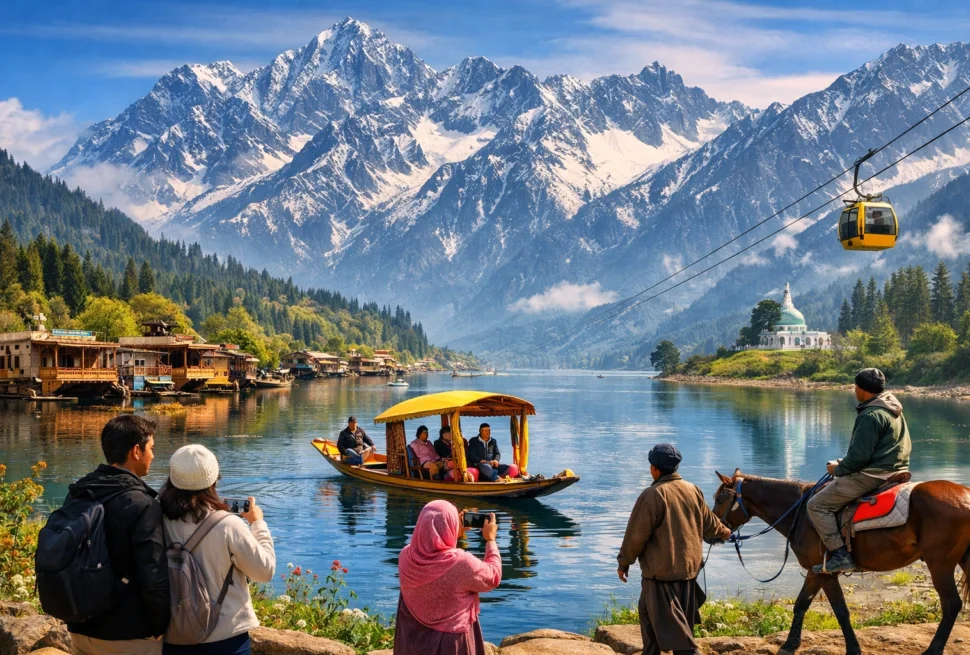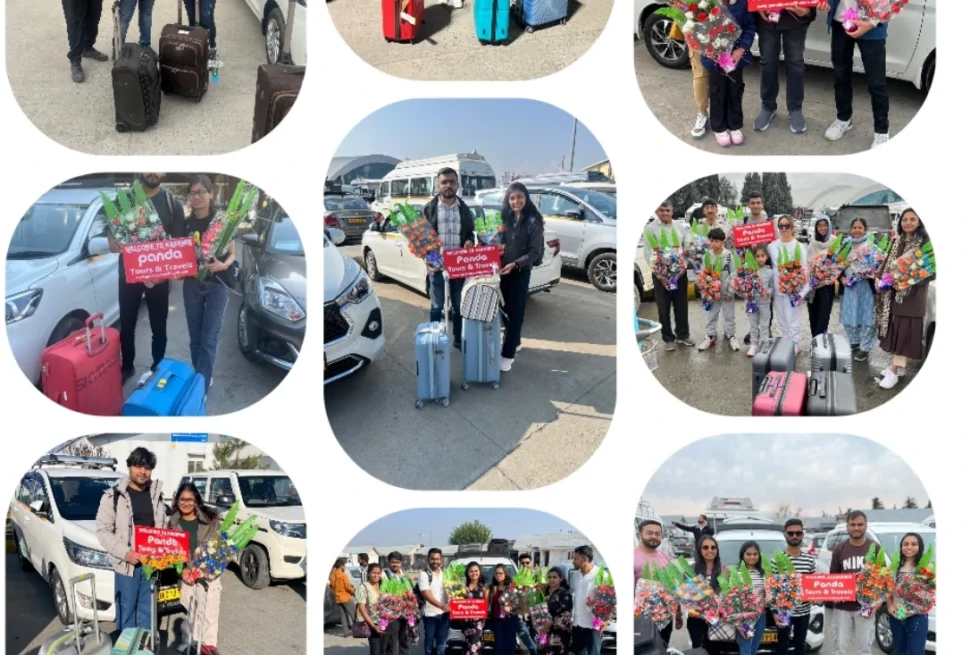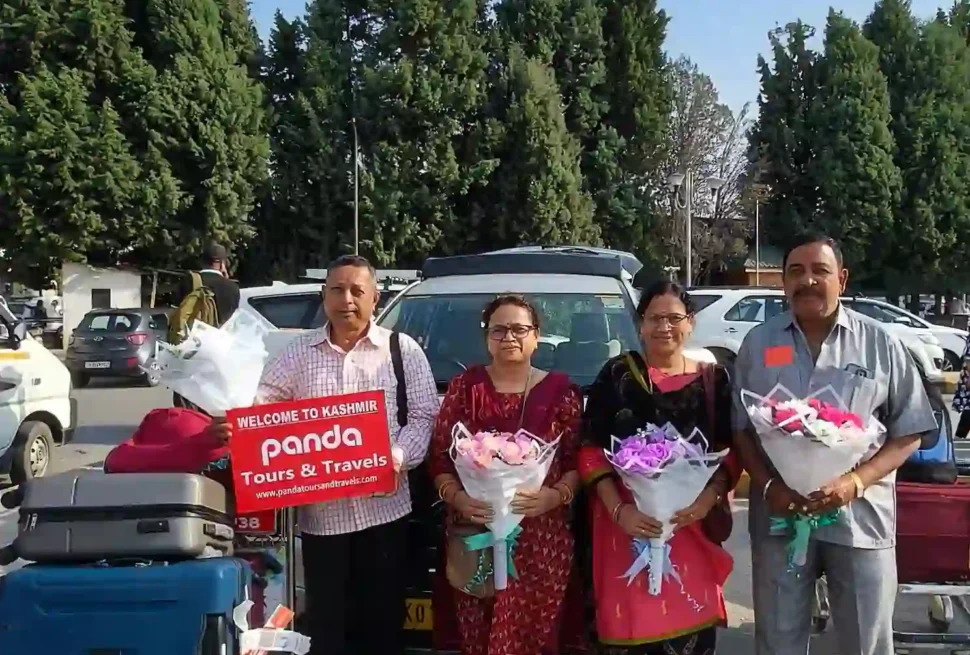
Is Kashmir Safe for USA and UK Tourists?
There is no single yes-or-no answer, and any website that gives you one is not being straight with you. As of 2026, both the U.S. Department of State and the UK Foreign, Commonwealth & Development Office (FCDO) advise against travel to the Kashmir Valley, specifically naming Srinagar, Gulmarg, Pahalgam and Sonamarg, while making an exception for the city of Jammu and the Union Territory of Ladakh (including Leh). At the same time, domestic and some international tourists continue to visit these same destinations every season, hotels operate normally on most days, and large parts of the tourist circuit see no incidents for long stretches.
Both of those things are true simultaneously. Official government advice and on-the-ground tourist activity are not the same measurement, and this guide keeps them separate throughout. What you decide to do with that information is a personal risk decision, not something we, or any tour operator, can make for you. Recheck your government’s advisory immediately before booking and again before departure, because conditions in Jammu & Kashmir can change quickly.
Panda Tours and Travels is a Srinagar-based local travel company that helps visitors plan Kashmir journeys with local route knowledge and practical, on-ground assistance. We coordinate transportation, accommodation, sightseeing and custom itineraries for domestic and international travelers alike. For visitors from the USA and UK specifically, our approach is informed planning and current local updates, not unrealistic safety promises. Reach us on WhatsApp or by phone at +91 7006982655 for Kashmir travel planning help.
What Do the US and UK Governments Currently Say About Kashmir?
Government travel advisories are the single most important document you should read before deciding whether to visit Kashmir, more important than any tour operator’s website, including this one.
Current US State Department Travel Advisory for Jammu & Kashmir
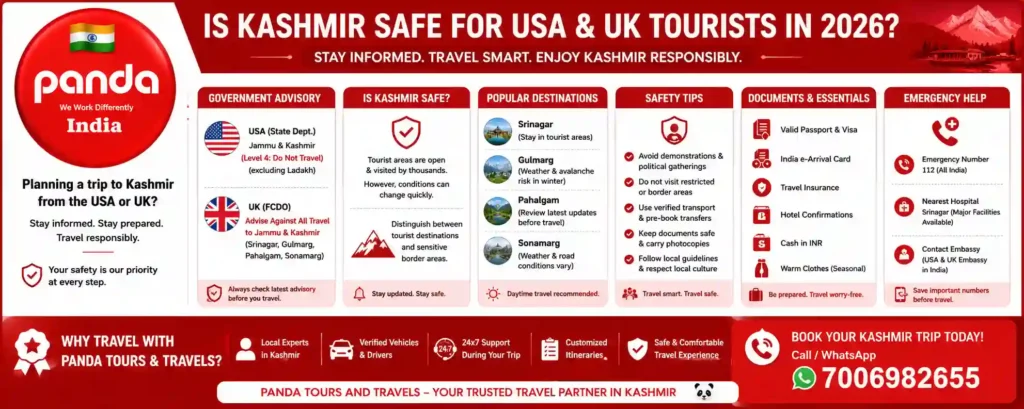
India as a whole sits at Level 2: Exercise Increased Caution on the US State Department’s four-level scale, citing crime and terrorism generally. Within that country-wide advisory, however, the Union Territory of Jammu and Kashmir is separately flagged at the highest tier, Level 4: Do Not Travel, with an explicit exception carved out for the eastern Ladakh region and its capital, Leh.
The advisory states that terrorist attacks and violent civil unrest are possible in Jammu & Kashmir, that sporadic violence occurs particularly along the Line of Control (LOC), and that violence has also occurred in the Valley’s core tourist destinations: Srinagar, Gulmarg and Pahalgam. It separately places a Level 4 designation on any area within 10 kilometers of the India-Pakistan border. This is a specific, named restriction, not a vague generalization about India.
Current UK FCDO Travel Advice for Jammu & Kashmir
The FCDO’s position is, if anything, more explicit about geography. It advises against all travel to the Union Territory of Jammu and Kashmir, and it names the exact tourist towns this covers: Pahalgam, Gulmarg, Sonamarg, the city of Srinagar, and the Jammu-Srinagar national highway. The advisory carves out three exceptions: travel by air to and from the city of Jammu, travel within the city of Jammu itself, and travel within the Union Territory of Ladakh.
This advice was reinforced and tightened following a 2025 terrorist attack on tourists at Baisaran meadow near Pahalgam, which killed 26 civilians. The FCDO also separately advises against all travel within 10 kilometers of the India-Pakistan border and notes that the Wagah-Attari border crossing is currently closed.
Why Government Travel Advisories Matter
Advisories are not just background reading; they are the primary reference point insurers, embassies and, in some cases, employers use to judge your trip.
Why: Advisory levels are built from a country’s own intelligence and diplomatic reporting, not tourism marketing, and they are updated as the security picture changes, sometimes within days of an incident.
What travelers should do: Read the full advisory yourself on travel.state.gov (US citizens) or gov.uk/foreign-travel-advice (UK citizens) rather than relying on summaries, including this one, and check again in the 48-72 hours before you fly.
Can Travel Insurance Be Affected by a Travel Warning?
This is one of the most overlooked questions among USA and UK travelers researching Kashmir, and it deserves a direct answer.
Possibly, yes.
Why: Many UK travel insurance policies explicitly exclude claims arising in an area the FCDO advises against traveling to, and the FCDO’s own guidance states plainly that your insurance could be invalidated if you travel against its advice. US travel insurance works differently policy-to-policy; there is no single federal rule, but many standard policies contain “state department advisory” exclusions or require a specialist “cancel for any reason” or high-risk add-on to cover Level 3 or Level 4 destinations.
What travelers should do: Before booking anything, call your insurer directly, tell them you are visiting Srinagar, Gulmarg, Pahalgam or Sonamarg specifically (not just “India”), and ask them in writing whether your policy covers claims there given the current advisory status. Do not assume a generic “worldwide” or “India” policy automatically includes areas under a Do Not Travel or Advise Against All Travel designation.
Is Kashmir Safe Right Now in 2026? What Travelers Need to Understand
Why “Safe” Is Not a Simple Yes-or-No Answer
Safety is not a fixed property of a place; it is a combination of what could happen, how likely it is, and how well you can respond if it does. Kashmir in 2026 has a heavy security presence, an active tourism economy, a documented history of periodic violent incidents, and two Western governments currently advising against travel to its main tourist towns. None of these facts cancels out the others. A responsible answer holds all of them at once instead of picking the one that supports a sales pitch or a scare headline.
Tourist Areas vs Sensitive Border Areas
There is a real difference between the risk profile of, say, a houseboat on Dal Lake and the risk profile of an unmarked track near the Line of Control. Government advisories draw this distinction too: the harshest language in both the US and UK advisories is reserved for areas within 10 km of the India-Pakistan border, which are functionally off-limits to foreign tourists in the first place under Indian government rules. But it is important to be accurate here: the current advisories do not stop at the border zone. Both governments have named Srinagar, Gulmarg, Pahalgam and Sonamarg directly as areas they advise against, not only the frontier.
Why Conditions Can Change Quickly
Kashmir’s security situation has shifted rapidly in the past, sometimes moving from routine tourist activity to curfews and evacuations within a single news cycle. Advisories themselves can be updated with no advance warning, often in direct response to a specific incident. This is precisely why blanket statements like “Kashmir is safe” or “Kashmir is dangerous,” made without a date attached, are not useful to a traveler making a real decision.
Why Travelers Should Recheck Advisories Before Departure
Because the advisory you read while researching your trip may not be the advisory in effect when you land.
Why: Both governments update their guidance in response to unfolding events, and updates can happen with little lead time.
What travelers should do: Set a calendar reminder to re-read the full, current advisory 72 hours before departure, and again on the morning of travel if possible. If you are a US citizen, enroll in the Smart Traveler Enrollment Program (STEP) so the embassy can reach you directly if the situation changes while you’re in the country.
Is Srinagar Safe for American and British Tourists?
Srinagar is the summer capital of Jammu & Kashmir and the hub almost every visitor passes through, whether staying in a houseboat on Dal Lake or using the city as a base for day trips.
Tourist Areas Around Dal Lake and Boulevard Road
The Boulevard Road, Dal Lake shoreline, Nishat and Shalimar Mughal gardens, and the old city’s shrines and markets see a steady flow of domestic tourists throughout the year, and a smaller but consistent number of international visitors. Daytime activity in these zones is generally routine, with shikara rides, houseboat stays and garden visits proceeding as normal on most days.
Srinagar Airport and Hotel Transfers
Srinagar’s Sheikh ul-Alam International Airport has visible security screening, including additional checks compared with many other Indian domestic airports, given its proximity to a sensitive region. Arriving foreign nationals should expect their documents to be checked more thoroughly than at, say, Delhi or Mumbai. A pre-arranged, verified transfer removes the uncertainty of negotiating transport at the terminal, which matters more in Srinagar than in most Indian cities.
Security Checkpoints in Srinagar
Checkpoints staffed by police or paramilitary forces are a routine part of daily life in Srinagar and across the Valley. For a first-time visitor from the USA or UK, this can feel unfamiliar, but it is a normal, everyday occurrence rather than a signal of an active incident. Carry your passport and visa documentation at all times, cooperate calmly, and avoid photographing checkpoints or military installations.
Daytime Sightseeing
Most organized sightseeing in Srinagar happens during daylight hours, and this is by design, not superstition. Reduced visibility of surroundings, fewer people on the streets, and less predictable checkpoint activity all make night movement a less favorable choice, independent of any specific threat on a given day.
Situations Foreign Tourists Should Avoid
Avoid political rallies, protests, religious processions you are not personally part of, and any gathering where a crowd has formed quickly. Avoid discussing local politics with strangers, even casually. Avoid wandering into unfamiliar residential lanes after dark. None of this is unique to Kashmir, but it applies with extra weight here given the advisory context.
Is Gulmarg Safe for USA and UK Tourists?
Tourist Infrastructure and Security
Gulmarg is a purpose-built hill resort with a dedicated tourism economy: hotels, a cable car, ski infrastructure and a resident security presence. It is one of the destinations both the US and UK advisories name specifically, so the same official caution applies here as it does to Srinagar.
Gulmarg Gondola and Activity Safety
The Gulmarg Gondola (cable car) is a major draw, run in two phases up the mountain. Mechanical safety, weather-dependent closures, and ordinary queue-management issues are the more common practical concerns for visitors day to day, separate from the broader security advisory.
Snow and Avalanche Risks
Gulmarg sits at altitude and experiences heavy winter snowfall. Avalanche risk is a genuine, recurring hazard on and off marked ski runs, and it has caused fatalities among both tourists and locals in past seasons. This is a weather and terrain risk, distinct from the security risk discussed in the advisories, and it deserves separate planning.
Skiing and Adventure Safety
Ski and snowboard visitors should use licensed instructors and stay on marked, currently open runs. Off-piste skiing in Gulmarg has led to serious incidents, including for experienced skiers who underestimated local avalanche conditions.
Winter Road Conditions
The Srinagar-Gulmarg road can close or become hazardous during heavy snowfall. Chained tires, experienced local drivers and flexible timing all reduce, but don’t eliminate, this risk.
Is Pahalgam Safe for American and British Tourists?
Main Tourist Areas
Pahalgam, set along the Lidder River, functions as a base for valley walks, pony rides and access to Aru, Betaab and Chandanwari. It is also the location of the April 2025 attack referenced in the FCDO’s advisory update, and it is explicitly named in both the US and UK advisories as a place they advise against visiting.
Aru Valley, Betaab Valley and Chandanwari
These are quieter, more rural extensions of the Pahalgam circuit. Being further from the main town means fewer people around if something goes wrong, whether that “something” is a medical issue, a road problem, or a security concern, and it reinforces the value of traveling with a known local operator rather than independently in these specific spots.
Weather and Road Risks
The Pahalgam road network is mountainous and can be affected by landslides, particularly during and after monsoon rains or spring snowmelt. This is a standalone planning consideration, separate from the security advisory, and one that affects domestic and international travelers equally.
What Foreign Travelers Should Know
Pahalgam being one of the two named locations in the 2025 attack the FCDO refers to means its advisory language is unusually specific here. Any traveler weighing a Pahalgam visit against official advice should read the full, current advisory text directly rather than a secondhand summary, including this one.
Is Sonamarg Safe for USA and UK Tourists?
Road and Weather Conditions
Sonamarg sits along the road toward Ladakh and Zoji La pass, at higher altitude than Srinagar. The route is scenic but genuinely mountainous, with sharp bends and exposure to weather.
Snow and Seasonal Closures
Sonamarg and the Zoji La route close seasonally due to heavy snow, generally from late autumn through spring, reopening once the Border Roads Organisation clears the pass. Travel plans that depend on this road need a weather-dependent buffer, not a fixed date.
Safe Transportation Practices
A vehicle and driver experienced specifically with mountain roads is more valuable here than in flatter parts of the itinerary. Confirm current road-opening status before committing to a Sonamarg day trip, particularly outside peak summer months.
Which Places in Kashmir Should Foreign Tourists Avoid?
Areas Near the Line of Control
Areas within roughly 10 km of the India-Pakistan border, and the LOC itself, are the single clearest “avoid” zone in both government advisories, and Indian authorities separately restrict civilian and foreign access to much of this zone regardless of advisory status.
Restricted and Sensitive Border Areas
Portions of Jammu & Kashmir and Ladakh near the LOC require Restricted Area Permits, issued through Indian government channels, for any traveler, foreign or domestic. This is a legal requirement layered on top of the safety advisory, and it means access is controlled independently of your personal risk tolerance.
Gurez, Keran, Bangus and Other Frontier Areas
Gurez Valley, Keran, and the Bangus Valley sit close to the LOC and are periodically opened to limited domestic tourism with permits, subject to security clearance that can change without notice. These are not standard international tourist stops, and travelers should not attempt to visit them independently.
Military Installations and Security Checkpoints
Never photograph or film military installations, checkpoints, personnel, or convoys anywhere in Jammu & Kashmir. This is both a legal restriction and a practical safety instruction; violations can lead to detention regardless of intent.
Why Foreign Nationals May Face Additional Restrictions
Foreign passport holders, including US and UK citizens, are sometimes subject to additional scrutiny or outright restriction in areas where Indian nationals face fewer controls, precisely because of the region’s disputed and militarized border status. This is a standing feature of travel to Jammu & Kashmir, not something specific to current conditions.
Is Kashmir Safe for UK Tourists Compared With US Tourists?
| Traveler | Advisory source | What to check | Practical implication |
|---|---|---|---|
| US citizen | travel.state.gov India Travel Advisory | Country-level Level 2, plus the specific Level 4 “Do Not Travel” designation on J&K (except Ladakh/Leh) and the India-Pakistan border | STEP enrollment recommended; check whether your insurance excludes Level 4 areas |
| UK citizen | gov.uk/foreign-travel-advice/india | “Advises against all travel” to J&K including named towns, with exceptions for Jammu city and Ladakh | FCDO explicitly warns your travel insurance may be invalidated if you travel against its advice |
What UK Travelers Should Check
Read the FCDO’s “Summary” and “Regional risks” pages for India in full, note the exact list of exempted areas (Jammu city, air travel to Jammu, and Ladakh), and confirm your insurer’s position on FCDO-advised-against areas in writing before booking.
What US Travelers Should Check
Read the full Level 4 section for Jammu & Kashmir on the State Department site, note the Ladakh/Leh exception, and separately check the India-Pakistan border designation if any part of your route runs near Jammu province’s western edge.
Insurance Considerations
UK insurers frequently tie coverage directly to FCDO status, making this a more binary issue for British travelers. US insurers vary more by provider, so a direct conversation with your specific insurer, referencing the exact towns you plan to visit, is essential rather than optional.
Consular Assistance
The US Embassy in New Delhi covers Jammu & Kashmir among the states and territories it serves, and it maintains an emergency contact line. The UK similarly provides consular support to British nationals in India through its diplomatic network. In both cases, consular officers can help with lost passports, arrests, medical emergencies, or a family’s ability to reach you, but neither government can guarantee your physical safety inside an area they advise against visiting, and both note limits on their ability to reach travelers quickly outside major cities.
Is Kashmir Safe for Solo American and British Travelers?
Solo Male Travelers
Solo male travelers generally face fewer of the specific harassment risks that solo women report, but the core advisory-related considerations, checkpoint areas, night travel, and named towns, apply equally regardless of gender.
Solo Female Travelers
The US advisory separately recommends that women avoid solo travel in India generally, not specific to Kashmir, citing rising rates of reported sexual assault nationwide. This is a country-wide caution, and Kashmir does not sit outside it. Solo female travelers who do proceed should favor verified accommodation, pre-booked transport rather than street hailing, and daytime movement.
Accommodation Selection
Independently verify any hotel or houseboat through multiple recent reviews, and confirm it is registered with the Jammu & Kashmir Tourism Department where possible. Unregistered, informally advertised houseboats carry more uncertainty around safety standards and dispute resolution if something goes wrong.
Transportation Planning
Solo travelers benefit disproportionately from a known driver and a fixed itinerary shared with someone outside Kashmir, since there is no travel companion to flag a problem if plans go off track.
Is Kashmir Safe for Families From the USA and UK?
Traveling With Children
Families should weigh the same advisory information as any other traveler; there is no separate, lower-risk designation for family travel. Practically, families tend to stick more closely to the core Srinagar-Gulmarg-Pahalgam circuit and keep a slower pace, which naturally reduces exposure to some of the more remote-area risks discussed above.
Traveling With Senior Citizens
Altitude at Gulmarg and Sonamarg, cold temperatures in winter, and rougher mountain roads toward Pahalgam and Sonamarg are the more immediate, non-security-related concerns for older travelers. A physician consultation before travel is sensible for anyone with cardiac or respiratory conditions.
Choosing a Practical Itinerary
A shorter, less remote itinerary focused on Srinagar and Gulmarg, with Pahalgam or Sonamarg added only after checking current advisory and road conditions, is a more conservative structure for families than a long circuit through multiple valleys.
Medical Planning
Confirm which hospitals along your route can handle a pediatric or geriatric emergency, and carry printed copies of any relevant medical history, since connectivity cannot be assumed everywhere.
Is It Safe to Travel Around Kashmir by Taxi?
Why Verified Local Transportation Matters
Kashmir’s tourism department restricts which vehicles can operate at which destinations, and a verified operator will know current road closures, checkpoint timing, and weather-related detours that an unfamiliar or informal driver may not.
Airport Pickup and Drop
Pre-arranged airport transfer removes the need to negotiate transport immediately after a long international flight, at a terminal where you are unfamiliar with the layout and local pricing norms. Panda Tours and Travels coordinates airport pickup and drop as a standard part of Kashmir itinerary planning; reach us on WhatsApp at +91 7006982655 if this is something you need arranged ahead of arrival.
Private Taxi vs Unverified Transport
A private, pre-booked taxi with a known driver is a materially different experience from flagging down an unmarked vehicle at a tourist spot. Fixed pricing, accountability, and local knowledge of current conditions all favor the verified option.
Daytime vs Night Travel
Plan mountain-road segments, in particular toward Sonamarg, Gulmarg and Pahalgam, for daylight hours. Poor lighting, unpredictable weather, and reduced checkpoint visibility all make night driving on these routes a less favorable choice.
What to Confirm With Your Driver
Confirm the vehicle is registered for the specific destination on your itinerary (Kashmir tourism rules restrict some vehicles to certain drop points only), confirm a rough return time, and keep the driver’s number saved before you set off each day.
How Safe Are Hotels and Houseboats in Kashmir?
Choosing Reputable Accommodation
Favor properties with a verifiable trail of recent, dated reviews across multiple platforms, not just a handful of testimonials on the property’s own website.
Choosing a Registered Houseboat
Houseboats on Dal Lake and Nagin Lake vary widely in build quality, fire safety and maintenance. A houseboat registered with the Jammu & Kashmir Tourism Department has met a baseline standard that an informally rented boat may not.
What International Travelers Should Check
Ask specifically about emergency exits, fire extinguishers, and how you would reach the shore quickly at night. These are reasonable questions for any houseboat operator and a legitimate one will answer them without hesitation.
Emergency Support at Your Accommodation
Confirm before booking whether your hotel or houseboat operator can reach you quickly in the event of a local security update, road closure, or weather event, and whether they have a direct line to local authorities or your tour coordinator.
Common Safety Risks for USA and UK Tourists in Kashmir
| Risk | What can happen | What travelers should do |
|---|---|---|
| Security incidents | Sporadic violence, unrest, or attacks, as referenced in current advisories | Monitor advisories, avoid named high-caution areas, follow local authority instructions |
| Demonstrations and strikes | Sudden road closures, transport shutdowns (“bandh”) | Avoid crowds, check local news daily, build flexibility into your schedule |
| Road accidents | Mountain roads, landslides, poor lane discipline | Use experienced local drivers, travel by day, wear seatbelts where fitted |
| Snow and avalanche | Closures, injury or worse on ski slopes and mountain roads | Check seasonal conditions, use licensed guides for skiing, avoid off-piste terrain |
| Landslides | Road blockages, delays, in rare cases injury | Build buffer days into itineraries during monsoon and snowmelt periods |
| Altitude | Headaches, breathlessness, in rare cases altitude sickness at higher points | Ascend gradually, stay hydrated, know symptoms before heading to higher elevations |
| Adventure activities | Injury from skiing, trekking or river activities without proper oversight | Use licensed operators and verified equipment only |
| Scams | Overpriced goods, pressured sales, inflated transport fares | Book through known operators, agree prices in advance, avoid unsolicited offers |
| Lost passport | Delays, need for police report (FIR) and embassy replacement | Keep digital and physical copies, know your embassy’s location and number |
| Connectivity | Patchy mobile signal in remote valleys | Download offline maps, share your daily plan with someone outside Kashmir |
| Cash and payment issues | Limited card acceptance outside main towns | Carry sufficient cash, notify your bank of travel to India in advance |
| Medical emergencies | Limited specialist care outside Srinagar | Buy insurance with medical evacuation coverage, know the nearest major hospital on your route |
20 Practical Safety Tips for American and British Tourists Visiting Kashmir
- Read the full, current US or UK advisory yourself before booking, not a summary of it.
- Recheck the advisory again 48-72 hours before departure.
- Buy travel insurance that explicitly covers your named destinations, and get that confirmation in writing.
- Enroll in STEP if you’re a US citizen; UK travelers should register their trip details with someone at home.
- Save the nearest embassy or consulate number in your phone before you land.
- Travel with a known, verified local operator rather than arranging everything informally on arrival.
- Keep digital and physical copies of your passport, visa and e-Arrival Card confirmation.
- Avoid photographing checkpoints, military personnel or installations anywhere in the region.
- Stick to daylight hours for road travel between towns.
- Avoid political rallies, protests and unfamiliar large gatherings.
- Confirm your houseboat or hotel is registered with J&K Tourism before booking.
- Agree taxi and activity prices in advance, in writing where possible.
- Carry sufficient cash; card acceptance thins out beyond Srinagar’s main hotels.
- Notify your bank of travel to India to avoid card blocks.
- Share your daily itinerary with someone outside Kashmir.
- Dress conservatively, particularly in religious sites and rural areas.
- Check seasonal road status (Zoji La, Gulmarg road) before finalizing day trips.
- Use only licensed instructors and guides for skiing, trekking or river activities.
- Keep a basic first-aid kit and any personal medication in original packaging with a prescription copy.
- If a sudden security alert occurs, follow local authority and hotel instructions immediately rather than trying to reach a specific location on your own initiative.
Kashmir Safety by Season: When Should USA and UK Tourists Visit?
Kashmir in Spring
March through May brings blooming gardens and milder temperatures. Some higher-altitude roads, including toward Sonamarg, may still be closed or partially open depending on snowmelt.
Kashmir in Summer
June through August is peak tourist season, with the fullest access to Gulmarg, Pahalgam and Sonamarg, alongside the highest hotel demand and prices. This is also peak Amarnath Yatra pilgrimage season, which brings additional security deployment and periodic road restrictions on certain routes.
Kashmir in Autumn
September through November offers chinar-leaf colors and thinner crowds, with road access typically still good until late in the season.
Kashmir in Winter
December through February brings snow tourism to Gulmarg specifically, alongside road closures elsewhere, particularly toward Sonamarg and Ladakh. Winter also concentrates avalanche risk, a weather hazard distinct from the security advisory.
Weather vs Security: Understanding the Difference
None of the above seasonal notes change the current advisory status of Srinagar, Gulmarg, Pahalgam or Sonamarg. Good weather does not offset an active Do Not Travel or Advise Against All Travel designation, and a quiet security period does not eliminate landslide or avalanche risk. Treat these as two separate checklists, not one.
What Should American and British Tourists Pack for Kashmir?
- Layered clothing: Kashmir’s weather shifts significantly by altitude and time of day, even in summer.
- A proper winter jacket, thermals, gloves and waterproof boots for winter or high-altitude trips (Gulmarg, Sonamarg).
- Modest clothing that covers shoulders and knees for religious sites and rural areas.
- A universal power adapter (India uses Type C/D/M sockets).
- Printed and digital copies of your passport, visa, e-Arrival Card confirmation and travel insurance policy.
- A basic first-aid kit, personal medication in original packaging with a prescription copy.
- A physical paper map or offline maps app, since mobile signal thins out in remote valleys.
- A reusable water bottle with a filter, or plan to buy sealed bottled water only.
- Cash in Indian rupees; card acceptance is inconsistent outside Srinagar’s main hotels.
- Sunscreen and sunglasses; UV exposure at altitude is stronger than it appears.
What Documents Do USA and UK Citizens Need for Kashmir?
Passport
A valid passport is required, and both governments recommend it remain valid well beyond your travel dates. Confirm current validity requirements directly with the Indian visa authorities before applying, since rules can change.
Indian Visa
Most short tourist stays under 60 days can use India’s e-Visa (eTourist visa) system, applied for in advance through the official Indian government portal. Longer stays or other purposes generally require a visa from an Indian embassy or consulate. Always use official government websites for visa applications; fraudulent look-alike sites are a known problem.
India e-Arrival Card
Since April 1, 2026, India requires all foreign nationals, including US and UK citizens, to complete a digital e-Arrival Card before landing, replacing the older paper disembarkation form entirely. It must be submitted online, through the official Indian government portal or the Su-Swagatam app, within 72 hours before arrival, and it generates a QR code you present on entry. This is not a substitute for a visa; you still need valid visa documentation separately. Confirm the current process directly on the official Indian government e-Arrival portal before you travel, since procedures have changed more than once in the past year.
Hotel and Identification Requirements
Hotels and houseboats in India, including Kashmir, are legally required to register foreign guests and typically ask for a passport and visa copy at check-in. Carry your original passport for this purpose; copies alone are usually not sufficient for hotel registration.
Additional Requirements for Restricted Areas
Any itinerary that extends toward the Line of Control, parts of Ladakh near the border, or other restricted zones requires a separate Restricted Area Permit, arranged in advance through Indian government channels. Standard Kashmir Valley tourism (Srinagar, Gulmarg, Pahalgam, Sonamarg) does not typically require this additional permit, but always confirm current requirements for your specific route before travel.
What Should You Do If There Is a Sudden Security Alert?
- Stop sightseeing activity immediately and return to your hotel, houseboat or nearest secure location.
- Follow instructions from your hotel staff, tour operator, or local authorities rather than making independent decisions about routes.
- Avoid the area of the incident entirely, including out of curiosity.
- Contact your embassy or consulate, or check for an alert through STEP if you’re a US citizen.
- Notify a family member or contact outside Kashmir of your status and location.
- Monitor official local news sources rather than social media rumors for updates on curfews or restrictions.
- Be prepared for transport disruptions and have a few days of essential medication and cash on hand.
- Wait for clear guidance before resuming travel plans, even if the immediate area appears to have returned to normal.
What Should You Do in a Medical or Travel Emergency?
For police assistance anywhere in India, dial 112 from a mobile phone or 100 from a landline. For ambulance services, dial 102 or 108 depending on the region. For fire services, dial 101.
If you are a US citizen, the US Embassy in New Delhi, which covers Jammu & Kashmir, can be reached through its main line, and after-hours emergency contact is available through the same number listed on the official embassy website. If you are a UK citizen, contact the nearest British consular office or the FCDO’s 24/7 emergency line, details of which are published on gov.uk.
For serious medical emergencies, taking a taxi or private vehicle directly to the nearest major hospital is often faster than waiting for an ambulance, given road and traffic conditions. Confirm your travel insurance’s emergency assistance number before you travel, and keep it saved offline, since medical evacuation coverage matters more in a region with limited specialist care outside Srinagar.
Why Book With a Local Kashmir Tour Operator for an International Trip?
A local operator cannot guarantee your safety, and any company that claims otherwise is not being honest with you. What a genuinely local, on-ground team can offer is different, and still meaningful:
- Current knowledge of which roads, passes and destinations are open on a given day.
- Coordination between hotel, transport and sightseeing so you are not negotiating each piece separately as a foreign visitor.
- Familiarity with which houseboats and hotels are properly registered and maintained.
- Faster local communication if weather, road conditions or a local situation requires an itinerary change.
- A single point of contact who can help you reach the right authorities or your embassy if something goes wrong.
None of this replaces reading your government’s advisory or making your own informed decision about whether to travel. It simply makes the trip more manageable if you decide to go.
Why International Travelers Choose Panda Tours and Travels
Panda Tours and Travels is a Srinagar-based, Kashmir tour operator that has coordinated trips for domestic and international travelers, including visitors from the UK, across Srinagar, Gulmarg, Pahalgam and Sonamarg. We build customized Kashmir tour packages around your dates, group size and comfort level, and we coordinate verified private transportation, hotel and houseboat bookings, and airport transfers as standard.
We will not tell you Kashmir is 100% safe, because no one honestly can. What we can do is give you current, practical, on-ground information as you plan, and be reachable throughout your trip if something needs adjusting. For planning help, current route updates, or a custom itinerary, contact Panda Tours and Travels on WhatsApp or by phone at +91 7006982655.



Frequently Asked Questions About Is Kashmir Safe for USA and UK Tourists
Is Kashmir safe to visit right now?
There is no fixed answer that stays true over time. As of 2026, both the US and UK governments advise against travel to the main Kashmir Valley tourist towns, while tourism activity continues there. Check the current advisory before deciding.
Is Kashmir safe for Americans specifically?
The US State Department places Jammu & Kashmir (excluding Ladakh/Leh) at Level 4, Do Not Travel, within its broader Level 2 advisory for India. American travelers should read this section directly before planning a trip.
Is Kashmir safe for British tourists specifically?
The FCDO advises against all travel to Jammu & Kashmir, naming Srinagar, Gulmarg, Pahalgam and Sonamarg, with exceptions for Jammu city and Ladakh. This is a stronger designation than a general caution.
Why do tourists still visit Kashmir despite the advisories?
Millions of domestic Indian tourists and a smaller number of international visitors travel to Kashmir each year, and most trips proceed without incident. This does not override the official advisory status; it simply reflects that on-the-ground activity and government risk assessment are two different things.
Is Srinagar safe for foreign tourists?
Srinagar sees regular tourist activity around Dal Lake and the Mughal gardens, but it is named specifically in both the US and UK advisories. Daytime sightseeing in established tourist areas is the lower-risk pattern most visitors follow.
Is Gulmarg safe for tourists?
Gulmarg has developed tourism infrastructure but is also named in both advisories. Winter visitors face an additional, separate avalanche risk unrelated to the security advisory.
Is Pahalgam safe for tourists?
Pahalgam is named in both advisories and was the site of a serious attack on tourists in 2025. Read the current, full advisory text before planning any Pahalgam visit.
Is Sonamarg safe for tourists?
Sonamarg is named in the UK advisory specifically and sits within the broader area the US flags at Level 4. Road and seasonal snow conditions are a separate, additional consideration.
Is Ladakh included in the same advisory as Kashmir?
No. Both the US and UK advisories carve out an explicit exception for Ladakh and its capital, Leh, treating it separately from the Kashmir Valley advisory.
What does “Level 4: Do Not Travel” actually mean?
It is the US State Department’s highest advisory tier, indicating the government’s strongest level of caution, reserved for the most serious safety and security concerns.
What does “advises against all travel” mean in UK terms?
It is the FCDO’s strongest advisory category short of evacuation guidance, meaning the UK government does not consider travel to that area advisable under current conditions.
Can my travel insurance be affected if I go anyway?
Yes, potentially. UK insurers often exclude claims in FCDO-advised-against areas, and the FCDO states this directly. US insurers vary, so check your specific policy in writing.
Will my embassy help me if something goes wrong in an advised-against area?
Consular support is generally still available, but both governments note limits on how quickly they can reach travelers outside major cities, and neither can guarantee outcomes in an area they advise against.
Is there a real terrorism risk in Kashmir?
Both advisories cite ongoing terrorism risk as a primary reason for their designation, referencing past attacks including in named tourist towns. This is a documented concern, not a rumor.
How common are protests or unrest in Kashmir?
Strikes and demonstrations (“bandh”) occur periodically and can shut down transport and tourist services for a day or more with limited notice.
Are there security checkpoints throughout Kashmir?
Yes, checkpoints staffed by police or paramilitary forces are a routine part of daily life across the region, not a sign of an active incident on their own.
Are there areas near the border that are off-limits?
Yes. Both governments advise against travel within roughly 10 km of the India-Pakistan border, and Indian authorities separately restrict civilian and foreign access to much of this zone.
What is Gurez Valley, and can foreign tourists visit?
Gurez is a frontier valley near the Line of Control, periodically opened to limited domestic tourism under permit. It is not a standard stop for international tourists and access can change without notice.
What about Keran and the Bangus Valley?
Both sit close to the LOC and follow the same restricted-access pattern as Gurez; they are not standard international tourist destinations.
Can I take photos freely in Kashmir?
General tourist photography is fine, but never photograph checkpoints, military personnel, convoys or installations anywhere in the region; this is a legal restriction, not just advice.
Is it safe to travel around Kashmir by taxi?
Verified, pre-booked private taxis with known local drivers are the lower-risk option compared with unmarked, informally hailed transport, particularly on mountain routes.
Should I pre-book airport transfers?
Yes. Arranging pickup in advance avoids negotiating transport immediately after arrival at an airport with heightened security screening.
Is night travel between Kashmir towns safe?
Daytime travel is generally preferred for mountain routes due to visibility, weather and checkpoint activity, independent of any specific security concern on a given day.
Are Kashmir hotels safe for international guests?
Reputable, well-reviewed, registered hotels generally maintain standard safety practices. Verify recent reviews across multiple platforms before booking.
Are houseboats on Dal Lake safe?
Registered houseboats with the J&K Tourism Department have met baseline standards; ask specifically about fire safety and emergency exits before booking an informal listing.
Is Kashmiri food safe for foreign visitors?
Standard food-safety precautions apply, as in most of India: eat at busy, reputable establishments, and drink only sealed bottled or properly treated water.
What is the medical care situation in Kashmir?
Major hospitals are concentrated in Srinagar; care in more remote valleys is limited. Insurance with medical evacuation coverage is strongly advised.
Does standard travel insurance cover Kashmir?
Not automatically, given the current advisory status of the main tourist towns. Confirm coverage for your named destinations directly with your insurer before booking.
Do US and UK citizens need a visa for India?
Yes. Most short tourist stays can use India’s e-Visa system; longer or other-purpose stays require an embassy-issued visa. Requirements can change, so verify current rules before applying.
What is the India e-Arrival Card, and is it mandatory?
Since April 1, 2026, it is mandatory for all foreign nationals, submitted online within 72 hours of arrival. It is not a visa and does not replace one.
What emergency numbers should I know in Kashmir?
Dial 112 (mobile) or 100 (landline) for police, 102 or 108 for ambulance, and 101 for fire, the same as elsewhere in India.
Is mobile connectivity reliable in Kashmir?
Connectivity is generally reasonable in Srinagar and main towns but thins out in remote valleys like Aru, Betaab and parts of the Sonamarg route.
Is internet access restricted in Kashmir?
Internet and mobile services have been restricted or suspended in the region during past periods of unrest. This can happen with little notice and should factor into any plan that depends heavily on connectivity.
What currency and payment options work in Kashmir?
Indian rupees are the standard currency; carry sufficient cash, as card acceptance thins out beyond Srinagar’s main hotels and shops.
What is the weather like in Kashmir, and does it affect safety?
Weather varies sharply by season and altitude. Snow, landslides and seasonal road closures are separate, genuine risks distinct from the security advisory.
When do Gulmarg and Sonamarg roads typically close for snow?
Roughly late autumn through spring, though exact dates vary year to year; always confirm current status before a day trip in that window.
Are adventure activities like skiing and trekking regulated?
Regulation and safety standards vary; use licensed instructors and registered operators rather than informal arrangements, especially for skiing and trekking.
Is the Gulmarg Gondola safe?
It operates as a standard tourist cable car with mechanical and weather-dependent considerations; check current operating status, especially in winter.
What local customs should visitors be aware of?
Kashmir is a predominantly Muslim-majority region with conservative social norms in many areas; modest dress and respectful behavior at religious sites are expected.
What should foreign visitors wear in Kashmir?
Layered, modest clothing covering shoulders and knees is appropriate for most settings, with additional warm gear needed at higher altitudes or in winter.
Are scams common in Kashmir?
As in much of India, inflated prices, pressured shopping and unofficial transport offers are the more common scam patterns; booking through a known operator with agreed pricing reduces this risk.
What is the best time to visit Kashmir?
There is no universally “safest” season; summer offers the fullest access, while spring, autumn and winter each carry their own weather trade-offs. None of these seasonal factors change current advisory status.
Should I use a local tour operator instead of planning independently?
A local operator cannot guarantee safety, but can offer current route knowledge, verified accommodation, and faster coordination if plans need to change.
What should I do if there’s a sudden security alert during my trip?
Return to secure accommodation immediately, follow local authority and hotel guidance, avoid the incident area, and contact your embassy or consulate.
Is solo travel to Kashmir advisable?
Both governments’ broader India advisories flag solo travel, particularly for women, as a heightened-risk pattern; this applies within Kashmir as well as nationally.
Is Kashmir suitable for families with children?
Families can and do visit, generally sticking to shorter, less remote itineraries; the same advisory considerations apply regardless of traveler age.
Are senior citizens at additional risk in Kashmir?
Altitude, cold and rougher roads are the main additional considerations for older travelers, separate from the security advisory itself.
What documents should I carry at all times in Kashmir?
Your original passport, visa, and e-Arrival Card confirmation, along with printed and digital backup copies.
Where can I find the most current, official safety information?
Directly on travel.state.gov for US citizens and gov.uk/foreign-travel-advice/india for UK citizens; these are updated more frequently and reliably than any secondhand summary.
Should I visit Kashmir in 2026?
That is a personal decision based on your own risk tolerance, once you’ve read the current, full advisories from your own government. This guide, and any tour operator, can inform that decision but cannot make it for you.