
Srinagar is far more than the postcard image of a shikara gliding across Dal Lake. The city sits in a bowl formed by the Zabarwan Range, and its sightseeing places fall into a handful of clear categories: the lakes, the Mughal-era gardens terraced into the hillsides, the hilltop shrines and viewpoints, and the old quarter with its shrines, mosques and centuries of trading history. Some of these places are famous enough to appear on every itinerary; others are known mainly to locals and repeat visitors.
This guide covers both. It explains what each Srinagar sightseeing place actually offers, who it suits, how much time to give it, and just as importantly how to combine attractions so a one-day or two-day visit doesn’t turn into a rushed checklist. Seasonal attractions like the Tulip Garden and activities like the Dal Lake shikara ride are treated as their own experiences, not footnotes.
Panda Tours and Travels is a local Kashmir tour operator based in Srinagar, offering customized Kashmir tour packages, sightseeing tours, airport transfers, and cab services. With local knowledge of Srinagar and other major destinations across Kashmir, we help travelers explore the valley comfortably with well-planned itineraries and reliable travel support.For visitors searching for the best Srinagar sightseeing places, we arrange convenient tours covering popular attractions such as Dal Lake, Mughal Gardens, Shankaracharya Temple, Pari Mahal, Hazratbal Shrine, Nishat Garden, Shalimar Garden, Chashme Shahi, and other must-visit places in and around Srinagar.
Registration No.: JKEA00006046
GST No.: 01BDCPA2043R1ZY
What Are the Best Srinagar Sightseeing Places?
For most visitors, the essential Srinagar sightseeing places are Dal Lake (with a shikara ride as the core experience), the Mughal gardens Nishat Bagh, Shalimar Bagh and Chashme Shahi, the hilltop Pari Mahal, Shankaracharya Temple for panoramic views, Nigeen Lake for a quieter lake experience, Hazratbal Shrine on the lake’s northern shore, the seasonal Indira Gandhi Memorial Tulip Garden, and the lanes of Old Srinagar for heritage and local life.
Which of these to prioritize depends on how much time you have, the season, and what you’re looking for — gardens and the Tulip Garden matter most in spring, Chinar-lined viewpoints matter most in autumn, and heritage sites and the lake work in any season. The sections below break down each place and help you build a realistic itinerary around it.
Best Srinagar Sightseeing Places
Dal Lake
Dal Lake is the reason most people plan a Srinagar trip in the first place, and it earns that reputation. It isn’t a single attraction so much as a whole landscape: houseboats line its edges, floating vegetable sellers work the interior channels in the early morning, and the Zabarwan hills rise directly behind it. The lake also connects several other sightseeing places Nishat Bagh, Shalimar Bagh and Chashme Shahi all sit along or near its shoreline, so a Dal Lake visit is really the anchor for a large part of Srinagar sightseeing.
Photographers get the best light and stillest water in the early morning, when mist often sits over the surface and the floating market is active. Evenings bring softer light and calmer boat traffic near the Boulevard side. The Char Chinar island, with its four large chinar (plane) trees, is one of the most recognisable spots on the lake and a natural stop on a shikara route. Houseboats are part of the lake experience even for visitors not staying overnight many can be viewed or briefly visited from the water.
Suggested time: 2–3 hours, including a shikara ride. Combine with: Nishat Bagh, Shalimar Bagh, or a Boulevard walk. For a deeper look at the lake itself, see our dedicated Dal Lake guide.
Shikara Ride on Dal Lake
A shikara ride deserves separate attention because it’s a distinct experience, not just a way of “seeing” Dal Lake from a different angle. On the boat, you pass close to houseboats, floating gardens, narrow interior channels and the Char Chinar island none of which are visible or accessible from the shore. It’s also one of the few genuinely relaxing, low-effort activities in a sightseeing-heavy day, which makes it useful for slowing an otherwise packed itinerary.
Early morning shikara rides overlap with the floating vegetable market and calmer water; evening rides catch the light over the mountains. A short ride covering the main channels and Char Chinar typically takes about an hour, though longer routes are available if you want to explore quieter parts of the lake. In a one-day Srinagar plan, this is worth building in as its own block of time rather than squeezing it between two other stops. Fares vary by route and season, so it’s best to confirm the current rate locally or with your boat operator rather than relying on a fixed figure.
Suggested time: 45–90 minutes. Best for: couples, photographers, first-time visitors, anyone wanting a slower-paced hour in the itinerary.
Nishat Bagh
Nishat Bagh (“Garden of Delight”) is the largest of Srinagar’s Mughal gardens and the one most visitors see first, largely because of its scale and its direct view across Dal Lake to the Pir Panjal range. It’s laid out in terraces that step down toward the lake, with a central water channel, fountains and rows of chinar trees that turn a deep orange in autumn. Because the terraces are wide and open, it photographs well at almost any time of day, though the golden hour view toward the lake is the standout shot.
Suggested time: 45–60 minutes. Best for: photography, first-time visitors, anyone short on time who wants one strong Mughal garden rather than three.
Shalimar Bagh
Shalimar Bagh was built as a royal pleasure garden and still carries that character it is more intimate and more formally structured than Nishat Bagh, with a sequence of pavilions and terraces rather than one long open slope. It’s popular for evening visits when a light-and-sound show sometimes runs (seasonal; confirm current schedule before planning around it), and its avenues of chinar trees make it one of the better autumn photography spots in the city.
Suggested time: 45–60 minutes. Best for: couples, history-minded visitors, an evening addition to a garden-focused day.
Chashme Shahi
The smallest of the three main Mughal gardens, Chashme Shahi is built around a natural spring believed locally to have healing properties. Its compact, terraced layout makes it a quick, easy stop, and its elevated position gives partial views over the valley. Because it takes less time than Nishat Bagh or Shalimar Bagh, it works well as a short add-on rather than a standalone destination.
Suggested time: 20–30 minutes. Best for: travellers combining several gardens in one day, or anyone wanting a brief, peaceful stop between larger sights.
Nishat Bagh vs Shalimar Bagh vs Chashme Shahi
All three are Mughal-era terraced gardens, but they serve slightly different purposes in a sightseeing plan:
- Nishat Bagh has the biggest scale and the best lake view — pick this if you’re visiting only one garden.
- Shalimar Bagh feels more intimate and historically layered, with stronger evening appeal.
- Chashme Shahi is the smallest and fastest to see, useful for rounding out a garden circuit without adding much time.
If you only have time for one, Nishat Bagh gives the most complete experience. If you have a half-day free, seeing all three back-to-back (they sit relatively close together) gives a genuine sense of how Mughal garden design varies in scale and mood.
Pari Mahal
Pari Mahal (“Palace of Fairies”) sits higher up the Zabarwan slope than the Mughal gardens below it and was originally built as a Sufi teaching school before later use as an observatory. Its arched terraces and stone structure are less about flowers and more about architecture and elevation it offers one of the better wide views over Dal Lake and the city, especially in the late afternoon. It’s quieter than Nishat or Shalimar and appeals more to visitors interested in history and viewpoints than to those seeking classic garden photography.
Suggested time: 30–45 minutes. Best for: photography, history, and travellers who want a viewpoint without hiking up Shankaracharya Hill.
Shankaracharya Temple and Shankaracharya Hill
Shankaracharya Temple sits atop a hill at roughly 1,000 feet above the city and is among the oldest religious sites associated with Srinagar, with the hill itself referenced in the region’s history for centuries. The temple building is relatively small; the real draw is the climb and the 360-degree view from the top, which takes in Dal Lake, the old city and the surrounding mountains in one sweep. Because it involves stairs and a security check, it demands a bit more time and effort than most other stops on this list, and it’s best attempted earlier in the day when visibility is better.
Suggested time: 1–1.5 hours including the climb. Best for: panoramic photography, history and pilgrimage interest, travellers comfortable with stairs.
Nigeen Lake
Nigeen Lake is connected to Dal Lake by a channel but feels distinctly different — smaller, quieter and ringed by willow trees, with far less boat traffic. It’s often described as Dal Lake’s calmer sibling, and it appeals to visitors who found the main lake’s houseboats and shikara traffic a bit much. A shorter shikara ride here, or simply a walk along its edge, gives a more peaceful counterpoint to the busier parts of a Srinagar sightseeing day.
Suggested time: 30–60 minutes. Best for: travellers seeking a quieter lake experience, second-time visitors to Srinagar who’ve already done Dal Lake. See our full comparison in the Dal Lake vs Nigeen Lake guide.
Hazratbal Shrine
Hazratbal Shrine stands on Dal Lake’s northern shore and holds particular religious significance for Kashmiri Muslims. Its white marble structure and lakeside setting make it a visually striking stop as well as a genuine pilgrimage site, and it’s especially active and worth seeing during religious occasions. As with any active place of worship, modest dress and quiet, respectful behaviour are expected.
Suggested time: 20–30 minutes. Best for: heritage and religious-site visitors, and anyone tracing the northern edge of Dal Lake.
Indira Gandhi Memorial Tulip Garden
Built into the foothills of the Zabarwan Range overlooking Dal Lake, this is Asia’s largest tulip garden and a strictly seasonal attraction it typically opens in late March and runs into mid-April, depending on the weather that year, with millions of tulips across dozens of varieties planted across terraced levels. Outside this narrow window it’s not in bloom, so it’s worth confirming current-year opening dates before building a trip around it. When it is open, it’s one of the most photogenic spots in Srinagar and pairs naturally with a Dal Lake or Nishat Bagh visit given its location.
Suggested time: 45–60 minutes. Best for: spring travellers, photography, families and couples. Note: check current-season opening and closing dates before planning your visit, since bloom timing shifts slightly year to year.
Dachigam National Park
Dachigam sits just outside the city on the Zabarwan Range and is best known as the last viable habitat of the endangered hangul (Kashmir stag). It’s a genuinely different kind of sightseeing place a protected forest and wildlife reserve rather than a garden or heritage site and it appeals specifically to travellers with an interest in nature and wildlife rather than general sightseeing. Because it requires more time and, often, permits arranged in advance, it suits a traveller with a spare half-day rather than a tight one-day plan.
Suggested time: Half a day. Best for: nature and wildlife enthusiasts, travellers with more than a single day in Srinagar.
More Places to Visit in Srinagar Beyond the Famous Tourist Circuit
Once the lakes and gardens are covered, Srinagar still has significant heritage and neighbourhood-level sightseeing that most short itineraries skip.
Hari Parbat and Hari Parbat Fort
Hari Parbat is a hill inside the city crowned by a fort built during the Afghan and later Sikh periods, and its slopes hold shrines of three faiths a temple, a gurdwara and a Sufi shrine making it one of the more layered heritage sites in Srinagar. The fort itself offers wide views over the city and is a useful stop for travellers who’ve already done Shankaracharya Hill and want a second, less-crowded viewpoint with a stronger historical angle.
Naseem Bagh
Naseem Bagh is one of the oldest Mughal-era gardens in Srinagar, planted originally as a chinar grove along Dal Lake’s shore rather than a formally terraced garden like Nishat or Shalimar. Its rows of centuries-old chinar trees make it a genuinely different kind of green space quieter, less manicured, and popular with locals rather than tour groups.
Badamwari Garden
Badamwari, meaning “almond orchard,” is a Mughal-era garden in the old city known for its almond blossoms in early spring. It’s smaller and more locally used than the lakeside gardens, which makes it a good pick for travellers who want a genuinely lesser-visited green space rather than another major tourist stop.
Old Srinagar / Downtown Srinagar
The old city is where Srinagar’s trading and craft history is most visible narrow lanes, wooden and brick architecture, papier-mâché and shawl workshops, and centuries-old mosques and shrines packed close together. It rewards slower, on-foot exploration rather than a drive-through, and it’s the part of the city most competitor guides underweight in favour of the lakes and gardens.
Jamia Masjid Srinagar
Jamia Masjid is one of the largest mosques in the region, built around a large open courtyard and supported by over 300 wooden pillars an architectural style distinct from the marble mosques found elsewhere in India. It remains an active place of worship, so visiting outside prayer times and dressing modestly is expected.
Lal Chowk
Lal Chowk is Srinagar’s central commercial square and a useful orientation point rather than a monument in itself it’s where local life, markets and the city’s modern history intersect. It’s worth a brief stop while moving between old-city sights rather than a dedicated visit.
Char Chinar
Already mentioned as part of the Dal Lake shikara route, Char Chinar’s four chinar trees on a small island make it one of the most photographed single spots in the city, particularly in autumn when the leaves turn.
Harwan
Harwan sits on the way toward Dachigam and is known for its garden and its role as part of Srinagar’s water supply, with a walking trail along a channel lined by tall trees. It’s a good half-stop for travellers heading toward Dachigam who want a quieter, forested break along the way.
Botanical Garden
Srinagar’s Botanical Garden, developed on the way to the Tulip Garden area, focuses on a wider range of regional plant species rather than a single seasonal bloom, making it a reasonable stop outside tulip season when the more famous garden isn’t at its best.
Historical and Cultural Places to Visit in Srinagar
If your focus is heritage rather than scenery, prioritize the old city (Old Srinagar and Jamia Masjid), Hari Parbat and its fort, Hazratbal Shrine, and Shankaracharya Temple. Together these cover Srinagar’s layered religious history Hindu, Muslim and Sikh and its Afghan and Mughal-era architecture, without requiring a detour into a separate history lesson. Pari Mahal is worth adding if you’re also interested in Sufi-era structures rather than only mosques and temples.
Hidden and Less-Visited Places to Explore in Srinagar
None of the places below are secret, but they see far fewer visitors than Dal Lake or the main Mughal gardens, which makes them worth adding for travellers who’ve already done a first Srinagar trip or who simply want a slower pace:
- Badamwari Garden — near-empty outside almond blossom season, genuinely local.
- Naseem Bagh — old-growth chinar grove on the lake, rarely crowded.
- Harwan — a quiet forested walk on the way to Dachigam.
- Select Old City lanes away from the main market stretch, where daily craft work continues largely unnoticed by tour groups.
Places to Visit in Srinagar in 1 Day
Direct answer: With one day, prioritize Dal Lake with a shikara ride, one or two Mughal gardens, and one viewpoint or heritage stop trying to cover the full list below is unrealistic and will leave you rushing through everything.
Morning: Start with a shikara ride on Dal Lake while the light and water are calmest, ideally including Char Chinar.
Late Morning: Visit Nishat Bagh, then Chashme Shahi if time allows — both sit close to the lake and require relatively little travel time between them.
Afternoon: Choose one of Pari Mahal or Shankaracharya Temple for a viewpoint over the city — not both, since each needs meaningful time on its own.
Evening: Shalimar Bagh works well as an evening stop, or substitute a walk through the old city or Lal Chowk if heritage interests you more than a third garden.
What to skip: Dachigam, Hari Parbat Fort and the full old-city walk are all worth doing, but not in a single day already built around the lake and gardens save them for a second day or a return visit.

Places to Visit in Srinagar in 2 Days
Day 1 — Classic Srinagar
Dal Lake and shikara ride in the morning, followed by Nishat Bagh, Shalimar Bagh and Chashme Shahi across the rest of the day. This covers the core lake-and-garden circuit that most first-time visitors come for.
Day 2 — Heritage, Culture and Quieter Srinagar
Spend the morning in Old Srinagar and Jamia Masjid, then Hari Parbat and its fort. In the afternoon, add Hazratbal Shrine and, if the season is right, the Indira Gandhi Memorial Tulip Garden or Nigeen Lake for a calmer close to the trip. This day trades scale for depth fewer stops, but a stronger sense of the city’s history and daily life.
Srinagar Local Sightseeing Itinerary
Rather than memorising a fixed route, it helps to think of Srinagar sightseeing in loose geographic clusters and group your day around whichever cluster you’re closest to:
Dal Lake and Boulevard side: Dal Lake, shikara rides, Char Chinar, Hazratbal Shrine (northern shore).
Mughal Garden circuit: Nishat Bagh, Shalimar Bagh, Chashme Shahi, Pari Mahal all within a short drive of each other along the lake’s eastern edge.
Old City and heritage side: Jamia Masjid, Lal Chowk, Old Srinagar lanes, Badamwari Garden.
Hari Parbat / Nigeen side: Hari Parbat and its fort, Nigeen Lake, Naseem Bagh.
Nature-oriented attractions: Harwan, Dachigam National Park, the Botanical Garden and Tulip Garden area.
Grouping your day this way rather than zig-zagging between clusters cuts down on unnecessary travel time and leaves more time for the places themselves.
Best Srinagar Places for Different Types of Travellers
Best Places for Couples in Srinagar
Chashme Shahi and Shalimar Bagh both suit couples well thanks to their smaller scale and calmer atmosphere, and a shikara ride at sunset on Nigeen Lake offers a quieter alternative to Dal Lake’s busier stretches. Pari Mahal’s elevated, less-crowded setting also makes it a good pick for an unhurried afternoon.
Best Srinagar Places for Families
Dal Lake and its shikara ride work for nearly all ages, and Nishat Bagh’s open lawns give children room to move around, unlike the more compact Chashme Shahi. The Tulip Garden, when in season, is an easy, visually rewarding stop for families travelling with kids or older relatives, since it involves flat walking paths rather than stairs or hikes.
Best Srinagar Places for Photography
Nishat Bagh’s lake-facing terraces, the Char Chinar island, Pari Mahal’s elevated views and the panorama from Shankaracharya Hill are the strongest single shots in the city. In autumn, the chinar avenues at Naseem Bagh and Shalimar Bagh add strong colour; in spring, the Tulip Garden is the standout.
Best Historical Places in Srinagar
Hari Parbat and its fort, Jamia Masjid, Old Srinagar’s lanes, Hazratbal Shrine and Pari Mahal together cover the fullest range of Srinagar’s religious and architectural history, spanning Hindu, Muslim and Sikh heritage as well as Mughal and Afghan-era building styles.
Best Time for Srinagar Sightseeing
Spring
Spring (roughly March to May) is when the gardens come alive and the Tulip Garden briefly opens, making it the strongest season for garden-focused sightseeing. Weather is generally mild, though it’s worth checking the current bloom window before planning a trip specifically around the tulips.
Summer
Summer brings the most comfortable, predictable weather for a full day of sightseeing, with the lake and gardens all fully accessible and long daylight hours to work with. It’s also the busiest season, so early starts help avoid crowds at Dal Lake and the main gardens.
Autumn
Autumn is chinar season the trees at Nishat Bagh, Shalimar Bagh and Naseem Bagh turn a deep orange, and it’s widely considered the best time for photography in the city. For a deeper look at what autumn sightseeing in the wider Kashmir region involves, see our Autumn in Kashmir guide.
Winter
Winter thins out the crowds considerably and gives the lake and gardens a completely different, quieter character, though some garden areas and boat activity may be more weather-dependent. It suits travellers more interested in atmosphere and heritage sites than in flowering gardens.
Places to Visit Near Srinagar
Srinagar also works as a base for day trips into the wider Kashmir Valley, though these destinations have their own dedicated guides and are only briefly summarised here:
- Pahalgam — riverside town and gateway to several valley excursions. See our full Pahalgam guide and Srinagar to Pahalgam distance guide for planning.
- Gulmarg — hill station known for its gondola and mountain scenery.
- Sonamarg — high-altitude valley popular for its glacier views; see our Sonamarg guide.
- Doodhpathri — a quieter meadow destination less crowded than Gulmarg.
- Dachigam — covered above as a Srinagar-adjacent nature stop rather than a separate day trip.
If any of these interest you, treat them as a separate day added to your Srinagar plan rather than something to squeeze into your city sightseeing itinerary.
Srinagar Sightseeing Tips Before You Visit
- Start early, especially for Dal Lake and Shankaracharya Hill — light, water conditions and crowd levels are all better in the morning.
- Don’t overpack a one-day plan. Three or four well-chosen stops with time to actually enjoy them beat six rushed ones.
- Dress modestly at religious sites such as Hazratbal Shrine and Jamia Masjid, and expect a security check at Shankaracharya Temple.
- Wear comfortable, closed footwear for the old city’s uneven lanes and for the stairs at Shankaracharya and Hari Parbat.
- Check seasonal availability before planning around the Tulip Garden, since its opening window shifts slightly each year.
- Allow real time for the gardens — they’re meant to be walked slowly, not photographed and left.
- Arrange your shikara ride through your houseboat, hotel or a known local operator, and confirm the route and duration before setting off.
- Group nearby attractions together using the clusters above to cut down on backtracking across the city.
- Confirm current access conditions for any site before your trip, since timings and restrictions can change with little notice.
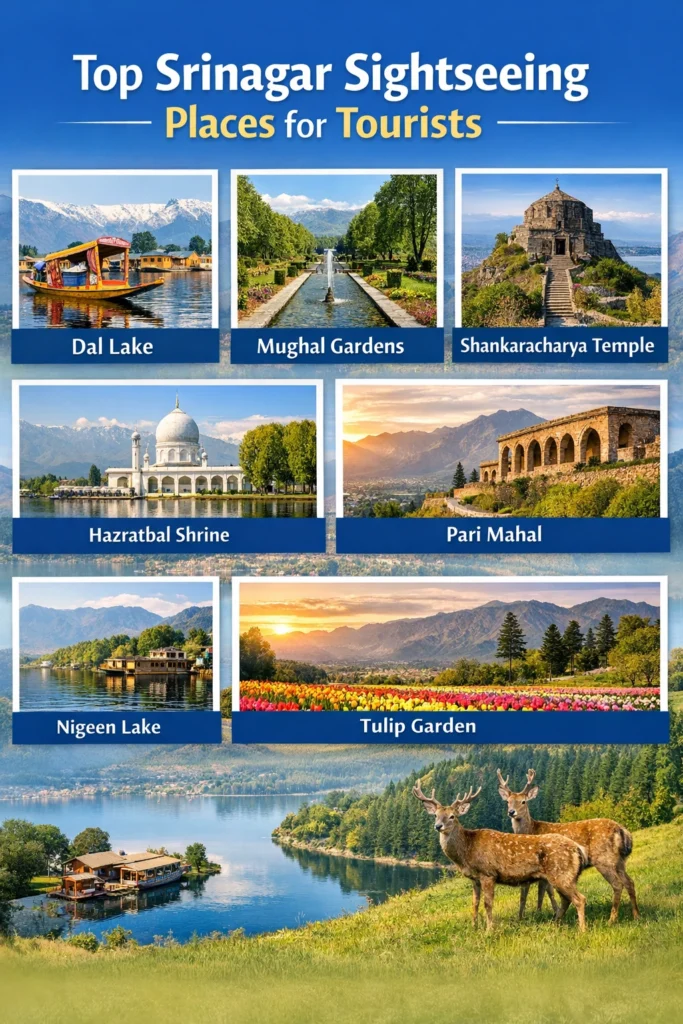
Srinagar Sightseeing at a Glance
| Srinagar Sightseeing Place | Best For | Suggested Time | What Makes It Special |
|---|---|---|---|
| Dal Lake | Everyone | 2–3 hours | Houseboats, floating market, Char Chinar |
| Shikara Ride | Couples, photographers | 45–90 min | Only way to see the lake’s interior channels |
| Nishat Bagh | Photography, first-timers | 45–60 min | Largest Mughal garden, best lake view |
| Shalimar Bagh | Couples, history | 45–60 min | Intimate royal garden, strong evening appeal |
| Chashme Shahi | Quick add-on stops | 20–30 min | Compact spring-fed garden |
| Pari Mahal | Photography, history | 30–45 min | Elevated Sufi-era terraces |
| Shankaracharya Temple | Panoramic views | 1–1.5 hours | Highest viewpoint over the city |
| Nigeen Lake | Quieter lake experience | 30–60 min | Calmer sibling of Dal Lake |
| Hazratbal Shrine | Heritage, religious interest | 20–30 min | Marble shrine on the lake’s north shore |
| Tulip Garden | Spring travellers, families | 45–60 min | Asia’s largest tulip garden (seasonal) |
| Dachigam National Park | Nature and wildlife | Half a day | Habitat of the endangered hangul |
| Hari Parbat & Fort | History | 45–60 min | Three-faith heritage hill |
| Old Srinagar | Culture, heritage | 1.5–2 hours | Old city lanes and craft workshops |



Frequently Asked Questions About Srinagar Sightseeing Places
What are the best Srinagar sightseeing places?
The best Srinagar sightseeing places for first-time visitors include Dal Lake and a Shikara ride, Nishat Bagh, Shalimar Bagh, Chashme Shahi, Pari Mahal, Shankaracharya Temple, Nigeen Lake, Hazratbal Shrine and the Indira Gandhi Memorial Tulip Garden. Old Srinagar and places such as Hari Parbat, Naseem Bagh and Badamwari are useful additions for travellers who want more than the classic sightseeing circuit.
What are the top 10 places to visit in Srinagar?
A practical top 10 list is Dal Lake, Shikara Ride, Nishat Bagh, Shalimar Bagh, Chashme Shahi, Shankaracharya Temple, Pari Mahal, Nigeen Lake, Hazratbal Shrine and Indira Gandhi Memorial Tulip Garden. The ideal order depends on the season and how much time you have.
Which is the most famous place to visit in Srinagar?
Dal Lake is the most iconic Srinagar attraction and is one of the city’s defining sightseeing experiences. A visit is more complete when you combine the lake with a Shikara ride rather than only viewing it from the shore.
How many days are enough for Srinagar sightseeing?
Two full sightseeing days are a practical choice for seeing Srinagar without rushing. One day can cover the major highlights, while two days allow more time for the Old City, Nigeen Lake, heritage attractions and quieter places. Current Srinagar sightseeing guides similarly recommend around two days for a comfortable city-focused visit.
What are the best places to visit in Srinagar in 1 day?
For one day, prioritize Dal Lake and a Shikara ride, Shankaracharya Temple, Nishat Bagh, Shalimar Bagh and one or two additional attractions based on the route. Trying to visit every major Srinagar attraction in a single day can make the sightseeing rushed.
What are the best places to visit in Srinagar in 2 days?
With two days, you can combine the classic attractions on the first day with Old Srinagar, Hazratbal, Nigeen Lake, Hari Parbat, Naseem Bagh or another quieter attraction on the second day. This gives a better balance between scenery, heritage and local experiences.
What are the best places for couples in Srinagar?
Dal Lake, a private Shikara ride, Nigeen Lake, Pari Mahal and the Mughal Gardens are among the most suitable Srinagar sightseeing choices for couples. The best combination depends on whether you prefer lake experiences, gardens, viewpoints or photography.
What are the best Srinagar sightseeing places for families?
Dal Lake, Shikara rides, Nishat Bagh, Shalimar Bagh, Chashme Shahi, Tulip Garden when open, and selected easy-access cultural attractions are good family options. A realistic itinerary is better than trying to cover every attraction.
Which places in Srinagar are best for photography?
Dal Lake, Char Chinar, Nishat Bagh, Shalimar Bagh, Pari Mahal, Nigeen Lake, Naseem Bagh, Old Srinagar and the Tulip Garden during its flowering season offer different photography opportunities. Autumn is especially useful for travellers interested in Chinar foliage.
What are the historical places to visit in Srinagar?
Important historical and cultural sightseeing places include Shankaracharya Temple, Hari Parbat, Hari Parbat Fort, Pari Mahal, Jamia Masjid, Hazratbal Shrine and the heritage areas of Old Srinagar. These attractions show a different side of the city beyond its gardens and lakes.
Is Dal Lake worth visiting in Srinagar?
Yes. Dal Lake is central to the Srinagar sightseeing experience, particularly when combined with a Shikara ride. The lake, surrounding mountains, houseboats and floating activity make it different from a conventional city attraction.
Is Nigeen Lake worth visiting?
Yes, especially for travellers looking for a quieter lake experience. Nigeen Lake is one of Srinagar’s notable lakes and can be considered alongside Dal Lake when planning local sightseeing.
Which Mughal garden is best in Srinagar?
There is no single best garden for everyone. Nishat Bagh is particularly strong for broad lake and mountain views, Shalimar Bagh for historic Mughal-garden atmosphere, and Chashme Shahi for its smaller scale and spring-fed setting. Visiting more than one makes the differences easier to appreciate.
Are Nishat Bagh, Shalimar Bagh and Chashme Shahi worth visiting together?
Yes. The three gardens form one of the main sightseeing clusters in Srinagar and can be planned together more efficiently than treating them as completely separate city trips. Their design, setting and atmosphere are not identical, so visiting more than one adds variety.
Is Shankaracharya Temple worth visiting in Srinagar?
Yes, particularly for travellers interested in a major religious landmark and elevated views over Srinagar. It is one of the city’s key sightseeing attractions and is frequently included in first-time itineraries.
Is Pari Mahal worth visiting?
Yes. Pari Mahal is especially attractive for travellers interested in architecture, historical surroundings, elevated views and photography. It works well as part of a viewpoint-and-garden-focused Srinagar sightseeing route.
Is Hazratbal Shrine a tourist place in Srinagar?
Yes. Hazratbal is an important religious and cultural landmark in Srinagar and is also a significant sightseeing stop because of its setting near Dal Lake. Visitors should follow the site’s religious etiquette and current visitor requirements.
What are the lesser-known places to explore in Srinagar?
Travellers looking beyond the standard list can consider Naseem Bagh, Badamwari Garden, parts of Old Srinagar, Harwan and other less-prominent local attractions. These can add a quieter and more local dimension to a Srinagar sightseeing plan.
What are the hidden places to visit in Srinagar?
Rather than looking only for places marketed as “hidden,” consider lesser-covered attractions such as Badamwari, Naseem Bagh, selected Old City areas and Harwan. Their appeal is usually their quieter atmosphere or cultural character rather than being completely unknown.
What are the best places to visit in Srinagar beyond Dal Lake?
Start with the Mughal Gardens, Shankaracharya Temple, Pari Mahal, Nigeen Lake, Hazratbal, Old Srinagar, Hari Parbat and seasonal attractions such as Tulip Garden. Srinagar sightseeing is much broader than Dal Lake alone.
What are the best places to visit near Srinagar?
Popular destinations near Srinagar include Doodhpathri, Yusmarg, Gulmarg, Sonamarg and Pahalgam, while Dachigam is also relevant for nature-oriented trips around Srinagar. These should generally be treated as separate excursions rather than squeezed into a full city-sightseeing day.
Can I cover Srinagar sightseeing in one day?
Yes, but only if you prioritize the main attractions and keep the route realistic. Dal Lake, a Shikara ride, one or two Mughal Gardens, Shankaracharya Temple and another nearby attraction can form a practical one-day plan.
What is the best time of year for Srinagar sightseeing?
The best time depends on what you want to see. Spring is especially attractive for flowering gardens, summer is popular for general sightseeing, autumn is strong for Chinar colours and photography, and winter offers a different seasonal atmosphere.
Which Srinagar sightseeing places are best in autumn?
Naseem Bagh, Mughal Gardens, Dal Lake surroundings, Pari Mahal and other tree-filled parts of Srinagar are particularly appealing in autumn, especially for Chinar foliage photography. Naseem Bagh is specifically noted for its autumn scenery.
Which places are best to visit in Srinagar during spring?
The Tulip Garden, Mughal Gardens, Badamwari and other landscaped areas are strong spring choices. Spring is particularly suited to travellers who want flowers, gardens and outdoor photography.
What is the best time of day for Srinagar sightseeing?
Start earlier when possible, especially for a one-day plan. Early hours can be useful for lake experiences and photography, while gardens and viewpoints can be scheduled later according to the season, opening arrangements and your route. Current local guides also recommend early or later-day garden visits for better light and fewer crowds.
What is the best Srinagar local sightseeing itinerary?
A practical itinerary groups attractions instead of moving randomly across the city. A classic plan can combine Dal Lake and the Shikara experience with the Mughal Garden circuit and Shankaracharya, while a second day can focus more on Old Srinagar, Hazratbal, Nigeen Lake and lesser-visited attractions.
Which are the best tourist places in Srinagar for first-time visitors?
First-time visitors should generally prioritize Dal Lake, Shikara riding, Nishat Bagh, Shalimar Bagh, Chashme Shahi, Shankaracharya Temple, Pari Mahal and one or two cultural landmarks such as Hazratbal or Old Srinagar.
How many places can I visit in Srinagar in one day?
There is no fixed number because travel time, season and how long you spend at each attraction vary. A better approach is to choose a small group of attractions that fit the same route rather than counting how many names you can tick off.
Which places in Srinagar are best for a short visit?
For a short stay, prioritize Dal Lake, a Shikara ride, one or two Mughal Gardens, Shankaracharya Temple and Pari Mahal or another attraction that fits the route. This gives a mix of lake, garden, heritage and viewpoint experiences.
What are the best Srinagar sightseeing places for photography?
For a photography-focused day, prioritize Dal Lake, Char Chinar, Nishat Bagh, Pari Mahal, Nigeen Lake and Naseem Bagh, with the Tulip Garden added during flowering season. Different locations work better for water reflections, architecture, gardens or foliage.
Are Srinagar sightseeing places suitable for senior citizens?
Many major Srinagar attractions can be visited by senior travellers, but the itinerary should be paced carefully. Choose fewer attractions, allow more time at each stop and consider the walking, steps and access involved at individual sites.
What should I see first in Srinagar?
For most first-time visitors, Dal Lake is the natural starting point, especially with a Shikara experience. After that, the best next stops depend on your route, available time and whether you prefer gardens, heritage or viewpoints.
What are the best places to explore in Srinagar besides the main tourist spots?
Old Srinagar, Naseem Bagh, Badamwari, Harwan and selected heritage areas offer alternatives to the busiest classic attractions. They are better suited to travellers who have extra time and want a less standard sightseeing experience.
Can Srinagar sightseeing and nearby destinations be covered on the same day?
It is usually better not to combine a full Srinagar sightseeing route with a distant day-trip destination. Keeping the city attractions together leaves more time to actually experience the places instead of spending most of the day travelling.
Is Srinagar sightseeing worth doing if I am staying only one night?
Yes. A carefully planned one-day city route can still cover several important attractions. Prioritize the experiences most important to you rather than trying to complete a very long sightseeing checklist.
What are the most beautiful places to visit in Srinagar?
For scenic appeal, Dal Lake, Nishat Bagh, Shalimar Bagh, Pari Mahal, Nigeen Lake and the surrounding hill and garden landscapes are among the strongest choices. The best option depends on whether you prefer water views, gardens, mountains or architecture.
What are the best sightseeing places in Srinagar for a peaceful experience?
Nigeen Lake, Naseem Bagh, Badamwari and selected quieter garden or heritage areas can provide a more relaxed experience than the busiest tourist stops. Timing also makes a major difference to the atmosphere.
What are the must-visit places in Srinagar for first-time tourists?
The essential shortlist is Dal Lake, Shikara Ride, Nishat Bagh, Shalimar Bagh, Chashme Shahi, Shankaracharya Temple, Pari Mahal, Nigeen Lake and at least one important cultural or religious landmark.
What are the best Srinagar sightseeing places in 2 days for couples?
Couples can build a two-day plan around Dal Lake and a Shikara ride, the Mughal Gardens, Pari Mahal and Nigeen Lake, then add selected heritage or photography locations on the second day. This provides variety without making the itinerary feel rushed.
Planning Your Srinagar Sightseeing with Panda Tours and Travels
If you’d rather not plan the routing and timing yourself, Panda Tours and Travels arranges Srinagar sightseeing days and multi-day Kashmir itineraries built around the clusters and timings described above, with local guidance on which combinations work best for your season and travel style.
Conclusion
Srinagar sightseeing places rewards a bit of planning far more than a long list of names. Dal Lake and its shikara ride, the Mughal gardens, a hilltop viewpoint and a heritage stop in the old city cover the core of what the city offers, while places like Badamwari, Naseem Bagh and Harwan reward a second visit or a slower pace. Whether you have one day or two, grouping attractions geographically and picking one strong option per category rather than trying to see everything is what actually makes a Srinagar sightseeing trip work.
PLANNING A TRIP TO KASHMIR ? CONTACT LOCAL EXPERTS IN SRINAGAR, KASHMIR FOR CUSTOMISED KASHMIR TOUR PACKAGES