Summer in Kashmir runs roughly from May to August, with June and early July marking the peak travel window. In the valley — Srinagar, Pahalgam, and similar altitudes daytime temperatures generally sit between 22°C and 33°C, cooling to 12–18°C after dark, so afternoons feel warm while mornings and evenings stay comfortable. Higher destinations such as Gulmarg and Sonamarg run noticeably cooler, and patches of old snow can still be seen near their upper slopes and ridgelines well into June, occasionally later at glacier-adjacent points.
Meadows turn fully green, rivers run high with snowmelt, and the mountain backdrop stays visible on clear days. July and August bring the monsoon’s edge, so short spells of rain are common. Summer suits travellers who want greenery, manageable weather, and full access to most destinations, though popular spots do get busy through June.
Panda Tours and Travels is a Srinagar-based local tour operator helping travellers plan and experience Kashmir. Registration No.: JKEA00006046 GSTIN: 01BDCPA2043R1ZY Call / WhatsApp: +91 7006982655.
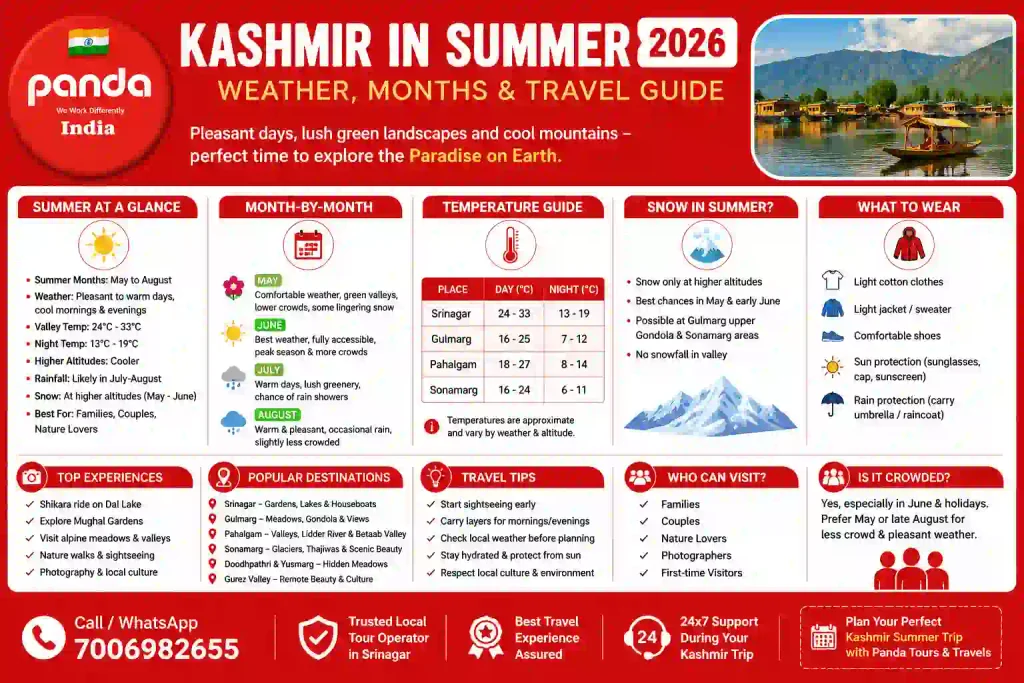
Kashmir in Summer at a Glance
| Aspect | What to Expect |
|---|---|
| Summer months | Roughly May to August, with June–early July as the busiest window |
| General weather | Warm, mostly clear days with occasional showers, especially from July |
| Typical valley feel | Pleasant mornings, warm afternoons, cool evenings in Srinagar, Pahalgam and similar altitudes |
| Higher-elevation feel | Distinctly cooler in Gulmarg and Sonamarg; a light jacket is useful even at midday |
| Rain possibility | Occasional short spells throughout summer, more frequent from mid-July onward |
| Snow possibility | Mostly gone from lower meadows by June; lingering patches possible at higher ridgelines and glacier-adjacent areas, especially early summer |
| Crowd level | Moderate to high in June and around holiday periods; comparatively quieter in early May and late August |
| Best suited for | Families, first-time visitors, nature lovers, and travellers who prefer greenery and manageable weather over deep snow |
What Is Summer Like in Kashmir?
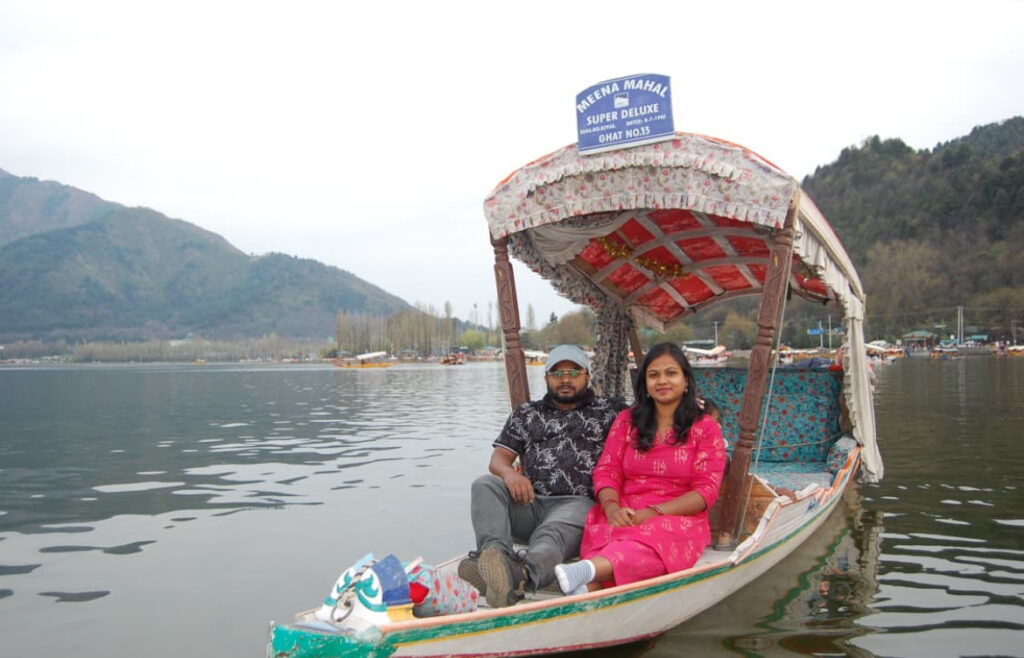
Summer changes the character of the valley more than most seasons. The brown, bare slopes of late winter give way to fields of green, apple and almond orchards fill out with leaves, and the rice paddies around Srinagar turn a deep emerald by June. Dal Lake and the Jhelum River carry more water from the spring snowmelt, and houseboats and shikaras sit against a backdrop of visibly fuller waterways.
Mornings in Srinagar are usually mild and unhurried, good for houseboat breakfasts or an early shikara ride before the heat builds. Afternoons are the warmest part of the day in the valley, and this is when most sightseeing feels most demanding. Evenings cool down again, often enough that a light layer feels welcome after sunset, particularly near water or in gardens.
The picture changes with altitude. Gulmarg, at close to 2,700 metres, and Sonamarg, higher still, stay several degrees cooler than Srinagar through the entire season. It’s common to leave a warm valley morning and reach a meadow where a jacket is genuinely necessary by midday. This is one of the most distinctive things about a Kashmir summer trip — the same day can move between two noticeably different climates depending on where you go.

Kashmir Summer Weather: What to Expect
There is no single “Kashmir summer temperature.” Weather depends heavily on where you are standing.
In the valley — Srinagar, Pahalgam’s lower reaches, and similarly elevated spots — days are warm and often sunny, with afternoon sun that can feel strong, especially in June. Evenings bring a real drop in temperature, helped by the surrounding mountains and, in Srinagar’s case, the lake and river systems.
At higher elevations, the pattern shifts. Gulmarg and Sonamarg see cooler days overall, with mornings and evenings that can feel closer to early spring than to a plains summer. Wind exposure adds to the chill at these heights, so a location’s altitude tells you more about likely comfort than the calendar month does.
Rain is part of the picture too. Kashmir sits at the edge of the Indian monsoon’s reach, so summer showers are common rather than exceptional, particularly from mid-July through August. These showers are typically short and localised rather than continuous, but they can affect visibility on higher routes and occasionally disrupt a day’s sightseeing plan. Cloud cover also moves quickly in the mountains — a clear Gulmarg morning can turn misty within an hour, then clear again by afternoon.
Because valley and mountain conditions diverge so much, the most useful mental model for a Kashmir summer trip isn’t “hot” or “cool” — it’s “warm below, cooler above, with weather that can shift through the day.”
Kashmir Summer Temperature by Month
| Month | Valley daytime (approx.) | Valley night/evening (approx.) | Higher-elevation feel | What to expect |
|---|---|---|---|---|
| May | 20–28°C | 10–15°C | Cool, occasional lingering snow at altitude | Transitional, greening landscape, comfortable sightseeing |
| June | 24–32°C | 13–18°C | Cool mornings, mild afternoons; some upper snow patches remain | Peak travel month, warm valley afternoons |
| July | 25–33°C | 15–19°C | Cooler than valley, rain more frequent | Warm, occasional showers, lush greenery |
| August | 24–31°C | 14–18°C | Similar to July, cooler at height | Rain likely at some point, humid afternoons in the valley |
These are indicative seasonal ranges rather than fixed daily figures, and mountain destinations run several degrees cooler than these valley numbers at any point in the range. Actual conditions vary year to year, so check a current forecast closer to your travel dates, especially before a Gulmarg or Sonamarg-heavy day.
Kashmir in May
May sits at the edge of Kashmir’s spring-to-summer transition. The valley is well into its green season by this point — orchards are in full leaf, and Srinagar’s gardens are past their tulip peak but still colourful. Daytime temperatures are comfortable for sightseeing without the stronger afternoon warmth of June, and evenings can still carry a genuine chill, particularly near water.
At higher elevations, May is where the snow question gets interesting. Gulmarg’s lower meadows are usually clear, but patches can still linger near the upper Gondola stations and ridgelines depending on how the winter played out. Sonamarg, being higher and more exposed, is more likely to show snow at this point in the season than Gulmarg is.
May suits travellers who want cooler, less crowded conditions than peak June, along with landscapes that are green but not yet at their most crowded with visitors. It is not a spring-flower guide in itself — by May, that window has largely passed — but it remains one of the more comfortable months for a first Kashmir visit.
Kashmir in June
June is generally considered the peak of Kashmir’s summer travel season, and the weather explains why. The valley is consistently warm during the day, meadows are fully green, and higher destinations are largely accessible without the access complications winter can bring.
Srinagar afternoons in June can be genuinely warm, so most travellers find early starts more comfortable for sightseeing, saving houseboat time or garden walks for the cooler parts of the day. Gulmarg and Sonamarg remain noticeably cooler, and this contrast is part of the appeal — many visitors experience a warm valley morning and a jacket-weather afternoon in the mountains on the same day.
Because June combines reliable weather with strong access, it draws the largest numbers of domestic and international travellers of any summer month. Families tend to favour it for exactly this reason: predictable conditions, functioning infrastructure, and comfortable temperatures across most itineraries. The trade-off is that popular stops — Gondola queues in Gulmarg, key viewpoints in Pahalgam, central Dal Lake access — are at their busiest.
Kashmir in July
July brings warmer valley afternoons and the first consistent arrival of monsoon-influenced showers. Greenery is at its richest by this point, rivers and waterfalls run fuller, and the landscape has a lushness that later summer months don’t quite match. Rain tends to arrive as shorter spells rather than sustained downpours, but it’s frequent enough that a rain layer earns its place in the bag.
Higher destinations stay cooler than the valley, though cloud and mist can move in and out through the day, occasionally affecting mountain views. Because rain is a real factor this month, flexibility matters more than in June — a plan that allows a spare hour or a shifted sightseeing order handles July’s weather better than a tightly fixed itinerary does.
For a full month-by-month breakdown specific to this period, see our dedicated guide to Kashmir in July.
Kashmir in August
August continues July’s pattern — warm valley days, cooler nights, and a real chance of rain at some point during a multi-day stay. Humidity tends to be a touch higher in the valley this month, which can make afternoon sightseeing feel more tiring than the temperature alone would suggest.
Greenery remains strong, and higher-altitude destinations stay accessible, though mountain weather can turn quickly, so it’s worth confirming conditions before a full day built around Sonamarg or Gulmarg’s upper points. August is not defined solely by rain — many days are clear and pleasant — but travellers should expect at least a few showers across a typical trip rather than treating it as a guaranteed dry month.
How Different Parts of Kashmir Feel in Summer
Kashmir’s summer isn’t uniform. Altitude and terrain change the experience significantly from one destination to the next.
Srinagar
The valley floor, and the warmest of the well-known destinations in summer. Expect warm afternoons, mild mornings and evenings, and full access to Dal Lake, the Mughal gardens, and the old city.
Gulmarg
Sitting at higher altitude, Gulmarg runs noticeably cooler than Srinagar through the entire summer. Meadows are green and full of wildflowers, and a light jacket is genuinely useful even on a sunny June afternoon.
Pahalgam
A valley-and-meadow setting along the Lidder River, with a climate closer to Srinagar’s than to Gulmarg’s higher slopes, though evenings by the river carry a distinct chill.
Sonamarg
Higher and more exposed than Gulmarg, with the most likely chance of visible snow patches at nearby glacier-adjacent points, particularly earlier in summer. Weather here can change faster than in the lower valley.
Doodhpathri
A quieter, high meadow experience — cooler than Srinagar, with rolling green pasture rather than dramatic peaks. Good for travellers wanting a slower, less crowded summer stop.
Yusmarg
A forested meadow setting with a similarly cool, green character to Doodhpathri, appealing for a half-day away from the busier circuits.
Achabal, verinag and kokernag
Achabal, Verinag and Kokernag are beautiful destinations in south Kashmir, known for their natural springs, lush Mughal gardens, green landscapes, and peaceful surroundings. Achabal is famous for its historic Mughal garden and spring, Verinag for its iconic spring and mountain setting, while Kokernag attracts visitors with its fresh springs, gardens, and scenic valleys, making all three ideal stops for a relaxing Kashmir sightseeing experience.
Keran Valley
Keran Valley is a picturesque border destination surrounded by mountains, forests, and the flowing Kishanganga River. Its peaceful villages and untouched landscapes give travelers a glimpse of Kashmir beyond the usual tourist circuit.
Sinthantop
Sinthan Top is a high-altitude mountain pass offering spectacular views of snow-covered peaks and vast valleys. The dramatic scenery and winding mountain roads make it a popular destination for nature and adventure lovers.
Gurez Valley
More remote and higher than most standard itineraries, with a shorter, more seasonally distinct summer window and conditions that depend heavily on current access and weather.
For a full list of summer destinations and detailed sightseeing information, see top places to visit in Kashmir in summer.
What Does Kashmir Look Like in Summer?
Summer is when Kashmir’s landscape is at its most visibly alive. Rice paddies around Srinagar shift from pale green to a deeper emerald as the season progresses. Orchards are in full leaf, and by June and July, apple and walnut trees carry visible fruit. Meadows at Gulmarg, Doodhpathri, and Yusmarg are covered in wildflowers, with colour that peaks around June before tapering later in summer.
Rivers and streams run fuller than in most other seasons, fed by snowmelt from higher elevations — the Lidder near Pahalgam and the Sindh near Sonamarg both carry noticeably more water than they do in autumn or winter. Dal Lake sits under a backdrop of green hillsides rather than the bare slopes of early spring or the snow of winter.
At higher elevations, the picture includes both green and white — meadows in the foreground with old snow still visible on the upper ridgelines, particularly through May and into June. Skies tend to be clearer in the mornings, with cloud building through the afternoon, especially from July onward, giving Kashmir’s summer light a changeable quality through the day.
Can You See Snow in Kashmir in Summer?
Yes, but only at higher elevations and only as lingering or old snow rather than fresh snowfall. Lower valley areas, including Srinagar, Pahalgam’s lower reaches, and most meadows, are snow-free by summer.
The likelihood depends on three things: month, elevation, and how the previous winter went. Early summer — May into June — offers the best chance, with patches sometimes visible near Gulmarg’s upper Gondola stations, Khilanmarg, and Sonamarg’s higher, glacier-adjacent points. By July, most of this has melted at accessible points, though isolated patches can persist at higher, less-visited elevations depending on that year’s conditions.
It’s worth being clear about what this is: leftover winter snow slowly melting, not active snowfall. Summer in Kashmir does not typically bring fresh snow at tourist-accessible altitudes. Travellers hoping specifically to walk on snow have a better, more reliable chance at these same destinations in winter, when snowfall is active and widespread rather than limited to scattered high-altitude patches.
What Can You Do in Kashmir During Summer?
Summer opens up experiences that other seasons restrict or complicate.
- Shikara rides on Dal and Nigeen Lake, best in the cooler morning or evening hours
- Meadow walks at Gulmarg, Doodhpathri, and Yusmarg while wildflowers are at their peak
- Nature photography, with green landscapes, fuller rivers, and clear-morning mountain views
- Sightseeing across Srinagar’s gardens, old city, and lakeside areas without winter access limits
- High-altitude scenery, with the Gondola in Gulmarg and drives toward Sonamarg both fully operational
- Outdoor recreation, including pony rides, short walks, and river-side time along the Lidder and Sindh
- Local markets, particularly Srinagar’s old city bazaars, comfortable to explore in the cooler parts of the day
- Cultural experiences, from houseboat stays to visiting shrines and heritage sites around the old city
- Trekking, where conditions and current access permit, generally best organised locally given how quickly mountain weather can change
Is Kashmir Crowded in Summer?
Yes, particularly through June and around national holiday periods, when Kashmir sees its highest volume of domestic and international travellers. Gulmarg’s Gondola, Pahalgam’s key viewpoints, and central spots around Dal Lake are where crowding is most noticeable, especially mid-morning through early afternoon.
Early May and late August tend to be quieter, offering similar greenery and generally comfortable weather with fewer visitors at the same popular stops. Weekday travel within summer months is typically less crowded than weekends, and starting sightseeing early in the day — before mid-morning — consistently makes the most difference regardless of which month you choose.
There’s no need to treat every summer week as equally busy; crowd levels move with school holidays, weekends, and specific festival periods rather than staying constant across the whole season.
Who Is Kashmir in Summer Best For?
Summer works well for first-time visitors who want a manageable introduction to Kashmir — comfortable temperatures, full destination access, and greenery that photographs well without requiring cold-weather preparation. Families tend to favour this season for the same reasons, alongside more predictable travel logistics than winter can offer.
Nature lovers and photographers find summer rewarding for its meadows, wildflowers, and the contrast between green lower elevations and snow-touched higher points early in the season. Couples looking for a relaxed houseboat stay, garden walks, and mountain day trips also fit well within a typical summer itinerary.
Summer is a weaker fit for travellers whose only priority is widespread snowfall — winter suits that goal far better, with active snow rather than scattered high-altitude patches. Similarly, those chasing peak autumn colour should look at the autumn season instead, since summer’s palette is green rather than the golds and reds of October and November.
What Should You Wear in Kashmir in Summer?
Pack for warm valley days and cooler mountain hours within the same trip.
- Breathable daytime clothing — cotton or linen works well for Srinagar and Pahalgam’s warmer afternoons
- Light layers that can be added or removed as you move between valley and higher-altitude stops
- A light jacket or fleece, essential for Gulmarg and Sonamarg regardless of how warm the valley feels
- Comfortable, closed footwear for meadow walks and uneven ground at higher elevations
- Sun protection — sunglasses, sunscreen, and a hat, since UV exposure is stronger at altitude
- Rain protection, particularly a compact umbrella or light rain jacket from July onward
- A warmer layer for evenings, especially near water in Srinagar or at any higher destination after sunset
Practical Tips for Visiting Kashmir in Summer
- Check current weather before any day built around Gulmarg or Sonamarg, since mountain conditions shift faster than valley ones
- Start popular sightseeing early, ideally before mid-morning, to avoid both crowds and the day’s warmest hours
- Carry layers rather than relying on a single outfit for the whole day
- Protect yourself from sun exposure, which is stronger at higher elevations than the temperature alone suggests
- Carry basic rain protection, particularly from July through August
- Build some flexibility into multi-day itineraries so a rainy morning doesn’t derail the whole plan
- Confirm access conditions before visiting higher-altitude points like Sonamarg’s upper reaches or Gurez Valley
- Respect local environments — stick to marked paths in meadows and avoid disturbing agricultural land
- Avoid littering, particularly around lakes, rivers, and meadow areas that see heavy summer footfall
- Where possible, plan key sightseeing around weekdays rather than weekends during peak June travel
What Can Change During a Kashmir Summer Trip?
A few conditions are worth planning around, since they can shift during a trip rather than staying fixed for the whole season.
Rain is the most common variable, particularly from mid-July onward, and can affect visibility or comfort on higher routes. Occasional landslides or temporary road restrictions can follow heavier rain in the mountains, and local road access can be adjusted at short notice depending on conditions and local administration decisions. High-altitude weather at Sonamarg and similar points can turn quickly, sometimes affecting a planned day trip. Crowd pressure also shifts through the season, tied to school holidays, weekends, and specific religious or festival periods that bring additional local and pilgrim traffic to parts of the region.
None of this should be read as a fixed warning against summer travel — these are manageable, typical seasonal variables rather than regular disruptions. The practical approach is simple: check conditions locally close to travel dates, particularly before mountain-heavy days, and build some flexibility into the itinerary.
Travellers deciding between Kashmir’s seasons more broadly may find it useful to compare summer against the rest of the year — see our guide to the best month to visit Kashmir for a fuller picture. And for those exploring Srinagar itself within a summer trip, our Srinagar sightseeing places guide covers the city’s gardens, lake, and old city in more detail.





Frequently Asked Questions About Kashmir in Summer
What is Kashmir weather like in summer?
Kashmir generally has warm valley days, cooler mornings and evenings, and noticeably cooler conditions at higher destinations such as Gulmarg and Sonamarg. Summer weather can vary by month, location, elevation, and short periods of rainfall.
How hot does Kashmir get in summer?
In Srinagar and other valley areas, daytime temperatures can commonly reach the mid-20s to low-30s°C during summer, while evenings are considerably cooler. Higher-altitude destinations such as Gulmarg and Sonamarg remain several degrees cooler.
What is the summer temperature in Kashmir?
There is no single summer temperature for all of Kashmir because conditions vary considerably by location and elevation. Srinagar and other valley areas are warmer, while places such as Gulmarg and Sonamarg generally experience cooler conditions.
Which months are summer in Kashmir?
Summer in Kashmir is generally considered to run from around May through August. May marks the transition into warmer conditions, June is typically a popular peak-summer month, while July and August can bring warmer weather with a greater chance of rain.
Is May good for Kashmir?
Yes, May can be an excellent time to visit Kashmir. The valley becomes increasingly green, temperatures are generally comfortable for sightseeing, and some higher-altitude areas may still have patches of lingering snow depending on recent weather and elevation.
Is June good for Kashmir?
Yes. June is one of the most popular summer months for visiting Kashmir because of generally comfortable weather, lush landscapes, and good conditions for sightseeing across many destinations. Because it is popular, some places can also be busier.
Is July good for Kashmir?
Yes, July can be a good month for Kashmir, particularly for travellers who enjoy lush green landscapes. Valley temperatures are warmer, while short rain spells can occur, so keeping some flexibility in your sightseeing plans is useful.
For detailed July-specific information, see our guide to Kashmir in July.
Is August good for Kashmir?
Yes. August continues to offer green landscapes, warm valley conditions, and cooler mountain environments. Rain can occur during this period, so travellers should keep an eye on local weather conditions, particularly when planning visits to higher-altitude areas.
Can you see snow in Kashmir in summer?
Yes, but generally not across the lower valley. Lingering snow may remain at higher elevations, particularly early in the summer season. The amount and exact locations depend on elevation, recent weather, and current accessibility, so snow should not be guaranteed.
Where can you still find snow in summer in Kashmir?
Higher-altitude areas around Gulmarg and Sonamarg can retain patches of old snow during the early part of summer. The likelihood generally decreases as the season progresses, and actual conditions vary from year to year.
Is Kashmir good for a summer holiday?
Yes. Summer is particularly suitable for travellers who want greener landscapes, comfortable valley conditions, and opportunities to explore Kashmir’s major mountain and valley destinations without the colder conditions of winter.
Is Kashmir crowded in summer?
Kashmir can be quite busy during the summer, particularly around popular destinations, weekends, and holiday periods. June is typically among the busier periods, while travel demand can vary during May, July, and August.
Does it rain in Kashmir during summer?
Yes. Rain can occur during summer, with rainfall becoming more noticeable during the later part of the season. Rain is often intermittent rather than continuous, but mountain weather can change quickly, so checking current conditions is important.
What should I wear in Kashmir in summer?
Wear comfortable, breathable clothing for warmer daytime conditions and carry light layers for mornings, evenings, and higher-altitude destinations. A light jacket, comfortable walking shoes, sun protection, and rain protection are useful, particularly later in summer.
Is Gulmarg good in summer?
Yes. Gulmarg is particularly attractive in summer because of its green meadows, cooler mountain climate, and scenic high-altitude surroundings. Conditions are generally much cooler than in the Kashmir Valley, making it a popular summer destination.
Is Pahalgam good in summer?
Yes. Pahalgam is well suited to summer travel, with green valleys, mountain scenery, and the Lidder River contributing to its appeal. Its conditions are generally milder than the higher reaches of Gulmarg and are comfortable for outdoor sightseeing.
Is Sonamarg good in summer?
Yes. Summer is an important season for visiting Sonamarg, especially for travellers interested in high-altitude mountain scenery. Depending on the month and recent weather, lingering snow may still be visible in some nearby higher areas.
Is summer good for families visiting Kashmir?
Yes. Summer is generally a convenient season for family travel because many popular destinations are accessible, daytime conditions are suitable for sightseeing, and travellers do not have to plan around the colder conditions associated with winter.
Is summer good for couples visiting Kashmir?
Yes. Summer can be a comfortable season for couples who want to enjoy Kashmir’s lakes, gardens, mountain scenery, houseboat stays, and relaxed sightseeing without dealing with winter’s colder conditions.
Is Kashmir in summer good for first-time visitors?
Yes. Summer is generally one of the easiest seasons for a first visit because travellers can experience green landscapes, major destinations, and outdoor sightseeing in relatively comfortable conditions. However, weather can still vary by location and month.