
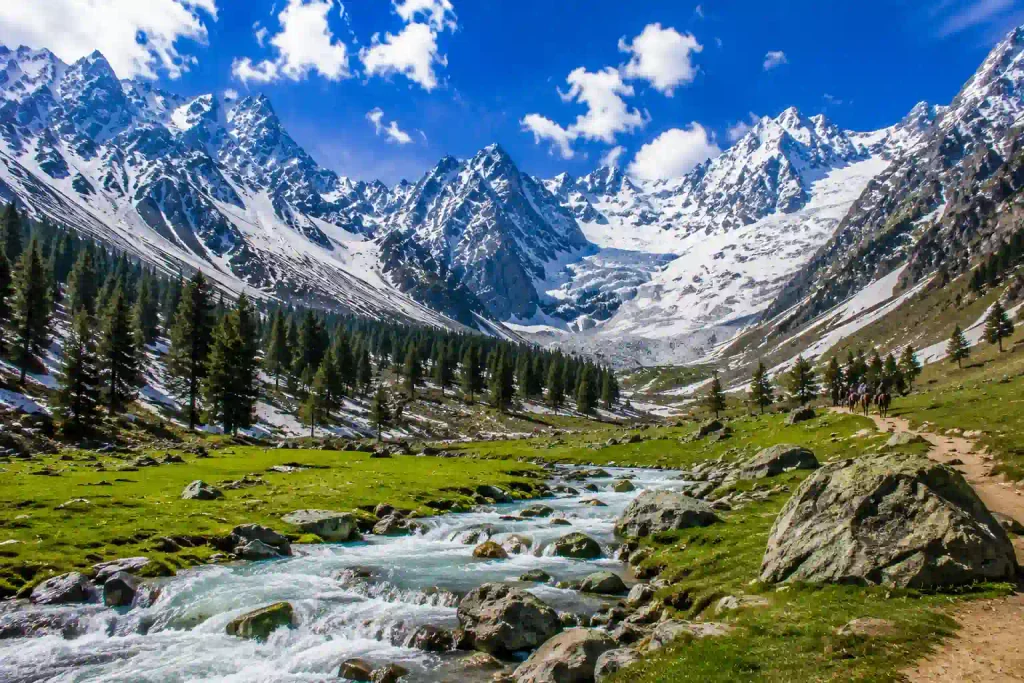
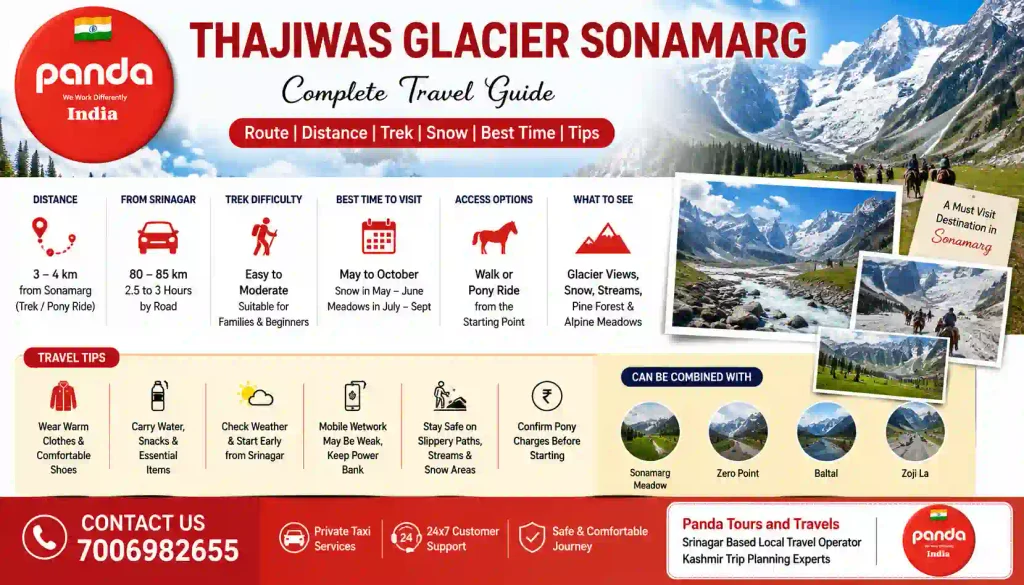
Thajiwas Glacier Sonamarg is approximately 3 km from Sonamarg town/market. It is one of Sonamarg’s most popular attractions, known for its snow, mountain scenery and alpine landscape. Visitors generally reach the glacier from Sonamarg by walking or taking a pony, with the journey taking roughly 1– 11.5 hours depending on the route, conditions and pace. Thajiwas Glacier is around 9,186 feet above sea level.
Panda Tours and Travels is a Srinagar-based local operator that helps travellers plan Jammu and Kashmir trips, including transport and timing for Sonamarg and Thajiwas Glacier. We arrange taxis for the Srinagar–Sonamarg road journey and help build realistic day-trip or overnight itineraries around the glacier visit. Because trail and snow conditions change through the season, we also share current, on-ground updates before you travel. Registration No. JKEA00006046. For planning help, you can call or WhatsApp us at +91 7006982655.
Thajiwas Glacier Sonamarg at a Glance
| Detail | Information |
|---|---|
| Location | Above Sonamarg town, Ganderbal district, Kashmir, on the Srinagar–Leh highway route |
| Approximate elevation | Roughly 3,800–4,000 metres at the glacier area (varies by exact viewpoint) |
| Distance from Sonamarg town | Short by road/track to the trailhead, then a walking or pony stretch of a 3 kilometres — see the detailed table below |
| Trail distance | Variable; depends on where the accessible snow starts that season |
| Typical visit duration | Roughly 2–4 hours for the walk/pony leg and viewing, excluding travel to Sonamarg |
| Difficulty | Easy to moderate walk on a mostly gentle gradient; not a technical mountaineering route |
| Main access options | Walk, pony ride, or a mix of both |
| Best broad season | Late April/May through September, weather permitting |
| Main experiences | Snow viewing, pony rides, meadow and pine-forest walk, photography |
What this means for a first-time visitor
If you are seeing Thajiwas Glacier for the first time, treat the numbers above as planning ranges, not fixed facts. The glacier itself is a walk or pony ride away from wherever vehicles stop near Sonamarg, and how far that walk feels depends entirely on the day’s snow cover, trail conditions, and which point locals or your driver consider the “starting point.” You don’t need trekking experience or specialised gear — sturdy shoes and warm layers are usually enough — but you should expect the last stretch to be on foot or pony, not by car.
What Is Thajiwas Glacier and Why Is It Famous?
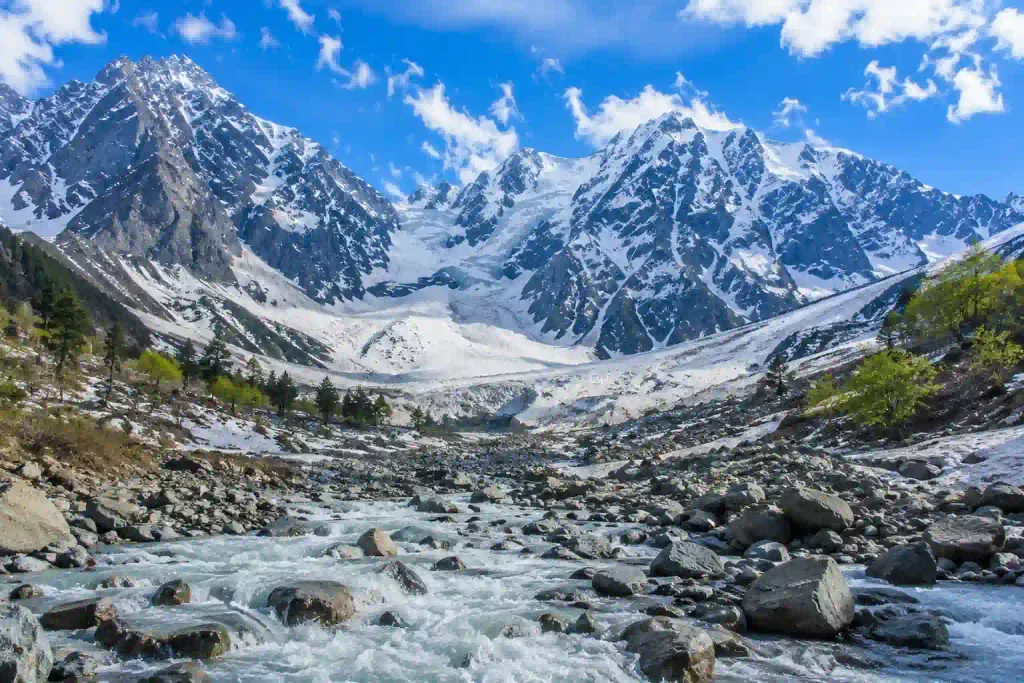
Thajiwas Glacier is a patch of permanent and seasonal snow and ice on the mountainside above Sonamarg, reached through a stretch of pine forest and alpine meadow. It’s famous largely because it’s the most accessible glacier-like landscape near Srinagar — visitors don’t need mountaineering skills, permits, or multi-day planning to see snow and glacier terrain up close.
What people actually come to see is less a single dramatic ice wall and more a full landscape: forest giving way to meadow, meadow giving way to a snowfield, with the Sindh Valley’s peaks as a backdrop. It appeals to first-time Kashmir travellers because it delivers a high-altitude, snow-and-mountain experience without requiring the fitness or preparation of an actual glacier trek.
It’s worth being clear about one thing: Thajiwas is not a mountaineering expedition. There’s no glacier travel involving crampons, ropes, or crevasse navigation for a typical visitor. What you’re doing is walking or riding to a viewing and activity area near the lower snowfield — a very different undertaking from an actual glacier ascent.
Where Exactly Is Thajiwas Glacier in Sonamarg?
Sonamarg town sits on the Srinagar–Leh highway, and Thajiwas Glacier is on the mountain slopes rising above it, reached by heading off the main road toward the base of the trail. From there, a path climbs gradually through pine forest, opens into meadow, and eventually reaches snow-covered ground.
This is exactly where online distance figures start to disagree. Some sources measure from the main Sonamarg market or bus stand; others measure from wherever the current motorable or pony track happens to begin, which itself can shift a little season to season depending on road work, water crossings, or where taxis are permitted to stop. A few describe the walking distance to the first visible snow, while others describe the distance to a specific glacier viewpoint further along. None of these are wrong — they’re just answering slightly different questions, which is why it’s more useful to think in terms of a starting area, a walking/pony stretch, and a viewing zone, rather than one single number.
Thajiwas Glacier Distance — Sonamarg, Srinagar & Srinagar Airport
| Journey | Approximate Distance | Main Travel Mode | Approximate Time |
|---|---|---|---|
| Sonamarg (town) → Thajiwas trailhead area | A short local stretch, typically covered by shared or hired local transport | Local taxi/pony stand pickup | 10–20 minutes |
| Trailhead → Thajiwas Glacier viewing area | A few kilometres, varying by snowline and route each season | Walk or pony | 45 minutes to 1.5 hours each way, pace-dependent |
| Srinagar → Sonamarg | Roughly 80–90 km by road (figures vary slightly by source and exact route) | Road (private taxi, shared taxi, or bus) | Approximately 2.5 hours, traffic and weather dependent |
| Srinagar Airport → Sonamarg | Similar to the Srinagar city distance above, plus a short city transfer | Road | Roughly 3 hours including the airport-to-city stretch |
| Srinagar → Thajiwas Glacier (full journey) | Road distance to Sonamarg plus the trailhead walk/pony stretch | Road + Walk/Pony | Best planned as most of a day when combined with the glacier visit |
Road distance is not the same as trail distance. The Srinagar–Sonamarg figure describes the highway journey by vehicle. The Thajiwas-specific distance is the separate walking or pony stretch from wherever vehicles stop to the snow and glacier area — and that second stretch is the one that varies most by season and source.
How to Reach Thajiwas Glacier from Sonamarg
- Reach Sonamarg first. Most visitors arrive by private taxi, shared sumo, or bus from Srinagar along the Srinagar–Leh highway.
- Get to the practical starting area. From the main town, a short local transfer (often by shared local taxi or on foot, depending on where your vehicle parks) brings you to the point where the walking or pony route to Thajiwas begins.
- Choose walking. The path climbs gradually through pine forest into open meadow before reaching snow-covered ground. It’s a manageable incline for most fitness levels, not a technical climb.
- Choose a pony instead. Ponies are available at the starting area for those who prefer to ride up, particularly useful for children, seniors, or anyone short on time or stamina.
- What happens at the final accessible point. Visitors typically stop at a designated viewing and activity zone on the lower snowfield — this is not an invitation to walk further onto glacier ice, which can be unstable and is not meant for casual visitors.
- How conditions change the experience. Heavy overnight snow, rain, or a landslide-affected patch can shift where the “final point” actually is on any given day. Local pony operators and drivers usually know the current situation better than any fixed online guide.
Tips for Visiting Thajiwas Glacier — What to Know Before You Go
Visiting Thajiwas Glacier is not simply a matter of reaching Sonamarg and getting out of your taxi. The practical experience can involve road travel from Srinagar, local access arrangements, an approach on foot or by pony, changing mountain weather and uneven terrain. A little preparation can make the visit much easier, especially if you are planning to return to Srinagar on the same day.
Start Your Thajiwas Glacier Visit Early
An early start gives you more daylight and more flexibility for the entire journey. If you are travelling from Srinagar, remember that your day includes the drive to Sonamarg, time for the Thajiwas approach, the glacier visit and the return journey.
Starting early can also give you some buffer if traffic, road delays or local arrangements take longer than expected. Mountain weather can change during the day, so an early departure should not be treated as a guarantee of better weather. Instead, think of it as a way to give yourself more time to handle changing conditions without rushing.
Check the Weather and Access Conditions Before Leaving
Conditions around Thajiwas Glacier can be different from those in Srinagar. Rain, snowfall, melting snow or other mountain conditions can affect the practical approach, while seasonal road conditions can affect the journey to Sonamarg.
It is useful to think of access in three stages:
Srinagar road access → Sonamarg access → Thajiwas approach/trail access.
Being able to reach Sonamarg does not automatically mean that the Thajiwas approach will have the same conditions. Check the day’s weather and local access situation before committing to activities.
Wear Shoes With Good Grip
Comfortable footwear is important because the approach may involve wet ground, mud, stones and uneven surfaces. Depending on the season and current conditions, snow or ice can also make parts of the route slippery.
Avoid smooth-soled fashion shoes or footwear that provides little traction. Shoes with a secure grip will give you better stability and make walking more comfortable, particularly when the ground is wet or uneven.
Carry Warm and Waterproof Layers
Do not judge your clothing only by the temperature in Srinagar. Conditions around the glacier can feel considerably colder, particularly when there is wind, snow or wet weather.
A practical combination is a warm layer when required, a jacket, gloves and a waterproof outer layer. If rain, melting snow or wet ground is expected, carrying an extra pair of socks can also be useful.
The objective is not to carry excessive luggage; it is to have enough protection to remain comfortable if conditions change.
Carry Water and Small Snacks
Sonamarg has tourist facilities, but you should not assume that the same level of convenience continues throughout the Thajiwas approach.
Carry enough drinking water and a few small snacks before starting the approach. This is particularly useful for families, older travellers and anyone who expects to spend several hours away from the main tourist area.
Carry Some Cash
Digital payments are increasingly common, but remote and temporary activity areas may not always provide the same payment convenience as larger towns.
Keeping some cash with you gives you a backup for small purchases or local activities. Do not assume that every vendor accepts or rejects a particular payment method; simply treat cash as a practical backup.
Keep Your Phone and Power Bank Charged
A charged phone is useful for communication, navigation, checking travel information and contacting your driver or travel companions.
Mobile connectivity can vary in mountainous areas, so do not rely on continuous network coverage. Before leaving Sonamarg, make sure your phone has sufficient battery and keep a power bank available if you have one.
Understand Where Your Taxi Can Take You
One common misunderstanding is assuming that a regular taxi from Srinagar can simply drive directly to Thajiwas Glacier.
The journey is better understood as:
Srinagar → Sonamarg by road → practical Thajiwas approach → remaining section on foot or by pony, depending on current local arrangements and conditions.
Your taxi gets you to Sonamarg; the final approach to the glacier is a different part of the experience. Confirm the day’s local access arrangements before planning your timing.
Confirm Pony Charges Before Starting
If you decide to use a pony, ask about the current charge before beginning the ride. Rates can vary according to season, local conditions and the arrangement being offered.
Also clarify exactly what the quoted amount covers. Avoid relying on an old online price as an assumed official rate because local charges and arrangements can change.
Do Not Follow Unsafe Shortcuts for Better Views
The desire to get a better photograph should not lead you away from the established route.
Avoid climbing unstable slopes, walking onto questionable snow or ice, getting too close to fast-flowing streams or taking shortcuts across unfamiliar terrain. Mountain landscapes can look deceptively easy to cross, particularly when viewed from a distance.
Stay on the safer established route and follow local instructions.
Keep Children Close During the Visit
Children may find the snow, streams, ponies and mountain landscape exciting, but these surroundings also require closer supervision.
Keep children within sight around uneven surfaces, water, snow and areas where ponies are moving. Crowded sections can also make it easier for a child to become separated from family members, so establish a simple meeting point if travelling in a larger group.
Do Not Assume Summer Means Guaranteed Snow
Thajiwas Glacier is associated with snow, but the amount and location of accessible snow can vary during the summer.
Early summer, peak summer and late summer can present different conditions depending on the preceding winter and the weather that year. If seeing snow is an important part of your trip, check current local conditions instead of treating a particular month as a guarantee.
Do Not Assume Winter Access Is the Same Every Year
Winter travel to Sonamarg and the practical approach toward Thajiwas can be affected by snowfall, road conditions, local restrictions, weather and trail conditions.
A route that was accessible during one winter should not automatically be assumed to have identical access the following year. Check the current conditions before travelling and be prepared for plans to change.
Carry Sunglasses and Basic Sun Protection
Sunglasses can be useful even when the weather feels cold. Snow and bright mountain conditions can create strong glare, making eye protection particularly helpful when snow is present.
Basic sun protection is also sensible during an outdoor excursion, especially if you expect to spend several hours outside.
Carry a Small First-Aid Kit
A compact first-aid kit can be useful for basic travel preparedness, particularly when spending several hours outdoors.
Keep it simple and practical rather than carrying a large medical kit. The purpose is to have basic supplies available during the excursion, not to replace professional medical care when it is needed.
Respect Local Instructions and the Environment
Thajiwas is a natural mountain environment as well as a popular tourist area. Follow instructions from local workers and authorities, avoid littering and do not damage vegetation while exploring or taking photographs.
Respect local workers, animals and other visitors. A responsible visit helps preserve the area and makes the experience better for everyone who comes after you.
Leave Enough Time for the Return Journey
Do not plan your day around the time needed only to reach Thajiwas.
Your actual schedule is:
Srinagar → Sonamarg → Thajiwas approach → glacier visit → return to Sonamarg → journey back to Srinagar.
Allow enough time for the return portion, particularly if you are travelling with children, senior family members or a group. A relaxed return is preferable to rushing because you underestimated how much time the complete excursion would take.
Plan the Visit According to Your Traveller Group
Different travellers may need to approach Thajiwas differently.
Families with children: Prioritize supervision, comfortable clothing and sufficient breaks.
Senior travellers: Allow extra time and consider the current terrain and weather before choosing how much of the approach to undertake.
Couples: Leave enough time for sightseeing and photography without sacrificing the return schedule.
First-time Kashmir visitors: Understand the difference between reaching Sonamarg and reaching the glacier approach.
Photographers: Protect cameras and phones from moisture and avoid unstable terrain simply to capture a particular viewpoint.
Check the Day’s Conditions Before Paying for Activities
Before paying for a pony ride or another local activity, confirm what is actually available that day.
Ask about:
- current access conditions
- weather
- pony availability
- activity availability
- applicable charges
- what the quoted amount includes
Availability can change with weather and local conditions, so confirming before paying helps prevent misunderstandings and allows you to adjust your plans when necessary.
Thajiwas Glacier Trek — Distance, Time & Difficulty
For most visitors, “trek” is a slightly generous word — it’s more accurately a graded uphill walk. Still, the questions people ask are the same ones they’d ask about any trek.
How long? Budget roughly 45 minutes to 1.5 hours each way on foot, depending on fitness, pace, and how far the snow-accessible area is that day.
How difficult? Easy to moderate. The gradient is gentle for most of the route, though it can feel more tiring at altitude if you’re not acclimatised.
Suitable for beginners? Yes — no prior trekking experience is needed, though reasonable fitness and proper footwear help.
Is it a proper trek? Not in the technical sense. There are no ropes, permits, or specialised skills required for the standard visitor route.
Is a guide necessary? Not usually for the main path, since it’s well-used and easy to follow, but a local guide or pony handler can be useful for exact current conditions, especially if you’re travelling with children or in changeable weather.
Can families do it? Generally yes, especially with the pony option available for anyone who doesn’t want to walk the full distance.
Walking Route
The walking route follows the same general path as the pony trail — through forest, into meadow, and up to the snowfield — at whatever pace suits you, with as many stops as you like for photos.
Pony Route
The pony route covers the same ground but takes the physical effort out of the climb, which matters more than it sounds like at this altitude.
Who Should Walk?
Reasonably fit travellers who enjoy the walk itself as part of the experience, and anyone not in a hurry, should consider walking.
Who May Prefer a Pony?
Seniors, young children, anyone with joint or mobility concerns, and travellers on a tight schedule often prefer the pony option.
Walking vs Pony Ride to Thajiwas Glacier
| Option | Approximate Effort | Best For | Advantages | Drawbacks | What to Confirm Before Starting |
|---|---|---|---|---|---|
| Walking | Moderate; steady uphill pace | Fit travellers, photography stops, budget-conscious visitors | Free, flexible pace, closer connection to the landscape | Takes longer, more tiring at altitude | Trail conditions that day, weather forecast |
| Pony ride | Low physical effort for the rider | Seniors, children, limited-time visitors | Faster, less tiring, good for mobility-limited travellers | Cost, less control over pace, can feel less secure on wet or icy patches | Current rate, condition of the pony and gear, safety of the animal handler |
Local pony rates are not fixed year-round — they shift with season, demand, and sometimes negotiation, so treat any number you see online as a starting reference rather than an official tariff. Confirm the current rate with the handler before starting, and agree on the round-trip price rather than assuming it.
How Much Time Do You Need at Thajiwas Glacier?
Break the day down realistically:
- Travel from Srinagar to Sonamarg: roughly 2.5 hours each way by road.
- Arrival and local transfer in Sonamarg: 15–30 minutes to reach the trailhead area.
- Trail/pony journey to the glacier area: 45 minutes to 1.5 hours each way.
- Time at the glacier viewing/activity area: 30–60 minutes is typical for photos and snow activities.
- Return journey: mirror the numbers above.
- Other Sonamarg sightseeing: add extra time if you plan to see the meadow or other nearby spots the same day.
Can it be done as a Srinagar day trip?
Yes, it’s commonly done as a day trip from Srinagar, but it makes for a long day — often 10 to 12 hours door to door once you include the road journey both ways, the walk or pony ride, and some time at the glacier itself. It’s manageable with an early start and a driver who knows the road, but it leaves little room for delays, so build in some buffer time rather than planning back-to-back.
Best Time to Visit Thajiwas Glacier — Snow, Greenery or Fewer Crowds?
May
Roads to Sonamarg typically reopen in this window, and snow is usually still substantial at Thajiwas, though the lower meadow starts turning green. Weather can still be unpredictable early in the month.
June
A popular month, with generally reliable access, visible snow at the glacier, and greener surroundings lower down. Crowds pick up as the peak season begins.
July
Warmer and greener overall, with snow persisting mainly at higher elevation near the glacier itself. This month often overlaps with the Amarnath Yatra season, which can affect road traffic and accommodation availability.
August
Similar to July — lush meadows, snow holding at altitude, and generally stable road access, though monsoon-related weather can occasionally disrupt plans.
September
Often considered one of the most pleasant months, with clearer skies, fewer crowds than peak summer, and still-visible snow at the glacier for most of the month.
October
Cooler, with the first hints of the coming winter. Snow at the glacier is usually easy to find, but weather and access should be checked closer to your travel date since conditions shift faster this late in the season.
Winter Months
Not a standard visitor season for reasons covered in detail below — road access to Sonamarg itself becomes unreliable, and the usual walking/pony route to the glacier area is affected by heavy snow.
Is There Snow at Thajiwas Glacier in Summer?
Yes, snow generally persists at Thajiwas Glacier through the summer months, though how much and how close it is to the accessible viewing area changes as the season progresses. Snow cover is heaviest earlier in the season and gradually recedes, so don’t treat “summer snow” as a guaranteed, fixed quantity — it depends on that year’s winter snowfall and how warm the summer has been.
Snow in May
Typically substantial, often close to the lower part of the trail, since the season’s melt has barely begun.
Snow in June
Still generally reliable and visible, though somewhat reduced from May depending on the year.
Snow in July
Present but usually further up the slope than in early summer, especially in a warm year.
Snow in August
Snow is usually confined to higher, cooler pockets by this point, though it’s rarely absent altogether.
Snow in September
Snow can still be found, typically at the upper part of the accessible area, and this varies noticeably year to year.
Can You Visit Thajiwas Glacier in Winter?
Winter at Thajiwas is a different situation from summer, and it’s not simply a matter of “open” or “closed.” Sonamarg itself sits on a stretch of highway that’s prone to heavy snowfall and can become difficult or unsafe to reach by road during peak winter months. Even when the town is reachable, the usual walking or pony route up to the glacier viewing area is often buried under fresh snow, changing how — or whether — visitors can approach it safely.
Because conditions change from week to week and year to year, this is one of those cases where you should always verify current access rather than rely on a general statement. Local operators tracking daily road and weather updates are usually the most reliable source close to your travel date.
Thajiwas Glacier in November
Early November often still allows access to Sonamarg town, but by late November, heavier snowfall frequently starts restricting the road and the trail to the glacier.
Thajiwas Glacier in December
Access becomes increasingly unreliable as the month progresses, with the Chillai Kalan winter period typically beginning around December 21st, bringing heavier and more consistent snowfall.
Thajiwas Glacier in January
Usually the least reliable month for reaching Sonamarg by road, let alone the glacier trail itself, due to deep snow and challenging conditions.
Thajiwas Glacier in February
Similar to January — Sonamarg often looks dramatic under heavy snow, but standard visitor access to the glacier area is generally not practical.
Thajiwas Glacier in March
Conditions can start easing later in the month in some years, but this varies enough that it should never be assumed without a current check.
For the fuller picture on winter travel to the wider Sonamarg region, see our seasonal guides on Kashmir in November and Kashmir in December, which go into more detail on road conditions and what’s realistically open during the colder months.
Thajiwas Glacier vs Zero Point — Which Is Better?
Both are snow-focused stops near Sonamarg, but they suit slightly different travellers.
| Factor | Thajiwas Glacier | Zero Point |
|---|---|---|
| Scenery | Forest-to-meadow-to-glacier progression | Open high-altitude snow landscape near the Zoji La approach |
| Access | Walk or pony from a trailhead near Sonamarg | Usually by vehicle further along the highway, seasonally dependent |
| Effort | Some walking or pony riding required | Mostly vehicle-based, less physical effort |
| Snow experience | Reliable through summer at higher points | Can offer more expansive high-altitude snow views when accessible |
| Family suitability | Good, especially with the pony option | Reasonable, but road conditions can matter more |
| Time requirement | A few hours including the walk/pony leg | Generally shorter if road access is straightforward |
| Best season | Late spring through early autumn | Season and access-dependent; check current status before planning |
| Combining both | Often done on the same day if time and conditions allow | Same |
If you want a walk-in landscape with forest, meadow, and glacier in one route, Thajiwas is the better fit. If you’d rather stay closer to the vehicle and see a broader high-altitude snow view, Zero Point is generally the easier option — conditions and seasonal access permitting for both.
Best Things to Do at Thajiwas Glacier
Walk Through the Pine Forest and Meadow
The approach itself, through pine forest opening into meadow, is part of the appeal — not just a means to reach the snow.
See the Snow and Glacier Landscape
The main draw: standing amid the snowfield with the Sindh Valley’s peaks as a backdrop.
Try a Pony Ride
A practical and popular option for covering the distance without the full physical effort of walking.
Enjoy Seasonal Snow Activities
Depending on conditions and what’s operating that day, simple snow activities are sometimes available at the lower snowfield — treat any specific activity as season-dependent rather than guaranteed.
Photography
The combination of forest, meadow, snow, and mountain backdrop makes this one of the more photogenic short outings near Srinagar.
Streams and Mountain Scenery
Meltwater streams along the route add to the scenery and are worth pausing for, though wet rocks near them deserve caution — more on that below.
We do not encourage walking beyond the designated viewing and activity zone onto the glacier ice itself, which can be unstable and isn’t meant for casual visitors.
What Is Available Near Thajiwas Glacier?
It’s important to separate what’s available in Sonamarg town from what’s actually available near the trail and glacier itself — the two are not the same, and assuming otherwise is one of the most common planning mistakes.
Is Food Available?
Sonamarg town has restaurants and food stalls. Near the trailhead and glacier area, options are limited to occasional small stalls when open, so it’s sensible to carry snacks and water.
Are Washrooms Available?
Basic facilities exist in Sonamarg town; near the trail and glacier, facilities are minimal or absent, so plan accordingly, especially with children.
Is Mobile Network Available?
Coverage in Sonamarg town is generally usable, but it can weaken or drop entirely along the trail and near the glacier, depending on your carrier and the terrain.
Is There an ATM?
ATMs exist in Sonamarg town; there is none at the trailhead or glacier area, so carry cash before heading up.
Is Parking Available?
Vehicle parking is generally available near the trailhead area in Sonamarg, though space and exact arrangements can vary by season and demand.
Can I Get Drinking Water?
Limited near the trail; carry your own water rather than relying on availability en route.
Can I Charge My Phone?
Charging points exist in Sonamarg town hotels and shops; there’s typically no charging infrastructure near the trail or glacier, so start the day with a full battery or a power bank.
Are Pony Rides Available?
Yes, ponies are available at the trailhead area for the ride up to the glacier viewing zone.
Are Local Guides Available?
Local guides and pony handlers are usually available near the trailhead and can offer the most current information on trail and snow conditions.
Thajiwas Glacier Safety Guide for First-Time Visitors
- Wet rocks: stream crossings and rocky patches near meltwater can be slippery — take them slowly, especially with children.
- Streams: fast-moving meltwater streams should be crossed only at established points, not shortcuts.
- Snow and ice: packed or icy snow can be more slippery than it looks; footwear with grip matters more than most visitors expect.
- Slippery trails: sections of the path can turn muddy or icy depending on recent weather.
- Sudden weather changes: mountain weather can shift quickly even on a clear morning; carry a layer for wind and cold regardless of how the day starts.
- Cold exposure: even in summer, temperatures near the glacier are noticeably colder than in Sonamarg town or Srinagar.
- Staying with children: keep children within reach near streams, snow edges, and rocky patches.
- Respecting local restrictions: if a guide, handler, or signage indicates an area is off-limits that day, treat it as a genuine safety call, not an inconvenience.
- Avoiding risky shortcuts: stick to the established path rather than cutting across snow or rock to save time.
- Carrying emergency essentials: basic first-aid items, any personal medication, and a charged phone are worth having on hand.
None of this is meant to alarm you — most visits are entirely uneventful — but a short walk at altitude still deserves the same basic caution as any outdoor activity.
What to Wear and Carry for Thajiwas Glacier
- Layers: temperatures shift quickly between Sonamarg town and the glacier area, so layering lets you adjust without carrying a single heavy jacket.
- Waterproof outerwear: protects against sudden rain, wet snow, or spray near streams.
- Grippy footwear: closed shoes with real tread help significantly on wet rock, mud, and packed snow.
- Gloves: useful if you’re spending time in the snow or riding a pony in cooler weather.
- Sunglasses: glare off snow at altitude is stronger than most visitors expect, even on a cloudy day.
- Sunscreen: high-altitude sun can burn skin faster than at lower elevations.
- Water: limited availability on the trail makes carrying your own essential.
- Snacks: useful given limited food options near the trail itself.
- Personal medication: especially relevant given the altitude and physical activity involved.
- Power bank: mobile network and charging options are unreliable near the trail.
- Cash: no ATM near the trailhead or glacier area.
- Rain protection: a compact poncho or rain cover is worth having even outside the monsoon months.
Is Thajiwas Glacier Suitable for Families, Couples & Seniors?
Families With Children
Generally suitable, with the pony option removing much of the physical demand for younger children. Keep a close eye near streams and snow edges.
Couples and Honeymooners
A popular short outing that pairs well with a broader Sonamarg or wider Kashmir itinerary, offering scenic, relatively unhurried time together.
Senior Travellers
Manageable for most seniors via the pony option; walking the full route may be more demanding depending on fitness and altitude tolerance.
First-Time Kashmir Visitors
A good, low-commitment introduction to high-altitude Kashmir scenery without requiring trekking experience.
Solo Travellers
Straightforward to do independently, with pony handlers and other visitors typically around on the main route.
Can You Visit Thajiwas Glacier From Srinagar in One Day?
Srinagar-Based Day Trip
This works well if you want to stay based in Srinagar and see Sonamarg and Thajiwas Glacier without changing hotels. The trade-off is a long day on the road — often 10–12 hours total — with less flexibility if traffic, weather, or the pony/walking leg takes longer than expected.
Overnight Sonamarg Plan
Staying overnight in or near Sonamarg gives you more breathing room: an earlier, less rushed start to the glacier walk, more flexibility if weather changes, and time to see other parts of Sonamarg without cramming everything into a single day. It suits travellers who want a slower pace or are combining Thajiwas with other Sonamarg sightseeing.
Neither option is objectively better — it depends on how much time you have and how much flexibility you want built into the day.
For help planning the Srinagar–Sonamarg leg itself, see our detailed breakdown of Srinagar to Sonamarg taxi fare, which covers current transport options for this route.
What Can You Combine With Thajiwas Glacier?
Realistic same-day or same-trip combinations include:
- Sonamarg meadow and general sightseeing, easily paired with the Thajiwas visit since you’re already in town.
- Zero Point, when road and weather conditions allow — see the comparison above for how the two experiences differ.
- Baltal, for travellers continuing further along the route, though this depends on season and current road status.
- Other nearby experiences, where seasonally appropriate and confirmed on the day.
Not every nearby attraction is accessible on every visit — road conditions, season, and time available all affect what’s realistically possible in a single day. For a fuller list of what else Sonamarg offers, see our guide to Sonamarg sightseeing places.
How to Plan Thajiwas Glacier Without Wasting Time
Travelling From Srinagar
Start early — ideally before 7 a.m. — to give yourself the fullest possible day at Sonamarg and Thajiwas without rushing the return drive after dark.
Staying Overnight in Sonamarg
Plan the glacier walk for the morning, when trail conditions are typically calmer and light is better for photography, and use the afternoon for other sightseeing or rest.
Travelling With Children
Default to the pony option for at least part of the route, and build extra buffer time into the schedule rather than a tight itinerary.
Travelling With Seniors
Prioritise the pony ride over walking, and avoid scheduling the visit back-to-back with a long onward drive the same day.
Visiting Mainly for Snow
Aim for May or June, when snow cover is typically at its most substantial and closest to the accessible trail.
Visiting Mainly for Photography
September often offers a useful combination of clearer weather, decent snow, and thinner crowds compared to peak summer months.





Frequently Asked Questions About Thajiwas Glacier Sonamarg
Where is Thajiwas Glacier located?
Thajiwas Glacier is located near Sonamarg in Ganderbal district of Jammu & Kashmir. It is one of the most popular natural attractions visited from Sonamarg and is reached from the Sonamarg area by walking or through local pony arrangements, depending on current conditions.
How do I reach Thajiwas Glacier from Srinagar?
The usual journey is Srinagar → Sonamarg by road → Thajiwas approach from Sonamarg. The Srinagar–Sonamarg drive generally takes around 2–3 hours depending on traffic and road conditions. From Sonamarg, visitors continue toward the glacier on foot or by locally available pony arrangements.
Can I go directly to Thajiwas Glacier by taxi?
No, travellers should not assume that a regular taxi can drive directly to the glacier. A taxi can take you to the Sonamarg area, after which the practical approach toward Thajiwas involves walking or a local pony arrangement depending on the day’s access conditions.
How far is Thajiwas Glacier from Sonamarg?
The commonly quoted approach distance varies between sources and can depend on the starting point and route used. Many travel guides describe the walk as roughly 2–4 km, so travellers should confirm the current local approach rather than relying on one fixed distance.
How long does it take to reach Thajiwas Glacier from Sonamarg?
The time depends on your route, walking pace, ground conditions and whether you use a pony. Travel sources commonly describe the approach as taking roughly 45 minutes to 1.5 hours on foot, while pony rides can be quicker.
What is the best time to visit Thajiwas Glacier?
For relatively easier access and a popular sightseeing experience, May to September or early autumn is generally considered a favourable period. The best month depends on whether you want lingering snow, green meadows, clearer conditions or fewer visitors.
Can I see snow at Thajiwas Glacier in summer?
You may find snow during summer, particularly earlier in the season, but snow conditions vary from year to year. Do not treat a particular month as a guarantee of snow. If snow is the main reason for your visit, check current local conditions before travelling.
Which month is best for snow at Thajiwas Glacier?
Late May and June can offer better chances of seeing lingering snow, although the actual amount depends on snowfall during the preceding winter and subsequent weather. Snow conditions can vary, so current conditions are more reliable than a fixed monthly guarantee.
Is Thajiwas Glacier open in winter?
Winter access should not be treated as automatically open or closed every year. Snowfall, road conditions, local restrictions, weather and trail conditions can affect access. Check the current situation before planning a winter visit.
Is the Thajiwas Glacier trek difficult?
For most sightseeing visitors, the Thajiwas approach is considered a relatively accessible mountain outing rather than a technical glacier expedition. However, difficulty can increase with snow, ice, mud, uneven ground, weather and individual fitness.
Can families with children visit Thajiwas Glacier?
Yes, many families include Thajiwas Glacier in their Sonamarg itinerary. However, parents should supervise children closely around streams, snow, uneven surfaces, pony routes and crowded areas. The practical suitability also depends on the day’s conditions and how much walking the children can comfortably manage.
Can senior citizens visit Thajiwas Glacier?
Senior travellers can visit if the current conditions and level of walking are suitable for them. It is better to allow extra time, avoid rushing and consider local conditions before deciding whether to walk the entire approach or use a pony.
Is a pony ride available at Thajiwas Glacier?
Pony rides are commonly used by visitors travelling from the Sonamarg area toward Thajiwas. Availability and arrangements can vary according to season and local conditions, so confirm the current arrangement and charges before starting.
How much does a pony ride to Thajiwas Glacier cost?
There is no single price you should assume is a permanent official rate. Charges can vary according to the season, local conditions, route and arrangement. Ask for the current charge and confirm exactly what it includes before starting the ride. Current online sources quote different amounts, which is another reason not to publish an unverified fixed rate as definitive.
Can I walk to Thajiwas Glacier instead of taking a pony?
Yes. Walking is a common way to experience the approach from Sonamarg, although the actual time and difficulty depend on your pace and current trail conditions. Travellers who prefer not to walk the full approach can ask about local pony arrangements.
How much time should I spend at Thajiwas Glacier?
For a typical sightseeing visit, allow enough time for the approach, time at the glacier area and return to Sonamarg rather than treating the glacier as a quick photo stop. If travelling from Srinagar, the entire outing can take a substantial part of the day once the road journey is included.
Can I visit Thajiwas Glacier as a day trip from Srinagar?
Yes. Thajiwas Glacier is commonly included in a Srinagar–Sonamarg day trip, but you should start early and allow sufficient time for the road journey, the Thajiwas approach and the return to Srinagar.
What should I wear to visit Thajiwas Glacier?
Wear comfortable footwear with good grip and carry layers suitable for changing mountain conditions. A jacket, warm layer and waterproof outer layer can be useful, particularly when rain, wind or snow is possible.
What should I carry for a Thajiwas Glacier trip?
Useful items include water, small snacks, a charged phone, power bank, sunglasses, sun protection, suitable footwear, warm layers and a basic first-aid kit. What you need may vary depending on the season and current conditions.
Is Thajiwas Glacier safe for tourists?
The visit can be suitable for ordinary tourists when they follow the established route and local instructions, but mountain conditions can change. Avoid unstable snow or ice, fast-flowing streams, unsafe shortcuts and exposed slopes, and take extra care when travelling with children.
Do I need a guide to visit Thajiwas Glacier?
A guide may not be necessary for every visitor, particularly when using the established tourist approach, but local conditions can change. If you are unfamiliar with the area, travelling during difficult weather or planning to go beyond the normal tourist route, seek appropriate local guidance rather than relying solely on online directions.
Is Thajiwas Glacier worth visiting on a Kashmir trip?
For travellers staying in Srinagar or visiting Sonamarg, Thajiwas Glacier can be a worthwhile addition if you want to experience mountain scenery, seasonal snow, alpine landscapes and a short outdoor excursion without planning a multi-day technical glacier expedition.
What is the difference between Sonamarg and Thajiwas Glacier?
Sonamarg is the mountain destination and base area, while Thajiwas Glacier is one of the major natural attractions reached from the Sonamarg area. Reaching Sonamarg by road does not mean you have reached the glacier; you generally need to continue through the practical local approach on foot or by pony arrangement.
Can I visit Thajiwas Glacier during rain?
You may be able to visit depending on the day’s conditions, but rain can make outdoor approaches wet, muddy or slippery and may affect local access. Check the weather and current access conditions before setting out, and avoid continuing if conditions become unsafe.
What is the best time of day to visit Thajiwas Glacier?
Starting earlier in the day can be useful because it gives you more daylight and flexibility for the Srinagar–Sonamarg journey, the glacier approach and the return trip. It does not guarantee better weather, since mountain conditions can change quickly.